Gain an understanding of various financial risks, the benefits of portfolio diversification, and the fundamental trade-off between risk and return.
About the Author: Peng Liu is an Assistant Professor of Quantitative Finance (Practice) at Singapore Management University and an adjunct researcher at the National University of Singapore.
238 Pages
Computers + Internet, Programming Languages
Description
Book Synopsis
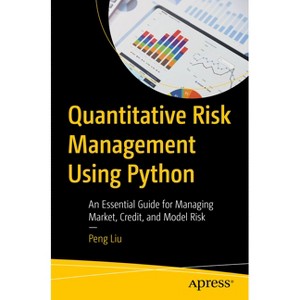
Gain an understanding of various financial risks, the benefits of portfolio diversification, and the fundamental trade-off between risk and return. This book takes an in-depth journey into the world of quantitative risk management using Python, focusing on credit and market risk, with an extension to model risk. You'll start by reviewing the different types of financial risk, the benefit of diversification in a portfolio, and the fundamental trade-off between risk and return. The book then offers an in-depth look at managing credit and market risk in today's dynamic markets, all with practical Python implementations. Moving on, you'll examine common hedging strategies used to manage investment positions, along with practical implementations on evaluating risk-adjusted, as well as downside risk measures. Finally, you'll be introduced to common risks related to the development and use of machine learning models in finance. Whether you're a finance professional, academic, or student, Quantitative Risk Management Using Python will empower you to make informed decisions in today's complex financial landscape. What You Will Learn
Explore techniques to assess and manage the risk of default by borrowers or counterparties. Identify, measure, and mitigate risks arising from fluctuations in market prices. Understand how derivatives can be employed for risk management purposes. Delve into both static and dynamic hedging techniques to protect investment positions, including practical applications for evaluating risk-adjusted and downside risk measures. Identify and address risks associated with the development and deployment of machine learning models in financial contexts.
Who This Book Is For Finance professionals, academics, and students seeking to deepen their understanding of Quantitative Risk Management using Python, especially those interested in navigating the intricate domains of credit, market and model risk within the financial sector and beyond.
From the Back Cover
Gain an understanding of various financial risks, the benefits of portfolio diversification, and the fundamental trade-off between risk and return. This book takes an in-depth journey into the world of quantitative risk management using Python, focusing on credit and market risk, with an extension to model risk.
You'll start by reviewing the different types of financial risk, the benefit of diversification in a portfolio, and the fundamental trade-off between risk and return. The book then offers an in-depth look at managing credit and market risk in today's dynamic markets, all with practical Python implementations. Moving on, you'll examine common hedging strategies used to manage investment positions, along with practical implementations on evaluating risk-adjusted, as well as downside risk measures. Finally, you'll be introduced to common risks related to the development and use of machine learning models in finance.
Whether you're a finance professional, academic, or student, Quantitative Risk Management Using Python will empower you to make informed decisions in today's complex financial landscape.
You will:
Explore techniques to assess and manage the risk of default by borrowers or counterparties.
Identify, measure, and mitigate risks arising from fluctuations in market prices.
Understand how derivatives can be employed for risk management purposes.
Delve into both static and dynamic hedging techniques to protect investment positions, including practical applications for evaluating risk-adjusted and downside risk measures.
Identify and address risks associated with the development and deployment of machine learning models in financial contexts.
About the Author
Peng Liu is an Assistant Professor of Quantitative Finance (Practice) at Singapore Management University and an adjunct researcher at the National University of Singapore. He holds a Ph.D. in statistics from the National University of Singapore and has over 10 years of working experience across the banking, technology, and hospitality industries. Peng is the author of Bayesian Optimization (Apress, 2023) and Quantitative Trading Strategies Using Python (Apress, 2023)
Dimensions (Overall): 9.21 Inches (H) x 6.14 Inches (W) x .55 Inches (D)
Weight: .81 Pounds
Suggested Age: 22 Years and Up
Number of Pages: 238
Genre: Computers + Internet
Sub-Genre: Programming Languages
Publisher: Apress
Theme: Python
Format: Paperback
Author: Peng Liu
Language: English
Street Date: September 3, 2025
TCIN: 1010169311
UPC: 9798868815294
Item Number (DPCI): 247-31-9524
Origin: Made in the USA or Imported
If the item details aren’t accurate or complete, we want to know about it.
Shipping details
Estimated ship dimensions: 0.55 inches length x 6.14 inches width x 9.21 inches height
Estimated ship weight: 0.81 pounds
We regret that this item cannot be shipped to PO Boxes.
This item cannot be shipped to the following locations: American Samoa (see also separate entry under AS), Guam (see also separate entry under GU), Northern Mariana Islands, Puerto Rico (see also separate entry under PR), United States Minor Outlying Islands, Virgin Islands, U.S., APO/FPO, Alaska, Hawaii
Return details
This item can be returned to any Target store or Target.com.
This item must be returned within 90 days of the date it was purchased in store, delivered to the guest, delivered by a Shipt shopper, or picked up by the guest.