Target New ArrivalsGift Ideas for MomClothing, Shoes & AccessoriesHome & DecorKitchen & DiningOutdoor Living & GardenGroceryHousehold EssentialsBabyBeautyPersonal CareHealthWellnessLuggageSports & OutdoorsToysElectronicsVideo GamesMovies, Music & BooksSchool & Office SuppliesParty SuppliesGift IdeasGift CardsPetsUlta Beauty at TargetShop by CommunityTarget OpticalDealsClearanceTarget New ArrivalsSpring OutfitsGift Ideas for MomWomen’s Festival OutfitsTop DealsTarget Circle DealsWeekly AdShop Order PickupShop Same Day DeliveryRegistryRedCardTarget CircleFind Stores
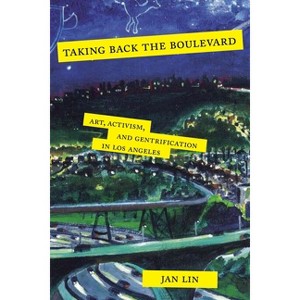
Taking Back the Boulevard - by  Jan Lin (Paperback) - 1 of 1

Taking Back the Boulevard - by Jan Lin (Paperback)

$36.00

In Stock

Free & easy returns

Free & easy returns

Return this item by mail or in store within 90 days for a full refund.
Eligible for registries and wish lists

About this item

Highlights

  • The promises and conflicts faced by public figures, artists, and leaders of Northeast Los Angeles as they enliven and defend their neighborhoods Los Angeles is well known as a sprawling metropolis with endless freeways that can make the city feel isolating and separate its communities.
  • Author(s): Jan Lin
  • 256 Pages
  • Social Science, Sociology

Description


Book Synopsis


The promises and conflicts faced by public figures, artists, and leaders of Northeast Los Angeles as they enliven and defend their neighborhoods

Los Angeles is well known as a sprawling metropolis with endless freeways that can make the city feel isolating and separate its communities. Yet in the past decade, as Jan Lin argues in Taking Back the Boulevard, there has been a noticeable renewal of public life on several of the city's iconic boulevards, including Atlantic, Crenshaw, Lankershim, Sunset, Western, and Wilshire. These arteries connect neighborhoods across the city, traverse socioeconomic divides and ethnic enclaves, and can be understood as the true locational heart of public life in the metropolis.

Focusing especially on the cultural scene of Northeast Los Angeles, Lin shows how these gentrifying communities help satisfy a white middle-class consumer demand for authentic experiences of "living on the edge" and a spirit of cultural rebellion. These neighborhoods have gone through several stages, from streetcar suburbs, to disinvested neighborhoods with the construction of freeways and white flight, to immigrant enclaves, to the home of Chicano/a artists in the 1970s. Those artists were then followed by non-Chicano/a, white artists, who were later threatened with displacement by gentrifiers attracted by the neighborhoods' culture, street life, and green amenities that earlier inhabitants had worked to create. Lin argues that gentrification is not a single transition, but a series of changes that disinvest and re-invest neighborhoods with financial and cultural capital.

Drawing on community survey research, interviews with community residents and leaders, and ethnographic observation, this book argues that the revitalization in Northeast LA by arts leaders and neighborhood activists marks a departure in the political culture from the older civic engagement to more socially progressive coalition work involving preservationists, environmentalists, citizen protestors, and arts organizers. Finally, Lin explores how accelerated gentrification and mass displacement of Latino/a and working-class households in the 2010s has sparked new rounds of activism as the community grapples with new class conflicts and racial divides in the struggle to self-determine its future.


Review Quotes


"In this heartfelt and meticulously researched history of the boulevard-lined neighborhoods of Northeast L.A., Jan Lin has given us a crucial and timely investigation into how local cultural and community movements, together with struggles over the right to the city, shape our contemporary urban landscapeWith imaginative theorization and brilliantly clear prose, Lin attends to the contradictions and conflicts of the current moment, as well as new, radical possibilities for a green and equitable city that are now also within sight."--Miriam Greenberg, Co-editor of The City is the Factory: New Solidarities and Spatial Tactics in an Urban Age

"Jan Lin has produced a deeply researched and beautifully written examination of more than a century of neighborhood change and activism in northeast Los Angeles ... Lin aims to take back the boulevards as a topic for urban sociology so that the continuity, growth, change, conflict, and drama of street life get a hearing in their own right. At this he succeeds admirably, and students of urban sociology at all levels have something to learn from entering into the world Lin has so skillfully depicted."-- "American Journal of Sociology"

"Jan Lin has written both a meticulous and a passionate documentation of the long waves of investment, migration, and cultural expression that have shaped Northeast Los Angeles since the heyday of Anglo urbanization. From bohemianism and bike lanes, to tacos and lattes, Lin shows how embedded cultural patterns and determined community activists keep the vitality of the streets even in our most automobile-dependent city."--Sharon Zukin, Author of Naked City: The Death and Life of Authentic Urban Places

"Taking Back the Boulevard is an excellent resource for scholars and researchers who see themselves as public intellectuals, as well as for individuals wishing to engage art and activism in urban communities. The text is accessible, comprehensive, and passionate. Lin offers a stimulating tales for which to approach Northeast L.A., transgenerational activism, and a community's cycles of cultural and economic transition."--Social Forces

"Taking Back the Boulevard is exemplary in its ability to weave the strands of structure and agency together to show how real gentrified spaces are produced. And just as important, such complexity is delivered with clear prose and riveting stories. Although the book focuses on Northeast Los Angeles, its lessons are generalizable. Scholars and students of gentrification would enjoy reading the book and benefit from engaging with its core arguments. It is at once a labour of love by an established urban sociologist and an important contribution to the sprawling literature on the subject."--International Journal of Urban and Regional Research
Dimensions (Overall): 8.9 Inches (H) x 6.0 Inches (W) x .9 Inches (D)
Weight: .9 Pounds
Suggested Age: 22 Years and Up
Number of Pages: 256
Genre: Social Science
Sub-Genre: Sociology
Publisher: New York University Press
Theme: Urban
Format: Paperback
Author: Jan Lin
Language: English
Street Date: January 15, 2019
TCIN: 1009813268
UPC: 9781479895700
Item Number (DPCI): 247-54-3911
Origin: Made in the USA or Imported
If the item details aren’t accurate or complete, we want to know about it.

Shipping details

Estimated ship dimensions: 0.9 inches length x 6 inches width x 8.9 inches height
Estimated ship weight: 0.9 pounds
We regret that this item cannot be shipped to PO Boxes.
This item cannot be shipped to the following locations: American Samoa (see also separate entry under AS), Guam (see also separate entry under GU), Northern Mariana Islands, Puerto Rico (see also separate entry under PR), United States Minor Outlying Islands, Virgin Islands, U.S., APO/FPO, Alaska, Hawaii

Return details

This item can be returned to any Target store or Target.com.
This item must be returned within 90 days of the date it was purchased in store, delivered to the guest, delivered by a Shipt shopper, or picked up by the guest.
See the return policy for complete information.

Q: What type of research methods does the author employ?

submitted by AI Shopping Assistant - 2 months ago
  • A: The author utilizes community surveys, interviews, and ethnographic observations to support the book's arguments.

    submitted byAI Shopping Assistant - 2 months ago
    Ai generated

Q: Who is the author of the book?

submitted by AI Shopping Assistant - 2 months ago
  • A: The book is authored by Jan Lin, a recognized urban sociologist.

    submitted byAI Shopping Assistant - 2 months ago
    Ai generated

Q: What is the primary genre of this book?

submitted by AI Shopping Assistant - 2 months ago
  • A: The book falls under the genre of Social Science, specifically Sociology.

    submitted byAI Shopping Assistant - 2 months ago
    Ai generated

Q: How does the book view gentrification in Northeast Los Angeles?

submitted by AI Shopping Assistant - 2 months ago
  • A: It portrays gentrification as a complex process involving disinvestment and re-investment, affecting neighborhoods culturally and economically.

    submitted byAI Shopping Assistant - 2 months ago
    Ai generated

Q: What is the main focus of the book's content?

submitted by AI Shopping Assistant - 2 months ago
  • A: The book examines the cultural scene and changes in Northeast Los Angeles, addressing gentrification and community activism.

    submitted byAI Shopping Assistant - 2 months ago
    Ai generated

Additional product information and recommendations

Discover more options

Trending Social Science Books

Get top deals, latest trends, and more.

Privacy policy