Target New ArrivalsGift Ideas for MomClothing, Shoes & AccessoriesHome & DecorKitchen & DiningOutdoor Living & GardenGroceryHousehold EssentialsBabyBeautyPersonal CareHealthWellnessLuggageSports & OutdoorsToysElectronicsVideo GamesMovies, Music & BooksSchool & Office SuppliesParty SuppliesGift IdeasGift CardsPetsUlta Beauty at TargetShop by CommunityTarget OpticalDealsClearanceNew ArrivalsSpring OutfitsGift Ideas for MomWomen’s Festival OutfitsTop DealsTarget Circle DealsWeekly AdShop Order PickupShop Same Day DeliveryRegistryRedCardTarget CircleFind Stores
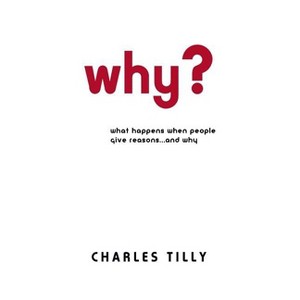
Why? - by  Charles Tilly (Paperback) - 1 of 1

Why? - by Charles Tilly (Paperback)

$37.00

In Stock

Free & easy returns

Free & easy returns

Return this item by mail or in store within 90 days for a full refund.
Eligible for registries and wish lists

About this item

Highlights

  • Why?
  • About the Author: Charles Tilly (1929-2008) was the Joseph L. Buttenwieser Professor of Social Science at Columbia University.
  • 216 Pages
  • Psychology, Social Psychology

Description


Book Synopsis


Why? is a book about the explanations we give and how we give them--a fascinating look at the way the reasons we offer every day are dictated by, and help constitute, social relationships. Written in an easy-to-read style by distinguished social historian Charles Tilly, the book explores the manner in which people claim, establish, negotiate, repair, rework, or terminate relations with others through the reasons they give.

Tilly examines a number of different types of reason giving. For example, he shows how an air traffic controller would explain the near miss of two aircraft in several different ways, depending upon the intended audience: for an acquaintance at a cocktail party, he might shrug it off by saying "This happens all the time," or offer a chatty, colloquial rendition of what transpired; for a colleague at work, he would venture a longer, more technical explanation, and for a formal report for his division head he would provide an exhaustive, detailed account.

Tilly demonstrates that reasons fall into four different categories:


  • Convention: "I'm sorry I spilled my coffee; I'm such a klutz."

  • Narratives: "My friend betrayed me because she was jealous of my sister."

  • Technical cause-effect accounts: "A short circuit in the ignition system caused the engine rotors to fail."

  • Codes or workplace jargon: "We can't turn over the records. We're bound by statute 369."


Tilly illustrates his topic by showing how a variety of people gave reasons for the 9/11 attacks. He also demonstrates how those who work with one sort of reason frequently convert it into another sort. For example, a doctor might understand an illness using the technical language of biochemistry, but explain it to his patient, who knows nothing of biochemistry, by using conventions and stories.

Replete with sparkling anecdotes about everyday social experiences (including the author's own), Why? makes the case for stories as one of the great human inventions.


From the Back Cover


"Readers will find this book stimulating, amusing, enlightening, and engaging. The veteran analyst of political conflict and change has shifted the scale and style of his analysis once again. The result is a tour de force."--Viviana Zelizer, Princeton University

"Impressive in scope and ambition, in the breadth of knowledge from which it draws, in its shrewd and careful use of Tilly's own experiences in public and scholarly life as well as in illness, in its acute observations in the materials it uses, and not least in the clear non-technical prose in which everything is presented."--Howard S. Becker, author of Tricks of the Trade


Review Quotes


"[A] persuasive book. . . . It is obvious that the cancer specialist talks differently to his colleagues from the way he talks to his patients: exactly what he might be doing in talking differently is Tilly's concern."---Adam Phillips, London Review of Books

"[Charles Tilly] argues convincingly that reason-giving always takes place in a social setting structured by the social relations of the persons in that setting. This [book is] eminently readable and interesting."---Leon H. Brody, Library Journal

"In the tradition of the legendary sociologist Erving Goffman, Tilly seeks to decode the structure of everyday social interaction, and the result is a book that forces readers to reexamine everything from the way they talk to their children to the way they argue about politics."---Malcolm Gladwell, New Yorker

"Tilly gives us . . . a good read, a book that calls our attention to a prevalent human phenomenon and raises the importance of investigating its nature. . . . The book also suggests that we sit down and begin to examine the nature of reason giving in our society--why we spend so much of our time doing it, what effect it has on our social relations, and . . . what effect it has on our own behavior and emotions."---Kurt Salzinger, PsycCritiques

"Tilly's book is insightful, easily accessible to any audience and worth reading."---Richard Findler, European Legacy

"We need to impose order on chaos, not by disregarding complicated realities, but by understanding what those complicated realities mean for us. Why? is a stimulating contribution to our thinking about this problem."---Dolan Cummings, Culture Wars

"While Why? may be a frustrating read to the social scientist looking for methodological innovation, it is warmly recommended for anybody who is simply curious about the central role of reason giving."---Kristian Berg Harpviken, Journal of Peace Research


About the Author


Charles Tilly (1929-2008) was the Joseph L. Buttenwieser Professor of Social Science at Columbia University. His work focused on large-scale social change and its relationship to contentious politics, especially in Europe, since 1500. His many books include The Politics of Collective Violence; Contention and Democracy in Europe, 1650-2000; Social Movements, 1768-2004; Economic and Political Contention in Comparative Perspective , coedited with Maria Kousis; Identities, Boundaries, and Social Ties; Trust and Rule; Regimes and Repertoires; Democracy; and Credit and Blame (Princeton).
Dimensions (Overall): 8.3 Inches (H) x 5.28 Inches (W) x .52 Inches (D)
Weight: .54 Pounds
Suggested Age: 22 Years and Up
Number of Pages: 216
Genre: Psychology
Sub-Genre: Social Psychology
Publisher: Princeton University Press
Format: Paperback
Author: Charles Tilly
Language: English
Street Date: April 13, 2008
TCIN: 1011331414
UPC: 9780691136486
Item Number (DPCI): 247-09-1565
Origin: Made in the USA or Imported
If the item details aren’t accurate or complete, we want to know about it.

Shipping details

Estimated ship dimensions: 0.52 inches length x 5.28 inches width x 8.3 inches height
Estimated ship weight: 0.54 pounds
We regret that this item cannot be shipped to PO Boxes.
This item cannot be shipped to the following locations: American Samoa (see also separate entry under AS), Guam (see also separate entry under GU), Northern Mariana Islands, Puerto Rico (see also separate entry under PR), United States Minor Outlying Islands, Virgin Islands, U.S., APO/FPO, Alaska, Hawaii

Return details

This item can be returned to any Target store or Target.com.
This item must be returned within 90 days of the date it was purchased in store, delivered to the guest, delivered by a Shipt shopper, or picked up by the guest.
See the return policy for complete information.

Q: What is the target audience for this book?

submitted by AI Shopping Assistant - 1 day ago
  • A: The book is suggested for readers aged 22 years and up, interested in psychology and social dynamics.

    submitted byAI Shopping Assistant - 1 day ago
    Ai generated

Q: How does Tilly illustrate his points in the book?

submitted by AI Shopping Assistant - 1 day ago
  • A: He uses anecdotes from everyday experiences and examples from various social contexts to illustrate his arguments.

    submitted byAI Shopping Assistant - 1 day ago
    Ai generated

Q: Who is the author of this book?

submitted by AI Shopping Assistant - 1 day ago
  • A: The author is Charles Tilly, a distinguished social historian and professor.

    submitted byAI Shopping Assistant - 1 day ago
    Ai generated

Q: What types of reason giving does Tilly discuss?

submitted by AI Shopping Assistant - 1 day ago
  • A: Tilly categorizes reasons into conventions, narratives, technical accounts, and workplace jargon.

    submitted byAI Shopping Assistant - 1 day ago
    Ai generated

Q: What is the main theme of the book?

submitted by AI Shopping Assistant - 1 day ago
  • A: The book explores how the reasons we provide shape and reflect our social relationships.

    submitted byAI Shopping Assistant - 1 day ago
    Ai generated

Additional product information and recommendations

Discover more options

Trending Diet, Health & Fitness Books

Get top deals, latest trends, and more.

Privacy policy