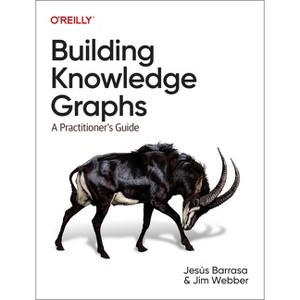
Incredibly useful, knowledge graphs help organizations keep track of medical research, cybersecurity threat intelligence, GDPR compliance, web user engagement, and much more.
About the Author: Dr. Jesus Barrasa - Jesus leads the Sales Engineering team in EMEA and is Neo4j's resident expert in Semantic technologies.
288 Pages
Computers + Internet,
Description
About the Book
"Incredibly useful, knowledge graphs help organizations keep track of medical research, cybersecurity threat intelligence, GDPR compliance, web user engagement, and much more. They do so by storing interlinked descriptions of entities--objects, events, situations, or abstract concepts--and encoding the underlying information. How do you create a knowledge graph? And how do you move it from theory into production? Using hands-on examples, this practical book shows data scientists and data engineers how to build their own knowledge graphs. Authors Jeúss Barrasa and Jim Webber from Neo4j illustrate common patterns for building knowledge graphs that solve many of today's pressing knowledge management problems. You'll quickly discover how these graphs become increasingly useful as you add data and augment them with algorithms and machine learning."--
Book Synopsis
Incredibly useful, knowledge graphs help organizations keep track of medical research, cybersecurity threat intelligence, GDPR compliance, web user engagement, and much more. They do so by storing interlinked descriptions of entities--objects, events, situations, or abstract concepts--and encoding the underlying information. How do you create a knowledge graph? And how do you move it from theory into production?
Using hands-on examples, this practical book shows data scientists and data engineers how to build their own knowledge graphs. Authors Jesús Barrasa and Jim Webber from Neo4j illustrate common patterns for building knowledge graphs that solve many of today's pressing knowledge management problems. You'll quickly discover how these graphs become increasingly useful as you add data and augment them with algorithms and machine learning.
Learn the organizing principles necessary to build a knowledge graph
Explore how graph databases serve as a foundation for knowledge graphs
Understand how to import structured and unstructured data into your graph
Follow examples to build integration-and-search knowledge graphs
Learn what pattern detection knowledge graphs help you accomplish
Explore dependency knowledge graphs through examples
Use examples of natural language knowledge graphs and chatbots
Use graph algorithms and ML to gain insight into connected data
About the Author
Dr. Jesus Barrasa - Jesus leads the Sales Engineering team in EMEA and is Neo4j's resident expert in Semantic technologies. He co-wrote Knowledge Graphs: Data in Context for Responsive Businesses (O'Reilly Report) and leads the development of Neosemantics (Neo4j plugin for RDF). Prior to joining Neo4j, Jesus worked for data integration companies like Denodo and Ontology Systems(now EXFO) where he got first-hand experience with many successful large Graph Technology projects for major companies all over the world. Jesus' Ph.D. is in Artificial Intelligence/Knowledge Representation, focused on the automatic repurposing of legacy relational data as Knowledge Graphs.
Dr. Maya Natarajan - Maya is Sr Director, Knowledge Graphs. At Neo4j, Maya is responsible for the 'go-to-market' strategy for knowledge graphs. She is the in-house knowledge graph expert and was a major contributor to Knowledge Graphs: Data in Context for Responsive Businesses (O'Reilly Report). Maya has positioned various technologies from blockchain to predictive and user-based analytics to machine learning to deep learning and search in a myriad of industries including Life Sciences, Financial Services, Supply Chain, and Manufacturing at various large and small organizations. Maya has a Ph.D. in Chemical Engineering from Rice University and started her career in biotechnology, where she has five patents to her name.
Dr. Jim Webber - Jim is Neo4j's Chief Scientist and Visiting Professor at Newcastle University, UK. At Neo4j, Jim works on fault-tolerant graph databases and co-wrote Graph Databases (1st and 2nd editions, O'Reilly), Graph Databases for Dummies (Wiley), and Knowledge Graphs: Data in Context for Responsive Businesses (O'Reilly Report). Jim has a long history of work on fault-tolerant distributed systems and often advises customers on issues of scale, performance, and fault tolerance for their data-intensive systems.
Dimensions (Overall): 9.1 Inches (H) x 6.9 Inches (W) x .8 Inches (D)
Weight: 1.1 Pounds
Suggested Age: 22 Years and Up
Number of Pages: 288
Genre: Computers + Internet
Publisher: O'Reilly Media
Format: Paperback
Author: Jesús Barrasa & Jim Webber
Language: English
Street Date: August 1, 2023
TCIN: 86266853
UPC: 9781098127107
Item Number (DPCI): 247-32-9648
Origin: Made in the USA or Imported
If the item details aren’t accurate or complete, we want to know about it.
Shipping details
Estimated ship dimensions: 0.8 inches length x 6.9 inches width x 9.1 inches height
Estimated ship weight: 1.1 pounds
We regret that this item cannot be shipped to PO Boxes.
This item cannot be shipped to the following locations: American Samoa (see also separate entry under AS), Guam (see also separate entry under GU), Northern Mariana Islands, Puerto Rico (see also separate entry under PR), United States Minor Outlying Islands, Virgin Islands, U.S., APO/FPO, Alaska, Hawaii
Return details
This item can be returned to any Target store or Target.com.
This item must be returned within 90 days of the date it was purchased in store, delivered to the guest, delivered by a Shipt shopper, or picked up by the guest.