Target New ArrivalsGift Ideas for MomClothing, Shoes & AccessoriesHome & DecorKitchen & DiningOutdoor Living & GardenGroceryHousehold EssentialsBabyBeautyPersonal CareHealthWellnessLuggageSports & OutdoorsToysElectronicsVideo GamesMovies, Music & BooksSchool & Office SuppliesParty SuppliesGift IdeasGift CardsPetsUlta Beauty at TargetShop by CommunityTarget OpticalDealsClearanceTarget New ArrivalsSpring OutfitsGift Ideas for MomWomen’s Festival OutfitsTop DealsTarget Circle DealsWeekly AdShop Order PickupShop Same Day DeliveryRegistryRedCardTarget CircleFind Stores
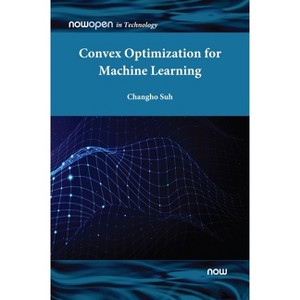
Convex Optimization for Machine Learning - by  Changho Suh (Hardcover) - 1 of 1

Convex Optimization for Machine Learning - by Changho Suh (Hardcover)

$134.99

In Stock

Free & easy returns

Free & easy returns

Return this item by mail or in store within 90 days for a full refund.
Eligible for registries and wish lists

About this item

Highlights

  • This book covers an introduction to convex optimization, one of the powerful and tractable optimization problems that can be efficiently solved on a computer.
  • About the Author: Dr. Changho Suh is an Associate Professor of Electrical Engineering at KAIST.
  • 386 Pages
  • Computers + Internet, Intelligence (AI) & Semantics

Description


About the Book


Covers an introduction to convex optimization, one of the powerful and tractable optimization problems that can be efficiently solved on a computer. The goal of the book is to help develop a sense of what convex optimization is, and how it can be used in a widening array of practical contexts with a particular emphasis on machine learning


Book Synopsis


This book covers an introduction to convex optimization, one of the powerful and tractable optimization problems that can be efficiently solved on a computer. The goal of the book is to help develop a sense of what convex optimization is, and how it can be used in a widening array of practical contexts with a particular emphasis on machine learning. The first part of the book covers core concepts of convex sets, convex functions, and related basic definitions that serve understanding convex optimization and its corresponding models. The second part deals with one very useful theory, called duality, which enables us to: (1) gain algorithmic insights; and (2) obtain an approximate solution to non-convex optimization problems which are often difficult to solve. The last part focuses on modern applications in machine learning and deep learning. A defining feature of this book is that it succinctly relates the "story" of how convex optimization plays a role, via historical examples and trending machine learning applications. Another key feature is that it includes programming implementation of a variety of machine learning algorithms inspired by optimization fundamentals, together with a brief tutorial of the used programming tools. The implementation is based on Python, CVXPY, and TensorFlow. This book does not follow a traditional textbook-style organization, but is streamlined via a series of lecture notes that are intimately related, centered around coherent themes and concepts. It serves as a textbook mainly for a senior-level undergraduate course, yet is also suitable for a first-year graduate course. Readers benefit from having a good background in linear algebra, some exposure to probability, and basic familiarity with Python.


Review Quotes


I have looked at the manuscript and my impression is positive, the aims and scope are actual and comprehensive. The intended audience is senior undergraduates and early graduate, which differs the book significantly from several competing books, and this should be an advantage. I would say that a good senior undergraduate level textbook on convex optimization would, in my opinion, be very timely. Arkadi Nemirovski, Georgia Tech, USA--Arkadi Nemirovski (3/15/2022 12:00:00 AM)

The topic is surely still of great interest, since courses on Convex Optimization, in conjunction or not with Machine Learning applications, are ubiquitous in Engineering curricula around the world. What appears as somewhat novel here is the juxtaposition of Part I and II on convex optimization and duality with Part III on machine learning applications. The emphasis on Python, TensorFlow etc. is also practically very important and surely appreciated by the students, especially if presented via challenging practical problems. More than completeness, I believe that what is important is that the book gives a meaningful "cut" through these topics, as this books appears to do. It seems important that the author tries to motivate and link together as much as possible part III with the previous parts, explaining why part I and II are important for part III, but also highlighting what the limits of convex models are and at which point they need be superseded by more general models. Giuseppe Carlo Calafiore, Professor at the Politecnico di Torino, Italy, and visiting Professor at UC Berkeley--Giuseppe Carlo Calafiore (5/1/2022 12:00:00 AM)


About the Author


Dr. Changho Suh is an Associate Professor of Electrical Engineering at KAIST. He received the B.S. and M.S. degrees in Electrical Engineering from KAIST in 2000 and 2002 respectively, and the Ph.D. degree in Electrical Engineering and Computer Sciences from UC Berkeley in 2011. From 2011 to 2012, he was a postdoctoral associate at the Research Laboratory of Electronics in MIT. From 2002 to 2006, he was with Samsung Electronics. Prof. Suh is a recipient of numerous awards in research and teaching: the 2022 Google Research Award, the 2021 James L. Massey Research & Teaching Award for Young Scholars from the IEEE Information Theory Society, the 2020 LINKGENESIS Best Teacher Award (the campus-wide Grand Prize in Teaching), the 2019 AFOSR Grant, the 2019 Google Education Grant, the 2018 IEIE/IEEE Joint Award, the 2015 IEIE Haedong Young Engineer Award, the 2015 Bell Labs Prize finalist, the 2013 IEEE Communications Society Stephen O. Rice Prize, the 2011 David J. Sakrison Memorial Prize (the best dissertation award in UC Berkeley EECS), the 2009 IEEE ISIT Best Student Paper Award, and the five Department Teaching Awards (2013, 2019, 2020, 2021, 2022). Dr. Suh is a Distinguished Lecturer of the IEEE Information Theory Society from 2020 to 2022, the General Chair of the Inaugural IEEE East Asian School of Information Theory 2021, an Associate Head of the KAIST AIInstitute from 2021 to 2022, and a Member of the Young Korean Academy of Science and Technology.

Dimensions (Overall): 9.21 Inches (H) x 6.14 Inches (W) x .88 Inches (D)
Weight: 1.58 Pounds
Suggested Age: 22 Years and Up
Number of Pages: 386
Genre: Computers + Internet
Sub-Genre: Intelligence (AI) & Semantics
Publisher: Now Publishers
Format: Hardcover
Author: Changho Suh
Language: English
Street Date: October 17, 2022
TCIN: 1008296737
UPC: 9781638280521
Item Number (DPCI): 247-53-2353
Origin: Made in the USA or Imported
If the item details aren’t accurate or complete, we want to know about it.

Shipping details

Estimated ship dimensions: 0.88 inches length x 6.14 inches width x 9.21 inches height
Estimated ship weight: 1.58 pounds
We regret that this item cannot be shipped to PO Boxes.
This item cannot be shipped to the following locations: American Samoa (see also separate entry under AS), Guam (see also separate entry under GU), Northern Mariana Islands, Puerto Rico (see also separate entry under PR), United States Minor Outlying Islands, Virgin Islands, U.S., APO/FPO, Alaska, Hawaii

Return details

This item can be returned to any Target store or Target.com.
This item must be returned within 90 days of the date it was purchased in store, delivered to the guest, delivered by a Shipt shopper, or picked up by the guest.
See the return policy for complete information.

Q: Who is the author of the book?

submitted by AI Shopping Assistant - 1 month ago
  • A: The author is Dr. Changho Suh, an Associate Professor at KAIST.

    submitted byAI Shopping Assistant - 1 month ago
    Ai generated

Q: What prior knowledge does the book assume?

submitted by AI Shopping Assistant - 1 month ago
  • A: Readers should have a background in linear algebra, some probability exposure, and basic Python familiarity.

    submitted byAI Shopping Assistant - 1 month ago
    Ai generated

Q: How is the content of the book organized?

submitted by AI Shopping Assistant - 1 month ago
  • A: It is organized into themes rather than traditional chapters, resembling a series of lecture notes.

    submitted byAI Shopping Assistant - 1 month ago
    Ai generated

Q: What programming tools are discussed in the book?

submitted by AI Shopping Assistant - 1 month ago
  • A: The book includes implementation using Python, CVXPY, and TensorFlow for various machine learning algorithms.

    submitted byAI Shopping Assistant - 1 month ago
    Ai generated

Q: What is the focus of this book?

submitted by AI Shopping Assistant - 1 month ago
  • A: The book focuses on convex optimization, particularly its applications in machine learning.

    submitted byAI Shopping Assistant - 1 month ago
    Ai generated

Additional product information and recommendations

Discover more options

Trending Computers & Technology Books

Get top deals, latest trends, and more.

Privacy policy