Target New ArrivalsGift Ideas for DadFourth of JulyClothing, Shoes & AccessoriesHome & DecorKitchen & DiningOutdoor Living & GardenGroceryHousehold EssentialsBabyBeautyPersonal CareSports & OutdoorsHealthWellnessLuggageSchool & Office SuppliesToys & GamesElectronicsVideo GamesMovies, Music & BooksParty SuppliesGift IdeasGift CardsPetsUlta Beauty at TargetShop by CommunityTarget OpticalDealsClearanceNew ArrivalsGift Ideas for DadBack to SchoolCollegeTop DealsTarget Circle DealsWeekly AdShop Order PickupShop Same Day DeliveryRegistryRedCardTarget CircleFind Stores
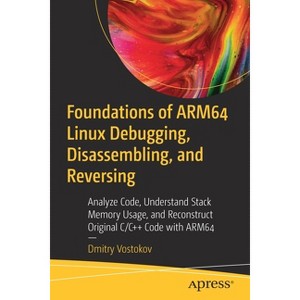
Foundations of Arm64 Linux Debugging, Disassembling, and Reversing - by  Dmitry Vostokov (Paperback) - 1 of 1

Foundations of Arm64 Linux Debugging, Disassembling, and Reversing - by Dmitry Vostokov (Paperback)

$54.99

In Stock

Free & easy returns

Free & easy returns

Return this item by mail or in store within 90 days for a full refund.
Eligible for registries and wish lists

About this item

Highlights

  • Gain a solid understanding of how Linux C and C++ compilers generate binary code.
  • About the Author: Dmitry Vostokov is an internationally recognized expert, speaker, educator, scientist, inventor, and author.
  • 170 Pages
  • Computers + Internet, Programming

Description


Book Synopsis


Gain a solid understanding of how Linux C and C++ compilers generate binary code. This book explains the reversing and binary analysis of ARM64 architecture now used by major Linux cloud providers and covers topics ranging from writing programs in assembly language, live debugging, and static binary analysis of compiled C and C++ code. It is ideal for those working with embedded devices, including mobile phones and tablets.

Using the latest version of Red Hat, you'll look closely at the foundations of diagnostics of core memory dumps, live and postmortem debugging of Linux applications, services, and systems. You'll also work with the GDB debugger and use it for disassembly and reversing. This book uses practical step-by-step exercises of increasing complexity with explanations and many diagrams, including some necessary background topics. In addition, you will be able to analyze such code confidently, understand stack memory usage, and reconstruct original C/C++ code.

And as you'll see, memory forensics, malware, and vulnerability analysis, require an understanding of ARM64 assembly language and how C and C++ compilers generate code, including memory layout and pointers. This book provides the background knowledge and practical foundations you'll need to understand internal Linux program structure and behavior.

Foundations of ARM64 Linux Debugging, Disassembling, and Reversing is the perfect companion to Foundations of Linux Debugging, Disassembling, and Reversing for readers interested in the cloud or cybersecurity.


What You'll Learn
  • Review the basics of ARM64 assembly language
  • Examine the essential GDB debugger commands for debugging and binary analysis
  • Study C and C++ compiler code generation with and without compiler optimizations
  • Look at binary code disassembly and reversing patterns
  • See how pointers in C and C++ are implemented and used
Who This Book Is For

Software support and escalation engineers, cloud security engineers, site reliability engineers, DevSecOps, platform engineers, software testers, Linux C/C++ software engineers and security researchers without ARM64 assembly language background, and beginners learning Linux software reverse engineering techniques.


From the Back Cover


Gain a solid understanding of how Linux C and C++ compilers generate binary code. This book explains the reversing and binary analysis of ARM64 architecture now used by major Linux cloud providers and covers topics ranging from writing programs in assembly language, live debugging, and static binary analysis of compiled C and C++ code. It is ideal for those working with embedded devices, including mobile phones and tablets.

Using the latest version of Red Hat, you'll look closely at the foundations of diagnostics of core memory dumps, live and postmortem debugging of Linux applications, services, and systems. You'll also work with the GDB debugger and use it for disassembly and reversing. This book uses practical step-by-step exercises of increasing complexity with explanations and many diagrams, including some necessary background topics. In addition, you will be able to analyze such code confidently, understand stack memory usage, and reconstruct original C/C++ code.

And as you'll see, memory forensics, malware, and vulnerability analysis, require an understanding of ARM64 assembly language and how C and C++ compilers generate code, including memory layout and pointers. This book provides the background knowledge and practical foundations you'll need to understand internal Linux program structure and behavior.

Foundations of ARM64 Linux Debugging, Disassembling, and Reversing is the perfect companion to Foundations of Linux Debugging, Disassembling, and Reversing for readers interested in the cloud or cybersecurity.


You will:
  • Review the basics of ARM64 assembly language
  • Examine the essential GDB debugger commands for debugging and binary analysis
  • Study C and C++ compiler code generation with and without compiler optimizations
  • Look at binary code disassembly and reversing patterns
  • See how pointers in C and C++ are implemented and used


About the Author


Dmitry Vostokov is an internationally recognized expert, speaker, educator, scientist, inventor, and author. He is the founder of the pattern-oriented software diagnostics, forensics, and prognostics discipline (Systematic Software Diagnostics), and Software Diagnostics Institute (DA+TA: DumpAnalysis.org + TraceAnalysis.org). Vostokov has also authored books on software diagnostics, anomaly detection and analysis, software and memory forensics, root cause analysis and problem solving, memory dump analysis, debugging, software trace and log analysis, reverse engineering, and malware analysis. He has over 25 years of experience in software architecture, design, development, and maintenance in various industries, including leadership, technical, and people management roles. In his spare time, he presents various topics on Debugging.TV and explores Software Narratology, its further development as Narratology of Things and Diagnostics of Things (DoT), Software Pathology, and Quantum Software Diagnostics. His current interest areas are theoretical software diagnostics and its mathematical and computer science foundations, application of formal logic, artificial intelligence, machine learning, and data mining to diagnostics and anomaly detection, software diagnostics engineering and diagnostics-driven development, diagnostics workflow, and interaction. Recent interest areas also include cloud native computing, security, automation, functional programming, and applications of category theory to software development and big data. He is based out of Dublin, Ireland.
Dimensions (Overall): 9.21 Inches (H) x 6.14 Inches (W) x .4 Inches (D)
Weight: .59 Pounds

Suggested Age: 22 Years and Up
Number of Pages: 170
Genre: Computers + Internet
Sub-Genre: Programming
Publisher: Apress
Theme: Open Source
Format: Paperback
Author: Dmitry Vostokov
Language: English
Street Date: January 31, 2023
TCIN: 1011991678
UPC: 9781484290811
Item Number (DPCI): 247-24-9756
Origin: Made in the USA or Imported
If the item details aren’t accurate or complete, we want to know about it.

Shipping details

Estimated ship dimensions: 0.4 inches length x 6.14 inches width x 9.21 inches height
Estimated ship weight: 0.59 pounds
We regret that this item cannot be shipped to PO Boxes.
This item cannot be shipped to the following locations: American Samoa (see also separate entry under AS), Guam (see also separate entry under GU), Northern Mariana Islands, Puerto Rico (see also separate entry under PR), United States Minor Outlying Islands, Virgin Islands, U.S., APO/FPO, Alaska, Hawaii

Return details

This item can be returned to any Target store or Target.com.
This item must be returned within 90 days of the date it was purchased in store, delivered to the guest, delivered by a Shipt shopper, or picked up by the guest.
See the return policy for complete information.

Q: Who is the target audience for this book?

submitted by AI Shopping Assistant - 2 days ago
  • A: The book is aimed at software engineers, security researchers, and beginners interested in Linux software reverse engineering.

    submitted byAI Shopping Assistant - 2 days ago
    Ai generated

Q: What programming languages does the book focus on?

submitted by AI Shopping Assistant - 2 days ago
  • A: The book primarily focuses on C and C++ programming languages, particularly in the context of ARM64 architecture.

    submitted byAI Shopping Assistant - 2 days ago
    Ai generated

Q: What practical skills can readers expect to gain?

submitted by AI Shopping Assistant - 2 days ago
  • A: Readers will learn to analyze binary code, understand stack memory usage, and reconstruct original C/C++ code.

    submitted byAI Shopping Assistant - 2 days ago
    Ai generated

Q: What debugging tool is emphasized in the book?

submitted by AI Shopping Assistant - 2 days ago
  • A: The book emphasizes the use of the GDB debugger for disassembly and binary analysis.

    submitted byAI Shopping Assistant - 2 days ago
    Ai generated

Q: What topics are covered regarding ARM64 architecture?

submitted by AI Shopping Assistant - 2 days ago
  • A: Topics include assembly language programming, live debugging, static binary analysis, and understanding memory layout.

    submitted byAI Shopping Assistant - 2 days ago
    Ai generated

Additional product information and recommendations

Discover more options

Best-selling Computers & Technology Books

Get top deals, latest trends, and more.

Privacy policy