Target New ArrivalsGift Ideas for MomClothing, Shoes & AccessoriesHome & DecorKitchen & DiningOutdoor Living & GardenGroceryHousehold EssentialsBabyBeautyPersonal CareHealthWellnessLuggageSports & OutdoorsToysElectronicsVideo GamesMovies, Music & BooksSchool & Office SuppliesParty SuppliesGift IdeasGift CardsPetsUlta Beauty at TargetShop by CommunityTarget OpticalDealsClearanceTarget New ArrivalsSpring OutfitsGift Ideas for MomWomen’s Festival OutfitsTop DealsTarget Circle DealsWeekly AdShop Order PickupShop Same Day DeliveryRegistryRedCardTarget CircleFind Stores
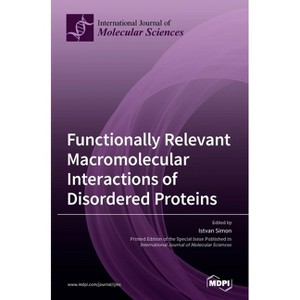
Functionally Relevant Macromolecular Interactions of Disordered Proteins - (Hardcover) - 1 of 1

Functionally Relevant Macromolecular Interactions of Disordered Proteins - (Hardcover)

$95.99Save $19.81 (17% off)

In Stock

Free & easy returns

Free & easy returns

Return this item by mail or in store within 90 days for a full refund.
Eligible for registries and wish lists

About this item

Highlights

  • Disordered proteins are relatively recent newcomers in protein science.
  • 520 Pages
  • Science, Life Sciences

Description


Book Synopsis


Disordered proteins are relatively recent newcomers in protein science. They were first described in detail by Wright and Dyson, in their J. Mol. Biol. paper in 1999. First, it was generally thought for more than a decade that disordered proteins or disordered parts of proteins have different amino acid compositions than folded proteins, and various prediction methods were developed based on this principle. These methods were suitable for distinguishing between the disordered (unstructured) and structured proteins known at that time. In addition, they could predict the site where a folded protein binds to the disordered part of a protein, shaping the latter into a well-defined 3D structure. Recently, however, evidence has emerged for a new type of disordered protein family whose members can undergo coupled folding and binding without the involvement of any folded proteins. Instead, they interact with each other, stabilizing their structure via "mutual synergistic folding" and, surprisingly, they exhibit the same residue composition as the folded protein. Increasingly more examples have been found where disordered proteins interact with non-protein macromolecules, adding to the already large variety of protein-protein interactions. There is also a very new phenomenon when proteins are involved in phase separation, which can represent a weak but functionally important macromolecular interaction. These phenomena are presented and discussed in the chapters of this book.

Dimensions (Overall): 9.61 Inches (H) x 6.69 Inches (W) x 1.56 Inches (D)
Weight: 2.9 Pounds
Suggested Age: 22 Years and Up
Number of Pages: 520
Genre: Science
Sub-Genre: Life Sciences
Publisher: Mdpi AG
Theme: Biology
Format: Hardcover
Language: English
Street Date: August 24, 2020
TCIN: 1010783597
UPC: 9783039365210
Item Number (DPCI): 247-34-2393
Origin: Made in the USA or Imported
If the item details aren’t accurate or complete, we want to know about it.

Shipping details

Estimated ship dimensions: 1.56 inches length x 6.69 inches width x 9.61 inches height
Estimated ship weight: 2.9 pounds
We regret that this item cannot be shipped to PO Boxes.
This item cannot be shipped to the following locations: American Samoa (see also separate entry under AS), Guam (see also separate entry under GU), Northern Mariana Islands, Puerto Rico (see also separate entry under PR), United States Minor Outlying Islands, Virgin Islands, U.S., APO/FPO, Alaska, Hawaii

Return details

This item can be returned to any Target store or Target.com.
This item must be returned within 90 days of the date it was purchased in store, delivered to the guest, delivered by a Shipt shopper, or picked up by the guest.
See the return policy for complete information.

Q: Who first described disordered proteins in detail?

submitted by AI Shopping Assistant - today
  • A: Wright and Dyson first described disordered proteins in their 1999 paper in J. Mol. Biol.

    submitted byAI Shopping Assistant - today
    Ai generated

Q: Who is the intended audience for this book?

submitted by AI Shopping Assistant - today
  • A: The book is suitable for individuals aged 22 and up, particularly those interested in science and life sciences.

    submitted byAI Shopping Assistant - today
    Ai generated

Q: What phenomenon related to proteins is discussed in the book?

submitted by AI Shopping Assistant - today
  • A: The book discusses the phenomenon of phase separation in proteins and its functional significance.

    submitted byAI Shopping Assistant - today
    Ai generated

Q: What type of binding do some disordered proteins undergo?

submitted by AI Shopping Assistant - today
  • A: Some disordered proteins can undergo coupled folding and binding without involving folded proteins.

    submitted byAI Shopping Assistant - today
    Ai generated

Q: What is the primary focus of this book?

submitted by AI Shopping Assistant - today
  • A: The book focuses on the interactions of disordered proteins and their implications in protein science.

    submitted byAI Shopping Assistant - today
    Ai generated

Additional product information and recommendations

Discover more options

Trending Education Books

Get top deals, latest trends, and more.

Privacy policy