Target New ArrivalsGift Ideas for DadFourth of JulyClothing, Shoes & AccessoriesHome & DecorKitchen & DiningOutdoor Living & GardenGroceryHousehold EssentialsBabyBeautyPersonal CareSports & OutdoorsHealthWellnessLuggageSchool & Office SuppliesToys & GamesElectronicsVideo GamesMovies, Music & BooksParty SuppliesGift IdeasGift CardsPetsUlta Beauty at TargetShop by CommunityTarget OpticalDealsClearanceNew ArrivalsGift Ideas for DadBack to SchoolCollegeTop DealsTarget Circle DealsWeekly AdShop Order PickupShop Same Day DeliveryRegistryRedCardTarget CircleFind Stores
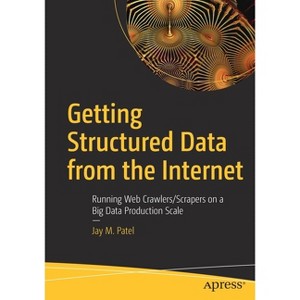
Getting Structured Data from the Internet - by  Jay M Patel (Paperback) - 1 of 1

Getting Structured Data from the Internet - by Jay M Patel (Paperback)

$59.99

In Stock

Free & easy returns

Free & easy returns

Return this item by mail or in store within 90 days for a full refund.
Eligible for registries and wish lists

About this item

Highlights

  • Utilize web scraping at scale to quickly get unlimited amounts of free data available on the web into a structured format.
  • About the Author: Jay M. Patel is a software developer with over 10 years of experience in data mining, web crawling/scraping, machine learning, and natural language processing (NLP) projects.
  • 397 Pages
  • Computers + Internet,

Description


Book Synopsis


Utilize web scraping at scale to quickly get unlimited amounts of free data available on the web into a structured format. This book teaches you to use Python scripts to crawl through websites at scale and scrape data from HTML and JavaScript-enabled pages and convert it into structured data formats such as CSV, Excel, JSON, or load it into a SQL database of your choice.

This book goes beyond the basics of web scraping and covers advanced topics such as natural language processing (NLP) and text analytics to extract names of people, places, email addresses, contact details, etc., from a page at production scale using distributed big data techniques on an Amazon Web Services (AWS)-based cloud infrastructure. It book covers developing a robust data processing and ingestion pipeline on the Common Crawl corpus, containing petabytes of data publicly available and a web crawl data set available on AWS's registry of open data.

Getting Structured Data from the Internet also includes a step-by-step tutorial on deploying your own crawlers using a production web scraping framework (such as Scrapy) and dealing with real-world issues (such as breaking Captcha, proxy IP rotation, and more). Code used in the book is provided to help you understand the concepts in practice and write your own web crawler to power your business ideas.


What You Will Learn

  • Understand web scraping, its applications/uses, and how to avoid web scraping by hitting publicly available rest API endpoints to directly get data
  • Develop a web scraper and crawler from scratch using lxml and BeautifulSoup library, and learn about scraping from JavaScript-enabled pages using Selenium
  • Use AWS-based cloud computing with EC2, S3, Athena, SQS, and SNS to analyze, extract, and store useful insights from crawled pages
  • Use SQL language on PostgreSQL running on Amazon Relational Database Service (RDS) and SQLite using SQLalchemy
  • Review sci-kit learn, Gensim, and spaCy to perform NLP tasks on scraped web pages such as name entity recognition, topic clustering (Kmeans, Agglomerative Clustering), topic modeling (LDA, NMF, LSI), topic classification (naive Bayes, Gradient Boosting Classifier) and text similarity (cosine distance-based nearest neighbors)
  • Handle web archival file formats and explore Common Crawl open data on AWS
  • Illustrate practical applications for web crawl data by building a similar website tool and a technology profiler similar to builtwith.com
  • Write scripts to create a backlinks database on a web scale similar to Ahrefs.com, Moz.com, Majestic.com, etc., for search engine optimization (SEO), competitor research, and determining website domain authority and ranking
  • Use web crawl data to build a news sentiment analysis system or alternative financial analysis covering stock market trading signals
  • Write a production-ready crawlerin Python using Scrapy framework and deal with practical workarounds for Captchas, IP rotation, and more


Who This Book Is For

Primary audience: data analysts and scientists with little to no exposure to real-world data processing challenges, secondary: experienced software developers doing web-heavy data processing who need a primer, tertiary: business owners and startup founders who need to know more about implementation to better direct their technical team


From the Back Cover


Utilize web scraping at scale to quickly get unlimited amounts of free data available on the web into a structured format. This book teaches you to use Python scripts to crawl through websites at scale and scrape data from HTML and JavaScript-enabled pages and convert it into structured data formats such as CSV, Excel, JSON, or load it into a SQL database of your choice.

This book goes beyond the basics of web scraping and covers advanced topics such as natural language processing (NLP) and text analytics to extract names of people, places, email addresses, contact details, etc., from a page at production scale using distributed big data techniques on an Amazon Web Services (AWS)-based cloud infrastructure. It covers developing a robust data processing and ingestion pipeline on the Common Crawl corpus, containing petabytes of data publicly available and a web crawl data set available on AWS's registry of open data.

Getting Structured Data from the Internet also includes a step-by-step tutorial on deploying your own crawlers using a production web scraping framework (such as Scrapy) and dealing with real-world issues (such as breaking Captcha, proxy IP rotation, and more). Code used in the book is provided to help you understand the concepts in practice and write your own web crawler to power your business ideas.

You will:

  • Understand web scraping, its applications/uses, and how to avoid web scraping by hitting publicly available rest API endpoints to directly get data
  • Develop a web scraper and crawler from scratch using lxml and BeautifulSoup library, and learn about scraping from JavaScript-enabled pages using Selenium
  • Use AWS-based cloud computing with EC2, S3, Athena, SQS, and SNS to analyze, extract, and store useful insights from crawled pages
  • Use SQL language on PostgreSQL running on Amazon Relational Database Service (RDS) and SQLite using SQLalchemy
  • Review sci-kit learn, Gensim, and spaCy to perform NLP tasks on scraped web pages such as name entity recognition, topic clustering (Kmeans, Agglomerative Clustering), topic modeling (LDA, NMF, LSI), topic classification (naive Bayes, Gradient Boosting Classifier) and text similarity (cosine distance-based nearest neighbors)
  • Handle web archival file formats and explore Common Crawl open data on AWS
  • Illustrate practical applications for web crawl data by building a similar website tool and a technology profiler similar to builtwith.com
  • Write scripts to create a backlinks database on a web scale similar to Ahrefs.com, Moz.com, Majestic.com, etc., for search engine optimization (SEO), competitor research, and determining website domain authority and ranking
  • Use web crawl data to build a news sentiment analysis system or alternative financial analysis covering stock market trading signals
  • Write a production-ready crawler in Python using Scrapy framework and deal with practical workarounds for Captchas, IP rotation, and more


About the Author


Jay M. Patel is a software developer with over 10 years of experience in data mining, web crawling/scraping, machine learning, and natural language processing (NLP) projects. He is a co-founder and principal data scientist of Specrom Analytics, providing content, email, social marketing, and social listening products and services using web crawling/scraping and advanced text mining.

Jay worked at the US Environmental Protection Agency (EPA) for five years where he designed workflows to crawl and extract useful insights from hundreds of thousands of documents that were parts of regulatory filings from companies. He also led one of the first research teams within the agency to use Apache Spark-based workflows for chem and bioinformatics applications such as chemical similarities and quantitative structure activity relationships. He developed recurrent neural networks and more advanced LSTM models in Tensorflow for chemical SMILES generation.

Jaygraduated with a bachelor's degree in engineering from the Institute of Chemical Technology, University of Mumbai, India and a master of science degree from the University of Georgia, USA. Jay serves as an editor of a publication titled Web Data Extraction and also blogs about personal projects, open source packages, and experiences as a startup founder on his personal site, jaympatel.com.

Dimensions (Overall): 10.0 Inches (H) x 7.0 Inches (W) x .86 Inches (D)
Weight: 1.6 Pounds
Suggested Age: 22 Years and Up
Number of Pages: 397
Genre: Computers + Internet
Publisher: Apress
Format: Paperback
Author: Jay M Patel
Language: English
Street Date: November 13, 2020
TCIN: 1011990137
UPC: 9781484265758
Item Number (DPCI): 247-19-7895
Origin: Made in the USA or Imported
If the item details aren’t accurate or complete, we want to know about it.

Shipping details

Estimated ship dimensions: 0.86 inches length x 7 inches width x 10 inches height
Estimated ship weight: 1.6 pounds
We regret that this item cannot be shipped to PO Boxes.
This item cannot be shipped to the following locations: American Samoa (see also separate entry under AS), Guam (see also separate entry under GU), Northern Mariana Islands, Puerto Rico (see also separate entry under PR), United States Minor Outlying Islands, Virgin Islands, U.S., APO/FPO, Alaska, Hawaii

Return details

This item can be returned to any Target store or Target.com.
This item must be returned within 90 days of the date it was purchased in store, delivered to the guest, delivered by a Shipt shopper, or picked up by the guest.
See the return policy for complete information.

Q: Does the book include practical coding examples?

submitted by AI Shopping Assistant - 2 days ago
  • A: Yes, the book provides code examples to help readers understand and implement web scraping concepts.

    submitted byAI Shopping Assistant - 2 days ago
    Ai generated

Q: What cloud service is utilized for data processing in the book?

submitted by AI Shopping Assistant - 2 days ago
  • A: The book utilizes Amazon Web Services (AWS) for cloud-based data processing and storage.

    submitted byAI Shopping Assistant - 2 days ago
    Ai generated

Q: What advanced topics are covered in the book?

submitted by AI Shopping Assistant - 2 days ago
  • A: It covers advanced topics like natural language processing and text analytics for data extraction.

    submitted byAI Shopping Assistant - 2 days ago
    Ai generated

Q: What programming language is primarily used in this book?

submitted by AI Shopping Assistant - 2 days ago
  • A: The book primarily uses Python for developing web scrapers and crawlers.

    submitted byAI Shopping Assistant - 2 days ago
    Ai generated

Q: What is the target audience for this book?

submitted by AI Shopping Assistant - 2 days ago
  • A: The primary audience includes data analysts and scientists with limited exposure to data processing challenges.

    submitted byAI Shopping Assistant - 2 days ago
    Ai generated

Additional product information and recommendations

Discover more options

Best-selling Computers & Technology Books

Get top deals, latest trends, and more.

Privacy policy