Target New ArrivalsGift Ideas for DadClothing, Shoes & AccessoriesHome & DecorKitchen & DiningOutdoor Living & GardenGroceryHousehold EssentialsBabyBeautyPersonal CareSports & OutdoorsHealthWellnessLuggageSchool & Office SuppliesToysElectronicsVideo GamesMovies, Music & BooksParty SuppliesGift IdeasGift CardsPetsUlta Beauty at TargetShop by CommunityTarget OpticalDealsClearanceNew ArrivalsGift Ideas for DadBack to SchoolCollegeTop DealsTarget Circle DealsWeekly AdShop Order PickupShop Same Day DeliveryRegistryRedCardTarget CircleFind Stores
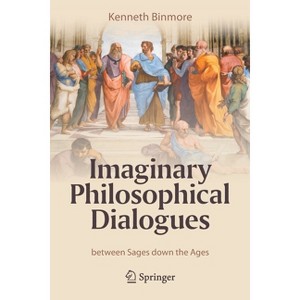
Imaginary Philosophical Dialogues - by  Kenneth Binmore (Paperback) - 1 of 1

Imaginary Philosophical Dialogues - by Kenneth Binmore (Paperback)

$31.34Save $6.65 (18% off)

In Stock

Free & easy returns

Free & easy returns

Return this item by mail or in store within 90 days for a full refund.
Eligible for registries and wish lists

About this item

Highlights

  • How would Plato have responded if his student Aristotle had ever challenged his idea that our senses perceive nothing more than the shadows cast upon a wall by a true world of perfect ideals?
  • About the Author: Kenneth Binmore is a mathematician turned economist and philosopher.
  • 209 Pages
  • Philosophy, General

Description


Book Synopsis


How would Plato have responded if his student Aristotle had ever challenged his idea that our senses perceive nothing more than the shadows cast upon a wall by a true world of perfect ideals? What would Charles Darwin have said to Karl Marx about his claim that dialectical materialism is a scientific theory of evolution? How would Jean-Paul Sartre have reacted to Simone de Beauvoir's claim that the Marquis de Sade was a philosopher worthy of serious attention?

This light-hearted book proposes answers to such questions by imagining dialogues between thirty-three pairs of philosophical sages who were alive at the same time. Sometime famous sages get a much rougher handling than usual, as when Adam Smith beards Immanuel Kant in his Konigsberg den. Sometimes neglected or maligned sages get a chance to say what they really believed, as when Epicurus explains that he wasn't epicurean. Sometimes the dialogues are about the origins of modern concepts, as when Blaise Pascal and Pierre de Fermat discuss their invention of probability, or when John Nash and John von Neumann discuss the creation of game theory. Even in these scientific cases, the intention is that the protagonists come across as fallible human beings like the rest of us, rather than the intellectual paragons of philosophical textbooks.


From the Back Cover


How would Plato have responded if his student Aristotle had ever challenged his idea that our senses perceive nothing more than the shadows cast upon a wall by a true world of perfect ideals? What would Charles Darwin have said to Karl Marx about his claim that dialectical materialism is a scientific theory of evolution? How would Jean-Paul Sartre have reacted to Simone de Beauvoir's claim that the Marquis de Sade was a philosopher worthy of serious attention?

This light-hearted book proposes answers to such questions by imagining dialogues between thirty-three pairs of philosophical sages who were alive at the same time. Sometime famous sages get a much rougher handling than usual, as when Adam Smith beards Immanuel Kant in his Konigsberg den. Sometimes neglected or maligned sages get a chance to say what they really believed, as when Epicurus explains that he wasn't epicurean. Sometimes the dialogues are about the origins of modern concepts, as when Blaise Pascaland Pierre de Fermat discuss their invention of probability, or when John Nash and John von Neumann discuss the creation of game theory. Even in these scientific cases, the intention is that the protagonists come across as fallible human beings like the rest of us, rather than the intellectual paragons of philosophical textbooks.


Review Quotes


About the Author


Kenneth Binmore is a mathematician turned economist and philosopher. He has held Chairs at the London School of Economics (UK), the University of Michigan (USA), and University College London (UK). He has been involved in a range of applied projects, including the design of major telecom auctions in various countries across the world. As a consequence of the $35 billion raised by the telecom auction he organized in the UK, he was described by Newsweek magazine as the "ruthless, poker-playing economist who destroyed the telecom industry". He has contributed to game theory, experimental economics, evolutionary biology and moral philosophy. His books include Natural Justice (OUP), Does Game Theory Work? (MIT Press), A Very Short Introduction to Game Theory (OUP), Rational Decisions (PUP), and Crooked Thinking or Straight Talk? (Springer).

Dimensions (Overall): 9.21 Inches (H) x 6.14 Inches (W) x .47 Inches (D)
Weight: .7 Pounds
Suggested Age: 22 Years and Up
Number of Pages: 209
Genre: Philosophy
Sub-Genre: General
Publisher: Springer
Format: Paperback
Author: Kenneth Binmore
Language: English
Street Date: December 24, 2020
TCIN: 1007038166
UPC: 9783030653866
Item Number (DPCI): 247-20-1101
Origin: Made in the USA or Imported
If the item details aren’t accurate or complete, we want to know about it.

Shipping details

Estimated ship dimensions: 0.47 inches length x 6.14 inches width x 9.21 inches height
Estimated ship weight: 0.7 pounds
We regret that this item cannot be shipped to PO Boxes.
This item cannot be shipped to the following locations: American Samoa (see also separate entry under AS), Guam (see also separate entry under GU), Northern Mariana Islands, Puerto Rico (see also separate entry under PR), United States Minor Outlying Islands, Virgin Islands, U.S., APO/FPO, Alaska, Hawaii

Return details

This item can be returned to any Target store or Target.com.
This item must be returned within 90 days of the date it was purchased in store, delivered to the guest, delivered by a Shipt shopper, or picked up by the guest.
See the return policy for complete information.

Q: What can readers expect from the book's style?

submitted by AI Shopping Assistant - 2 months ago
  • A: Readers can expect a light-hearted, conversational tone that presents philosophical ideas in a more humanized way.

    submitted byAI Shopping Assistant - 2 months ago
    Ai generated

Q: How many philosophical pairs are discussed in the book?

submitted by AI Shopping Assistant - 2 months ago
  • A: The book features dialogues between thirty-three pairs of philosophical sages.

    submitted byAI Shopping Assistant - 2 months ago
    Ai generated

Q: What makes this book's approach to philosophy unique?

submitted by AI Shopping Assistant - 2 months ago
  • A: It imagines light-hearted dialogues between historical philosophers, allowing them to address their criticisms and beliefs.

    submitted byAI Shopping Assistant - 2 months ago
    Ai generated

Q: Who is the author of this book?

submitted by AI Shopping Assistant - 2 months ago
  • A: The author is Kenneth Binmore, a mathematician who transitioned into economics and philosophy.

    submitted byAI Shopping Assistant - 2 months ago
    Ai generated

Q: What themes are explored in the philosophical dialogues?

submitted by AI Shopping Assistant - 2 months ago
  • A: The dialogues explore concepts such as perception, evolution, morality, and the origins of modern philosophical ideas.

    submitted byAI Shopping Assistant - 2 months ago
    Ai generated

Additional product information and recommendations

Discover more options

Frequently bought together

Get top deals, latest trends, and more.

Privacy policy