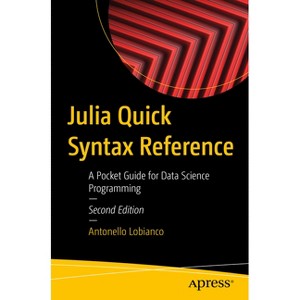
Learn the Julia programming language as quickly as possible.
About the Author: Antonello Lobianco, PhD is a research engineer employed by a French Grande É cole (polytechnic university).
361 Pages
Computers + Internet, Compilers
Description
Book Synopsis
Learn the Julia programming language as quickly as possible. This book is a must-have reference guide that presents the essential Julia syntax in a well-organized format, updated with the latest features of Julia's APIs, libraries, and packages.
This book provides an introduction that reveals basic Julia structures and syntax; discusses data types, control flow, functions, input/output, exceptions, metaprogramming, performance, and more. Additionally, you'll learn to interface Julia with other programming languages such as R for statistics or Python. At a more applied level, you will learn how to use Julia packages for data analysis, numerical optimization, symbolic computation, and machine learning, and how to present your results in dynamic documents.
The Second Edition delves deeper into modules, environments, and parallelism in Julia. It covers random numbers, reproducibility in stochastic computations, and adds a section on probabilistic analysis. Finally, it provides forward-thinking introductions to AI and machine learning workflows using BetaML, including regression, classification, clustering, and more, with practical exercises and solutions for self-learners.
What You Will Learn
Work with Julia types and the different containers for rapid development
Use vectorized, classical loop-based code, logical operators, and blocks
Explore Julia functions: arguments, return values, polymorphism, parameters, anonymous functions, and broadcasts
Build custom structures in Julia
Use C/C++, Python or R libraries in Julia and embed Julia in other code.
Optimize performance with GPU programming, profiling and more.
Manage, prepare, analyse and visualise your data with DataFrames and Plots
Implement complete ML workflows with BetaML, from data coding to model evaluation, and more.
Who This Book Is For
Experienced programmers who are new to Julia, as well as data scientists who want to improve their analysis or try out machine learning algorithms with Julia.
From the Back Cover
Learn the Julia programming language as quickly as possible. This book is a must-have reference guide that presents the essential Julia syntax in a well-organized format, updated with the latest features of Julia's APIs, libraries, and packages.
This book provides an introduction that reveals basic Julia structures and syntax; discusses data types, control flow, functions, input/output, exceptions, metaprogramming, performance, and more. Additionally, you'll learn to interface Julia with other programming languages such as R for statistics or Python. At a more applied level, you will learn how to use Julia packages for data analysis, numerical optimization, symbolic computation, and machine learning, and how to present your results in dynamic documents.
The Second Edition delves deeper into modules, environments, and parallelism in Julia. It covers random numbers, reproducibility in stochastic computations, and adds a section on probabilistic analysis. Finally, it provides forward-thinking introductions to AI and machine learning workflows using BetaML, including regression, classification, clustering, and more, with practical exercises and solutions for self-learners.
What You Will Learn
Work with Julia types and the different containers for rapid development
Use vectorized, classical loop-based code, logical operators, and blocks
Explore Julia functions: arguments, return values, polymorphism, parameters, anonymous functions, and broadcasts
Build custom structures in Julia
Use C/C++, Python or R libraries in Julia and embed Julia in other code.
Optimize performance with GPU programming, profiling and more.
Manage, prepare, analyse and visualise your data with DataFrames and Plots
Implement complete ML workflows with BetaML, from data coding to model evaluation, and more.
Who This Book Is For
Experienced programmers who are new to Julia, as well as data scientists who want to improve their analysis or try out machine learning algorithms with Julia.
About the Author
Antonello Lobianco, PhD is a research engineer employed by a French Grande É cole (polytechnic university). He works on the biophysical and economic modelling of the forest sector and is responsible for the lab models portfolio. He does programming in C++, Perl, PHP, Visual Basic, Python, and Julia. He teaches environmental and forest economics at undergraduate and graduate levels and modelling at PhD level. For a few years, he has followed the development of Julia as it fits his modelling needs. He is the author of a few Julia packages, particularly on data analysis and machine learning (search sylvaticus on GitHub).
Dimensions (Overall): 9.21 Inches (H) x 6.14 Inches (W) x .79 Inches (D)
Weight: 1.18 Pounds
Suggested Age: 22 Years and Up
Number of Pages: 361
Genre: Computers + Internet
Sub-Genre: Compilers
Publisher: Apress
Format: Paperback
Author: Antonello Lobianco
Language: English
Street Date: January 4, 2025
TCIN: 1004137211
UPC: 9798868809644
Item Number (DPCI): 247-26-1282
Origin: Made in the USA or Imported
If the item details aren’t accurate or complete, we want to know about it.
Shipping details
Estimated ship dimensions: 0.79 inches length x 6.14 inches width x 9.21 inches height
Estimated ship weight: 1.18 pounds
We regret that this item cannot be shipped to PO Boxes.
This item cannot be shipped to the following locations: American Samoa (see also separate entry under AS), Guam (see also separate entry under GU), Northern Mariana Islands, Puerto Rico (see also separate entry under PR), United States Minor Outlying Islands, Virgin Islands, U.S., APO/FPO
Return details
This item can be returned to any Target store or Target.com.
This item must be returned within 90 days of the date it was purchased in store, shipped, delivered by a Shipt shopper, or made ready for pickup.