Target New ArrivalsGift Ideas for DadClothing, Shoes & AccessoriesHome & DecorKitchen & DiningOutdoor Living & GardenGroceryHousehold EssentialsBabyBeautyPersonal CareSports & OutdoorsHealthWellnessLuggageSchool & Office SuppliesToysElectronicsVideo GamesMovies, Music & BooksParty SuppliesGift IdeasGift CardsPetsUlta Beauty at TargetShop by CommunityTarget OpticalDealsClearanceNew ArrivalsGift Ideas for DadBack to SchoolCollegeTop DealsTarget Circle DealsWeekly AdShop Order PickupShop Same Day DeliveryRegistryRedCardTarget CircleFind Stores
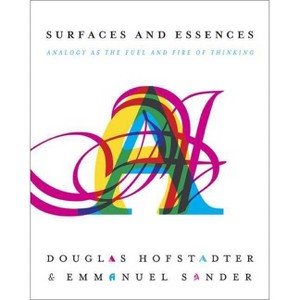
Surfaces and Essences - by  Douglas R Hofstadter & Emmanuel Sander (Hardcover) - 1 of 1

Surfaces and Essences - by Douglas R Hofstadter & Emmanuel Sander (Hardcover)

$19.83Save $15.17 (43% off)

In Stock

Free & easy returns

Free & easy returns

Return this item by mail or in store within 90 days for a full refund.
Eligible for registries and wish lists

About this item

Highlights

  • A revelatory foray into cognition and the dynamics of the mind.
  • About the Author: Douglas R. Hofstadter is College of Arts and Sciences Distinguished Professor of Cognitive Science and Comparative Literature at Indiana University, Bloomington.
  • 592 Pages
  • Philosophy, Mind & Body

Description


About the Book


A Pulitzer Prize-winning cognitive scientist and a leading psychologist offera lively new way of thinking about thinking.


Book Synopsis


A revelatory foray into cognition and the dynamics of the mind.

"Surfaces and Essences warrants a place alongside Gödel, Escher, Bach and major recent treatments of human cognition. Analogy is not the endpoint of understanding, but its indispensable beginning." -Science

Analogy is the core of all thinking.

This is the simple but unorthodox premise that Pulitzer Prize-winning author Douglas Hofstadter and French psychologist Emmanuel Sander defend in their new work. Hofstadter has been grappling with the mysteries of human thought for over thirty years. Now, with his trademark wit and special talent for making complex ideas vivid, he has partnered with Sander to put forth a highly novel perspective on cognition.

We are constantly faced with a swirling and intermingling multitude of ill-defined situations. Our brain's job is to try to make sense of this unpredictable, swarming chaos of stimuli. How does it do so? The ceaseless hail of input triggers analogies galore, helping us to pinpoint the essence of what is going on. Often this means the spontaneous evocation of words, sometimes idioms, sometimes the triggering of nameless, long-buried memories.

Why did two-year-old Camille proudly exclaim, "I undressed the banana!"? Why do people who hear a story often blurt out, "Exactly the same thing happened to me!" when it was a completely different event? How do we recognize an aggressive driver from a split-second glance in our rearview mirror? What in a friend's remark triggers the offhand reply, "That's just sour grapes"? What did Albert Einstein see that made him suspect that light consists of particles when a century of research had driven the final nail in the coffin of that long-dead idea?

The answer to all these questions, of course, is analogy-making - the meat and potatoes, the heart and soul, the fuel and fire, the gist and the crux, the lifeblood and the wellsprings of thought. Analogy-making, far from happening at rare intervals, occurs at all moments, defining thinking from top to toe, from the tiniest and most fleeting thoughts to the most creative scientific insights.

Like Gödel, Escher, Bach before it, Surfaces and Essences will profoundly enrich our understanding of our own minds. By plunging the reader into an extraordinary variety of colorful situations involving language, thought, and memory, by revealing bit by bit the constantly churning cognitive mechanisms normally completely hidden from view, and by discovering in them one central, invariant core - the incessant, unconscious quest for strong analogical links to past experiences - this book puts forth a radical and deeply surprising new vision of the act of thinking.


Review Quotes


Longlisted for the PEN / E. O. Wilson Literary Science Writing Award

"Surfaces and Essences warrants a place alongside Gödel, Escher, Bach and major recent treatments of human cognition. Analogy is not the endpoint of understanding, but its indispensable beginning."--Science

"A revelatory foray into the dynamics of the mind."--Booklist (Starred)

"Clear, lively, and personal."--Wall Street Journal

"Hofstadter and Sander's book is a wonderful and insightful account of the role of analogy in cognition. Immensely enjoyable, with a plethora of fascinating examples and anecdotes, this book will make you understand your own thought processes in a wholly new way. It's analogy all the way down!"--Melanie Mitchell, author of Complexity

"Hofstadter and Sander's book starts with two audacious goals: to show that none of us can think a minute without using a variety of analogies, and that becoming aware of this fact can help us think more clearly. Then, patiently and with humor, the authors prove their claims across the whole spectrum, from everyday conversation to scientific thought processes, even that of Einstein."--Gerald Holton, Harvard University

"How do we know what we know? How do we know at all? With an enjoyable blend of hard science and good storytelling, Hofstadter and French psychologist Sander tackle these most elusive of philosophical matters... It's worth sticking with Hofstadter's long argument, full of up-to-date cognitive science and, at the end, a beguiling look at how the theory of relativity owes to analogy... First rate popular science: difficult but rewarding."--Kirkus (Starred)

"I am one of those cognitive scientists who believe that analogy is a key to explaining human intelligence. This magnum opus by Douglas Hofstadter, who has reflected on the nature of analogy for decades, and Emmanuel Sander, is a milestone in our understanding of human thought, filled with insights and new ideas."--Steven Pinker, author of How the Mind Works and The Stuff of Thought

"Knowing what makes a duck a bird and what makes a plane not a bird may not seem like very profound mental feats, but Douglas Hofstadter and Emmanuel Sander see such cognitive connections as part of an extraordinarily profound process... Be prepared to become hyper-conscious of the myriad of analogies one makes every moment of every day... The end result is a book that is ambitious and provocative."--Globe and Mail (Canada)

"Like Hofstadter's Pulitzer Prize-winning Gödel, Escher, Bach, this work executes, from a very complex thesis, an understanding by general readers while also appealing to specialists in philosophy of mind and cognitive science."--Library Journal

"Lucid and, page for page, a delight to read... Surfaces and Essences contains gems of insight."--Nature

"Placing analogy at the core of cognition Hofstadter and Sander provide a persuasive answer to the question 'what is thought?' Analogy is the mechanism underlying the myriad instances of concept formation and categorization we perform throughout any day, whether unconscious or explicit, without which there would be no thought. They mount a compelling case through analysis of a wealth of insightful, imaginative and real exemplars, from everyday thinking to the highest achievements of the human mind, which are sure to persuade a broad range of readers."--Nancy J. Nersessian, author of Creating Scientific Concepts


About the Author


Douglas R. Hofstadter is College of Arts and Sciences Distinguished Professor of Cognitive Science and Comparative Literature at Indiana University, Bloomington. He is the author of the Pulitzer Prize-winning Gödel, Escher, Bach; Metamagical Themas; Fluid Concepts and Creative Analogies; I Am a Strange Loop; "Translator, Trader"; and most recently, Ambigrammia: Between Creation and Discovery.  He translated Alexander Pushkin's novel-in-verse Eugene Onegin from Russian verse into English verse, and has also translated books from several other languages into English.  

Emmanuel Sander is Professor of Cognitive and Developmental Psychology at the University of Paris (Saint-Denis), specializing in the study of analogy-making and categorization and their connections to education. Among his previous works is the book Analogy, from the Naïve to the Creative.

Dimensions (Overall): 9.48 Inches (H) x 7.69 Inches (W) x 1.91 Inches (D)
Weight: 2.22 Pounds
Suggested Age: 22 Years and Up
Number of Pages: 592
Genre: Philosophy
Sub-Genre: Mind & Body
Publisher: Basic Books
Format: Hardcover
Author: Douglas R Hofstadter & Emmanuel Sander
Language: English
Street Date: April 23, 2013
TCIN: 77263206
UPC: 9780465018475
Item Number (DPCI): 247-53-1639
Origin: Made in the USA or Imported
If the item details aren’t accurate or complete, we want to know about it.

Shipping details

Estimated ship dimensions: 1.91 inches length x 7.69 inches width x 9.48 inches height
Estimated ship weight: 2.22 pounds
We regret that this item cannot be shipped to PO Boxes.
This item cannot be shipped to the following locations: American Samoa (see also separate entry under AS), Guam (see also separate entry under GU), Northern Mariana Islands, Puerto Rico (see also separate entry under PR), United States Minor Outlying Islands, Virgin Islands, U.S., APO/FPO, Alaska, Hawaii

Return details

This item can be returned to any Target store or Target.com.
This item must be returned within 90 days of the date it was purchased in store, delivered to the guest, delivered by a Shipt shopper, or picked up by the guest.
See the return policy for complete information.

Q: What is the main premise of the book?

submitted by AI Shopping Assistant - 10 days ago
  • A: The book argues that analogy is the core of all thinking and essential for understanding cognition.

    submitted byAI Shopping Assistant - 10 days ago
    Ai generated

Q: What type of writing style is used in the book?

submitted by AI Shopping Assistant - 10 days ago
  • A: The writing is described as clear, lively, and personal, making complex ideas accessible to readers.

    submitted byAI Shopping Assistant - 10 days ago
    Ai generated

Q: What topics does the book cover?

submitted by AI Shopping Assistant - 10 days ago
  • A: It explores cognition, the dynamics of the mind, and the role of analogy in thought processes.

    submitted byAI Shopping Assistant - 10 days ago
    Ai generated

Q: Who are the authors of this book?

submitted by AI Shopping Assistant - 10 days ago
  • A: The authors are Douglas R. Hofstadter and Emmanuel Sander, both experts in cognitive science and psychology.

    submitted byAI Shopping Assistant - 10 days ago
    Ai generated

Q: What is the significance of analogy in cognition according to the authors?

submitted by AI Shopping Assistant - 10 days ago
  • A: Analogy is presented as a fundamental mechanism that underlies all forms of thought and understanding.

    submitted byAI Shopping Assistant - 10 days ago
    Ai generated

Additional product information and recommendations

Discover more options

Get top deals, latest trends, and more.

Privacy policy