Target New ArrivalsGift Ideas for DadClothing, Shoes & AccessoriesHome & DecorKitchen & DiningOutdoor Living & GardenGroceryHousehold EssentialsBabyBeautyPersonal CareSports & OutdoorsHealthWellnessLuggageSchool & Office SuppliesToysElectronicsVideo GamesMovies, Music & BooksParty SuppliesGift IdeasGift CardsPetsUlta Beauty at TargetShop by CommunityTarget OpticalDealsClearanceNew ArrivalsGift Ideas for DadBack to SchoolCollegeTop DealsTarget Circle DealsWeekly AdShop Order PickupShop Same Day DeliveryRegistryRedCardTarget CircleFind Stores
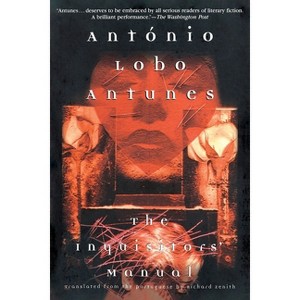
The Inquisitors' Manual - by  António Lobo Antunes (Paperback) - 1 of 1

The Inquisitors' Manual - by António Lobo Antunes (Paperback)

$12.49Save $7.51 (38% off)

In Stock

Free & easy returns

Free & easy returns

Return this item by mail or in store within 90 days for a full refund.
Eligible for registries and wish lists

About this item

Highlights

  • An international best-seller and the novel that established Antune's reputation in Europe, The Inquistor's Manual is a harrowing indictment of Portuguese fascism.António Lobo Antunes is one of the great European literary masters, a writer of whom The Boston Globe has said, "When Antunes is in full heat . . . he reads like William Faulkner or Céline.
  • About the Author: António Lobo Antunes, who was called "one of Portugal's pre-eminent writers" by the New York Times, was born in Lisbon in 1942.
  • 448 Pages
  • Fiction + Literature Genres, Literary

Description


About the Book


An international best-seller and the novel that established Antunes's reputation in Europe, "The Inquisitors' Manual" is a rewarding and stunning piece of art that shows the damage tyranny does to each layer of society.


Book Synopsis


An international best-seller and the novel that established Antune's reputation in Europe, The Inquistor's Manual is a harrowing indictment of Portuguese fascism.

António Lobo Antunes is one of the great European literary masters, a writer of whom The Boston Globe has said, "When Antunes is in full heat . . . he reads like William Faulkner or Céline."

The Inquistors' Manual chronicles the decadence not just of a family but of an entire society--a society morally and spiritually vitiated by four decades of totalitarian rule. Senhor Francisco, a once powerful state minister and a personal friend of the Portuguese dictator Salazar, is incapacitated by a stroke, and as he spends his last days in a nursing home in Lisbon, he reviews his life and his loves. His son Jo'o, raised by the housekeeper, grows up to be good-hearted but totally inept, so that his ruthless in-laws easily defraud him of his father's farm. The minister's daughter, Paula, whom he had by the cook and who was raised by a childless widow in another town, is ostracized after the Revolution due to her father's position in Salazar's regime.

The emotional turmoil enveloping Francisco's family finally catches up with him when the Revolution ends the forty-two years of the dictatorship, and the old regime tumbles like a castle of cards. Senhor Francisco, more paranoid than ever, remains a large but empty shadow of his seeming omnipotence. Drawing comparison to The Sound and the Fury and Moby-Dick, The Inquistors' Manual is a fierce exploration of life under one of the worst dictators of the last century, and a modern classic.


Review Quotes


Praise for The Inquisitor's Manual

"The Inquisitor's Manual is not so much an allegory of fascism as an anatomy of the way it penetrates societies. . . . Arrogance, brutality, moral squalor-much here is reminiscent of another anatomist of tyranny's intimacies, William Faulkner. . . . Motives that seemed clear mutate into their opposite; villains and victims change places, then change places again; ironies mount, and with them the force of the blows they deliver. The story takes shape like a painting, its pattern gradually emerging as the artist traverses and re-traverses its surface. . . . Personal nightmares become national tragedies, in turn breeding new and ever fiercer nightmares."--William Deresiewicz, The New York Times Book Review

"A brilliant performance. Too often, novelistic treatments of life under a dictatorship are unrelentingly bleak, but Lobo Antunes's witnesses are wonderfully diverse in their testimonials: Some are bitter, but others are funny, sarcastic or simply clueless. . . . Together, they provide a panoramic view of recent Portuguese history that is impressive both as a work of art and as a condemnation of fascism."--Steven Moore, The Washington Post

"Antunes creates voices with a scrupulous, authorial neutrality. . . . He also has created a character in Senhor Francisco . . . as complex in his cunning, blindness, selfishness and casual brutality as King Lear."--Thomas McGonigle, The Los Angeles Times

"Vast and masterful. . . . A scathing critique of the regime of fascist dictator Antonio de Oliveira Salazar, but it's also a domestic drama chronicling the ruin of an aristocratic family during the Communist revolution of the mid-1970's. Brimming with sex, violence and decadence, The Inquisitor's Manual has the sweep of a grand Bertoluccian saga."--Dodie Bellamy, San Francisco Chronicle

"A swirl of narratives and perspectives revolving around the family of powerful, eccentric oligarch in Salazar's government. . . . Antunes, one of the most skillful psychological portraitists writing anywhere, renders the turpitude of an entire society through an impasto of intensely individual voices."--The New Yorker

"Fiery and starling. . . . Antunes' obsessive rendering of each character exerts a coherent force on the sprawl of the novel. . . . It has been said that to read this master of a dozen novels is like trying to board a fast-moving train, and indeed, it is an exhilarating and consuming experience to get on board."--Wingate Packard, The Seattle Times

"A vivid exploration of life under one of the worst dictators of the last century."--Michael Shelden, The Baltimore Sun

"A brilliant performance. . . . Antunes' witnesses are wonderfully diverse in their testimonials: Some bitter, some funny, others sarcastic or simply clueless. . . . A panoramic view of recent Portuguese history that is impressive as a work of art and as a condemnation of fascism."--Steven Moore, Miami Herald

"This novel powerfully portrays the hopelessness of Portugal's lower classes. . . . Antunes's grasp of the workings of his characters' minds is amazing. . . . The Inquisitors' Manual will be remembered for the voices of its characters . . . and the dark humor that emerges from the conflict between their desires and the hopelessness of their situations."--Chad W. Post, Review of Contemporary Fiction

"Antunes, who trained as a psychologist, reaches into the desperate horror of human longing and the innate yearning to feel complete. . . . This book is a shrill warning which demands the reader's attention. It is hardly any wonder Antunes has been nominated for the Nobel Prize. . . . It is the interpenetrating points of view, which allow minor characters to take center stage, that make this book magical."--M. Casey Diana, Magill's Literary Annual

"Riveting. . . . Closing this difficult and extraordinarily rewarding book, one is tempted to say, "Portugal, yes, I was there. I know what that was like." Antunes has opened the doors and windows of his nation's secret history."--Nagle Jackson, The New Jersey Time

"Using stream of consciousness, Antunes gets to the heart and soul of the depravity of Portugal's Salazar dictatorship through the lives that were affected."--American Library Association

"Antunes recreates the harrowing story of Salazar's regime. . . . With this tapestry of harrowing testimonials, the supremely confident Antunes illuminates a dark corner of European history and produces a stunning piece of narrative art."--Publishers Weekly (starred review)

"Remarkable. . . . A gripping tale of the struggle of people to live under an oppressive, omnipresent government. . . . Antunes brings these characters to life through their own stories, from their own viewpoints, as he toggles between 'reports' and 'commentary' of the vents and the thoughts behind them."--Michael Spinella, Booklist (starred review)

"António Lobo Antunes is a novelist of the very first rank. His formidably concentrated, ironic fictions engage moral and political issues in a way that makes him heir to Conrad and to Faulkner. For the English-language reader, there is a world to discover."--George Steiner, author of The Death of Tragedy and Grammars of Creation

"In so dark a tale there can be no chirpy affirmations, but only telling indictments of the corrupt, the cruel, and the unjust-and these Antunes memorably accomplishes. . . . Antunes experiments with language and ideas in a story both allusive and surreal. . . . What counts is the cumulative effect and an atmosphere rendered so that history is both judged and understood."--Kirkus Reviews

"Antunes's razor-sharp eye dissects the outsized shadow cast by this fallen minister of state in all of its paranoia-induced variations. Remarkable for its descriptive exuberance."--Jack Shreve, Library Journal

"In this, perhaps Lobo Antunes's blackest novel to date, what impels the reader through the hopeless, loveless landscape he paints is the sheer energy of the writing, the scalpel-sharp eye for physical and psychological detail and the parade of vivid characters voicing their discontents and desires."--Margaret Jull Costa, Times Literary Supplement

"The Inquisitors' Manual is a dense and profound book. . . . [It is] a terrifying portrait of the moral decrepitude of Portugal during the [Salazar] dictatorship."--El Peri'dico (Madrid)


Praise for António Lobo Antunes

"A master navigator or the human psyche . . . [with] the voice of Nabokov by way of Cortazar, Gogol by way of Dylan."--Jonathan Levi, Los Angeles Times Book Review

"Perhaps Portugal's greatest living author . . . A genius."--Alan Kaufman, San Francisco Chronicle Book Review


About the Author


António Lobo Antunes, who was called "one of Portugal's pre-eminent writers" by the New York Times, was born in Lisbon in 1942. The son of a physician, he too became a doctor and then spent four years in the Portuguese army during the Angolan war. His fictional "memoir" of that war, South of Nowhere, was internationally praised and followed by other widely translated and much-honored novels, including Act of the Damned, Fado Alexandrino, Explanation of the Birds, and The Natural Order of Things.

Dimensions (Overall): 8.34 Inches (H) x 5.56 Inches (W) x 1.17 Inches (D)
Weight: 1.1 Pounds
Suggested Age: 22 Years and Up
Sub-Genre: Literary
Genre: Fiction + Literature Genres
Number of Pages: 448
Publisher: Grove Press
Format: Paperback
Author: António Lobo Antunes
Language: English
Street Date: April 8, 2004
TCIN: 82940177
UPC: 9780802140524
Item Number (DPCI): 247-08-3254
Origin: Made in the USA or Imported
If the item details aren’t accurate or complete, we want to know about it.

Shipping details

Estimated ship dimensions: 1.17 inches length x 5.56 inches width x 8.34 inches height
Estimated ship weight: 1.1 pounds
We regret that this item cannot be shipped to PO Boxes.
This item cannot be shipped to the following locations: American Samoa (see also separate entry under AS), Guam (see also separate entry under GU), Northern Mariana Islands, Puerto Rico (see also separate entry under PR), United States Minor Outlying Islands, Virgin Islands, U.S., APO/FPO, Alaska, Hawaii

Return details

This item can be returned to any Target store or Target.com.
This item must be returned within 90 days of the date it was purchased in store, delivered to the guest, delivered by a Shipt shopper, or picked up by the guest.
See the return policy for complete information.

Q: What themes does The Inquisitors' Manual explore?

submitted by AI Shopping Assistant - 2 months ago
  • A: The novel explores themes of tyranny, moral decay, and the societal impact of dictatorship.

    submitted byAI Shopping Assistant - 2 months ago
    Ai generated

Q: What can readers expect in terms of narrative style?

submitted by AI Shopping Assistant - 2 months ago
  • A: The narrative style is described as a swirl of voices blending individual experiences and societal critique.

    submitted byAI Shopping Assistant - 2 months ago
    Ai generated

Q: What is the historical backdrop of the story?

submitted by AI Shopping Assistant - 2 months ago
  • A: The story is set during and after the Portuguese dictatorship under Salazar, focusing on its societal consequences.

    submitted byAI Shopping Assistant - 2 months ago
    Ai generated

Q: Who is the central character in the novel?

submitted by AI Shopping Assistant - 2 months ago
  • A: The central character is Senhor Francisco, a former state minister reflecting on his life.

    submitted byAI Shopping Assistant - 2 months ago
    Ai generated

Q: How does Antunes portray life under dictatorship?

submitted by AI Shopping Assistant - 2 months ago
  • A: Antunes presents a vivid depiction of life under dictatorship through diverse character perspectives.

    submitted byAI Shopping Assistant - 2 months ago
    Ai generated

Additional product information and recommendations

Discover more options

Frequently bought together

Get top deals, latest trends, and more.

Privacy policy