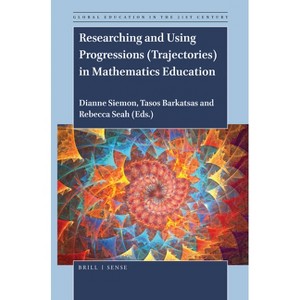
The relationship between research and practice has long been an area of interest for researchers, policy makers, and practitioners alike.
About the Author: Anastasios (Tasos) Barkatsas is a Senior Academic in Mathematics and Statistics Education and a Quantitative Data Analyst at the School of Education, RMIT University, Australia and has published more than 100 refereed papers, chapters and books.
240 Pages
Education, Philosophy, Theory & Social Aspects
Description
About the Book
This book presents a contemporary focus on significant issues in STEM teaching, learning and research that are valuable in preparing students for a digital 21st century. The book chapters cover a wide spectrum of issues and topics using a wealth of research methodologies and methods.
Book Synopsis
The relationship between research and practice has long been an area of interest for researchers, policy makers, and practitioners alike. One obvious arena where mathematics education research can contribute to practice is the design and implementation of school mathematics curricula. This observation holds whether we are talking about curriculum as a set of broad, measurable competencies (i.e., standards) or as a comprehensive set of resources for teaching and learning mathematics. Impacting practice in this way requires fine-grained research that is focused on individual student learning trajectories and intimate analyses of classroom pedagogical practices as well as large-scale research that explores how student populations typically engage with the big ideas of mathematics over time. Both types of research provide an empirical basis for identifying what aspects of mathematics are important and how they develop over time.
This book has its origins in independent but parallel work in Australia and the United States over the last 10 to 15 years. It was prompted by a research seminar at the 2017 PME Conference in Singapore that brought the contributors to this volume together to consider the development and use of evidence-based learning progressions/trajectories in mathematics education, their basis in theory, their focus and scale, and the methods used to identify and validate them. In this volume they elaborate on their work to consider what is meant by learning progressions/trajectories and explore a range of issues associated with their development, implementation, evaluation, and on-going review. Implications for curriculum design and future research in this field are also considered.
Contributors are: Michael Askew, Tasos Barkatsas, Michael Belcher, Rosemary Callingham, Doug Clements, Jere Confrey, Lorraine Day, Margaret Hennessey, Marj Horne, Alan Maloney, William McGowan, Greg Oates, Claudia Orellana, Julie Sarama, Rebecca Seah, Meetal Shah, Dianne Siemon, Max Stephens, Ron Tzur, and Jane Watson.
About the Author
Anastasios (Tasos) Barkatsas is a Senior Academic in Mathematics and Statistics Education and a Quantitative Data Analyst at the School of Education, RMIT University, Australia and has published more than 100 refereed papers, chapters and books. Tasos is also the Series Editor of the Brill Sense series Global Education in the 21st Century.
Dianne Siemon is a Professor of Mathematics Education in the School of Education at RMIT University (Bundoora). Di has directed a number of large-scale research projects including the Scaffolding Numeracy in the Middle Years Project (2003-2006), the Researching Numeracy Teaching Approaches in Primary Schools Project (2001-2003), and the Middle Years Numeracy Research Project (1999-2001). Di is a past President of the Australian Association of Mathematics Teachers and a life member of the Mathematical Association of Victoria.
Rebecca Seah is a Mathematics Education lecturer in the School of Education, RMIT University, Melbourne, Australia. She is part of the research team in the Reframing Mathematical Futures II project. Her research interests include: spatial and geometric reasoning, assessments and instructional design, numeracy and students with special needs.
Dimensions (Overall): 9.1 Inches (H) x 6.1 Inches (W) x .6 Inches (D)
Weight: .85 Pounds
Suggested Age: 22 Years and Up
Number of Pages: 240
Genre: Education
Sub-Genre: Philosophy, Theory & Social Aspects
Publisher: Brill
Format: Paperback
Language: English
Street Date: February 14, 2019
TCIN: 1013398250
UPC: 9789004396432
Item Number (DPCI): 247-61-8848
Origin: Made in the USA or Imported
If the item details aren’t accurate or complete, we want to know about it.
Shipping details
Estimated ship dimensions: 0.6 inches length x 6.1 inches width x 9.1 inches height
Estimated ship weight: 0.85 pounds
We regret that this item cannot be shipped to PO Boxes.
This item cannot be shipped to the following locations: American Samoa (see also separate entry under AS), Guam (see also separate entry under GU), Northern Mariana Islands, Puerto Rico (see also separate entry under PR), United States Minor Outlying Islands, Virgin Islands, U.S., APO/FPO, Alaska, Hawaii
Return details
This item can be returned to any Target store or Target.com.
This item must be returned within 90 days of the date it was purchased in store, delivered to the guest, delivered by a Shipt shopper, or picked up by the guest.