Target New ArrivalsGift Ideas for MomClothing, Shoes & AccessoriesHome & DecorKitchen & DiningOutdoor Living & GardenGroceryHousehold EssentialsBabyBeautyPersonal CareHealthWellnessLuggageSports & OutdoorsToysElectronicsVideo GamesMovies, Music & BooksSchool & Office SuppliesParty SuppliesGift IdeasGift CardsPetsUlta Beauty at TargetShop by CommunityTarget OpticalDealsClearanceNew ArrivalsSpring OutfitsGift Ideas for MomWomen’s Festival OutfitsTop DealsTarget Circle DealsWeekly AdShop Order PickupShop Same Day DeliveryRegistryRedCardTarget CircleFind Stores
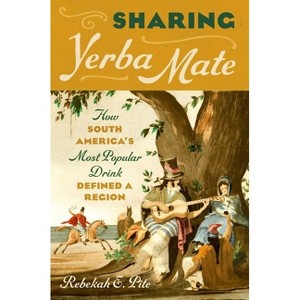
Sharing Yerba Mate - by  Rebekah E Pite (Paperback) - 1 of 1

Sharing Yerba Mate - by Rebekah E Pite (Paperback)

$29.95

In Stock

Free & easy returns

Free & easy returns

Return this item by mail or in store within 90 days for a full refund.
Eligible for registries and wish lists

About this item

Highlights

  • Drinking yerba mate is a daily, communal ritual that has brought together South Americans for some five centuries.
  • Author(s): Rebekah E Pite
  • 310 Pages
  • Social Science,

Description


About the Book


"Rebekah Pite's examination of mate consumption offers a lens into the everyday life and identity formation in a region often studied individually by country or through comparative politics. The book travels through the top-consuming nations of Argentina and Uruguay; visits Paraguay, the original home of yerba mate; and enters southern Brazil, the second largest producer after Argentina, the main supplier of the Uruguayan market, and a significant consumer in its own right. Pite also analyzes ... the promotion and consumption of yerba mate in other global markets in South America (especially Chile), the Middle East, Europe, and the US, where yerba mate is widely sold in health food stores, online, and in cafes, especially in California, which has a robust 'super food' market and culture"--


Book Synopsis


Drinking yerba mate is a daily, communal ritual that has brought together South Americans for some five centuries. In lively prose and with vivid illustrations, Rebekah E. Pite explores how this Indigenous infusion, made from the naturally caffeinated leaves of a local holly tree, became one of the most distinctive and widely consumed beverages in the region. Latin American food and commodity studies have focused on consumption in the global north, but Pite tells the story of yerba mate in South America, illuminating dynamic and exploitative circuits of production, promotion, and consumption. Ideas about who should harvest and serve yerba mate, along with visions of the archetypical mate drinker, persisted and were transformed alongside the shifting politics of class, race, and gender.

This global history takes us from the colonial Río de la Plata to the top yerba-consuming and producing nations of Argentina, Brazil, Paraguay, and Uruguay, with excursions to Chile, the Middle East, Europe, and the United States, where yerba mate is now sold as a "superfood." For readers eager to understand South America and its unique drink, Sharing Yerba Mate is an essential text that delves into an everyday ritual to expose systems of power and the taste of belonging.


Review Quotes


"Pite, however, introduces her readers to what is, most likely, unknown to them: a multifaceted ritual that moves from preparation to consumption. . . . She also explores its sociocultural meanings. She carefully maps out the path that she follows throughout the book, always graced with copious observation. . . . This book guarantees a thought-provoking and very pleasurable read. It will become a widely cited source, welcomed by scholars from many different fields."--Environmental History


"A well-researched, engaging, and important look at yerba mate's history and geography of cultivation and consumption from the precolonial era to the present. . . . Sharing Yerba Mate is an engaging and enjoyable read, enlightening and accessible to those interested in the history of the region, as well those interested in the history of stimulants and rituals of consumption generally."--American Historical Review


"Beautifully written and solidly grounded in multisite archival research. Pite displays a command of scholarly methodologies of the histories of Latin America, nationalism, and commodities, as well as visual culture and food studies."--Jeffrey M. Pilcher, author of Planet Taco: A Global History of Mexican Food


"Like an expert cebadora, Pite serves up a rich, complex, and deeply sensory brew--a story of yerba mate that spans centuries, empires, nations, environments, trade circuits, and preparations, yet fits satisfyingly in our hands. Throughout, Pite reveals how yerba mate's production and consumption created bonds of community among South Americans even as it bound many in enduring hierarchies of difference and exploitation."--Paulina L. Alberto, Harvard University, author of Black Legend: The Many Lives of Raúl Grigera and the Power of Racial Storytelling in Argentina


"Pite deftly navigates the changes in late colonial territory to trace how the widespread usage of ka'a crossed social classes . . . [and the book's] excellent visual and written analysis includes a vast number of primary sources produced by writers, painters, and naturalists from Europe and the United States."--H-Diplo


"Pite succeeds in crafting an innovative history social history, one which centers on yerba mate and explores its producers, its consumers and its servers. . . . Sharing Yerba Mate is an entertaining and clear contribution to multiple aspects of the historiography of the Southern Cone. Pite successfully delves into themes of nationalism, gender, racism, and social history all through the lens of yerba mate's evolution. . . . [T]his is an excellently researched and theoretically situated work that contributes to numerous historical fields, while also being an accessible text for scholars and history students alike."--Journal of Social History


"Working from the premise that the culture surrounding yerba mate (ka'a) needs to be studied from a broad regional perspective, Pite confidently crosses linguistic and political boundaries to shed light on how the infusion has shaped ideas about class, race, gender, and nation in southern South America."--Bridget Chesterton, author of The Grandchildren of Solano López: Frontier and Nation in Paraguay, 1904-1936


Dimensions (Overall): 9.21 Inches (H) x 6.14 Inches (W) x .7 Inches (D)
Weight: 1.06 Pounds
Suggested Age: 22 Years and Up
Number of Pages: 310
Genre: Social Science
Publisher: University of North Carolina Press
Format: Paperback
Author: Rebekah E Pite
Language: English
Street Date: September 19, 2023
TCIN: 1011318213
UPC: 9781469674537
Item Number (DPCI): 247-00-0866
Origin: Made in the USA or Imported
If the item details aren’t accurate or complete, we want to know about it.

Shipping details

Estimated ship dimensions: 0.7 inches length x 6.14 inches width x 9.21 inches height
Estimated ship weight: 1.06 pounds
We regret that this item cannot be shipped to PO Boxes.
This item cannot be shipped to the following locations: American Samoa (see also separate entry under AS), Guam (see also separate entry under GU), Northern Mariana Islands, Puerto Rico (see also separate entry under PR), United States Minor Outlying Islands, Virgin Islands, U.S., APO/FPO, Alaska, Hawaii

Return details

This item can be returned to any Target store or Target.com.
This item must be returned within 90 days of the date it was purchased in store, delivered to the guest, delivered by a Shipt shopper, or picked up by the guest.
See the return policy for complete information.

Q: What type of research supports the book's findings?

submitted by AI Shopping Assistant - 4 days ago
  • A: The book is grounded in multisite archival research, utilizing primary sources from various writers, painters, and naturalists.

    submitted byAI Shopping Assistant - 4 days ago
    Ai generated

Q: Which countries are primarily discussed in the book?

submitted by AI Shopping Assistant - 4 days ago
  • A: The book discusses Argentina, Uruguay, Paraguay, and Brazil, along with mentions of Chile, the Middle East, Europe, and the US.

    submitted byAI Shopping Assistant - 4 days ago
    Ai generated

Q: How does the author approach the topic of yerba mate?

submitted by AI Shopping Assistant - 4 days ago
  • A: Rebekah Pite uses a combination of historical analysis and sociocultural exploration to examine yerba mate's role in identity formation.

    submitted byAI Shopping Assistant - 4 days ago
    Ai generated

Q: What is the main focus of the book?

submitted by AI Shopping Assistant - 4 days ago
  • A: The book explores the cultural significance and history of yerba mate in South America, examining its communal rituals and social implications.

    submitted byAI Shopping Assistant - 4 days ago
    Ai generated

Q: What themes are explored in relation to yerba mate?

submitted by AI Shopping Assistant - 4 days ago
  • A: Themes include class, race, gender, nationalism, and the dynamics of production and consumption surrounding yerba mate.

    submitted byAI Shopping Assistant - 4 days ago
    Ai generated

Additional product information and recommendations

Discover more options

Trending Social Science Books

Get top deals, latest trends, and more.

Privacy policy