Target New ArrivalsGift Ideas for DadClothing, Shoes & AccessoriesHome & DecorKitchen & DiningOutdoor Living & GardenGroceryHousehold EssentialsBabyBeautyPersonal CareSports & OutdoorsHealthWellnessLuggageSchool & Office SuppliesToysElectronicsVideo GamesMovies, Music & BooksParty SuppliesGift IdeasGift CardsPetsUlta Beauty at TargetShop by CommunityTarget OpticalDealsClearanceNew ArrivalsGift Ideas for DadBack to SchoolCollegeTop DealsTarget Circle DealsWeekly AdShop Order PickupShop Same Day DeliveryRegistryRedCardTarget CircleFind Stores
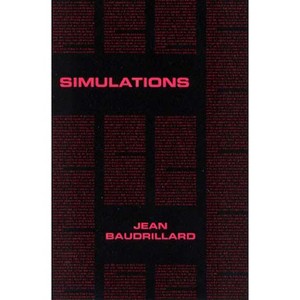
Simulations - (Semiotext(e) / Foreign Agents) by  Jean Baudrillard (Paperback) - 1 of 1

Simulations - (Semiotext(e) / Foreign Agents) by Jean Baudrillard (Paperback)

$13.95

In Stock

Free & easy returns

Free & easy returns

Return this item by mail or in store within 90 days for a full refund.
Eligible for registries and wish lists

About this item

Highlights

  • Baudrillard's bewildering thesis, a bold extrapolation on Ferdinand de Saussure's general theory of general linguistics, is in fact a clinical vision of contemporary consumer societies where signs don't refer anymore to anything except themselves.
  • About the Author: Jean Baudrillard (1929-2007) was a philosopher, sociologist, cultural critic, and theorist of postmodernity who challenged all existing theories of contemporary society with humor and precision.
  • 176 Pages
  • Literary Criticism, Semiotics & Theory
  • Series Name: Semiotext(e) / Foreign Agents

Description


About the Book


Baudrillard's bewildering thesis, a bold extrapolation on Ferdinand de Saussure's general theory of general linguistics, is in fact a clinical vision of contemporary consumer societies where signs don't refer anymore to anything except themselves. They all are generated by the matrix.


Book Synopsis


Baudrillard's bewildering thesis, a bold extrapolation on Ferdinand de Saussure's general theory of general linguistics, is in fact a clinical vision of contemporary consumer societies where signs don't refer anymore to anything except themselves. They all are generated by the matrix.

Simulations never existed as a book before it was "translated" into English. Actually it came from two different bookCovers written at different times by Jean Baudrillard. The first part of Simulations, and most provocative because it made a fiction of theory, was "The Procession of Simulacra." It had first been published in Simulacre et Simulations (1981). The second part, written much earlier and in a more academic mode, came from L'Echange Symbolique et la Mort (1977). It was a half-earnest, half-parodical attempt to "historicize" his own conceit by providing it with some kind of genealogy of the three orders of appearance: the Counterfeit attached to the classical period; Production for the industrial era; and Simulation, controlled by the code. It was Baudrillard's version of Foucault's Order of Things and his ironical commentary of the history of truth. The book opens on a quote from Ecclesiastes asserting flatly that "the simulacrum is true." It was certainly true in Baudrillard's book, but otherwise apocryphal.One of the most influential essays of the 20th century, Simulations was put together in 1983 in order to be published as the first little black book of Semiotext(e)'s new Foreign Agents Series. Baudrillard's bewildering thesis, a bold extrapolation on Ferdinand de Saussure's general theory of general linguistics, was in fact a clinical vision of contemporary consumer societies where signs don't refer anymore to anything except themselves. They all are generated by the matrix.In effect Baudrillard's essay (it quickly became a must to read both in the art world and in academe) was upholding the only reality there was in a world that keeps hiding the fact that it has none. Simulacrum is its own pure simulacrum and the simulacrum is true. In his celebrated analysis of Disneyland, Baudrillard demonstrates that its childish imaginary is neither true nor false, it is there to make us believe that the rest of America is real, when in fact America is a Disneyland. It is of the order of the hyper-real and of simulation. Few people at the time realized that Baudrillard's simulacrum itself wasn't a thing, but a "deterrence machine," just like Disneyland, meant to reveal the fact that the real is no longer real and illusion no longer possible. But the more impossible the illusion of reality becomes, the more impossible it is to separate true from false and the real from its artificial resurrection, the more panic-stricken the production of the real is.


About the Author


Jean Baudrillard (1929-2007) was a philosopher, sociologist, cultural critic, and theorist of postmodernity who challenged all existing theories of contemporary society with humor and precision. An outsider in the French intellectual establishment, he was internationally renowned as a twenty-first century visionary, reporter, and provocateur.
Dimensions (Overall): 7.06 Inches (H) x 4.56 Inches (W) x .4 Inches (D)
Weight: .32 Pounds
Suggested Age: 22 Years and Up
Number of Pages: 176
Genre: Literary Criticism
Sub-Genre: Semiotics & Theory
Series Title: Semiotext(e) / Foreign Agents
Publisher: Semiotext(e)
Format: Paperback
Author: Jean Baudrillard
Language: English
Street Date: January 1, 1983
TCIN: 1008938463
UPC: 9780936756028
Item Number (DPCI): 247-15-0386
Origin: Made in the USA or Imported
If the item details aren’t accurate or complete, we want to know about it.

Shipping details

Estimated ship dimensions: 0.4 inches length x 4.56 inches width x 7.06 inches height
Estimated ship weight: 0.32 pounds
We regret that this item cannot be shipped to PO Boxes.
This item cannot be shipped to the following locations: American Samoa (see also separate entry under AS), Guam (see also separate entry under GU), Northern Mariana Islands, Puerto Rico (see also separate entry under PR), United States Minor Outlying Islands, Virgin Islands, U.S., APO/FPO, Alaska, Hawaii

Return details

This item can be returned to any Target store or Target.com.
This item must be returned within 90 days of the date it was purchased in store, delivered to the guest, delivered by a Shipt shopper, or picked up by the guest.
See the return policy for complete information.

Q: Is the work a single cohesive essay?

submitted by AI Shopping Assistant - 3 months ago
  • A: No, it comprises two different essays from various times by Baudrillard, presenting distinct yet related ideas.

    submitted byAI Shopping Assistant - 3 months ago
    Ai generated

Q: What is the main thesis of Baudrillard's work?

submitted by AI Shopping Assistant - 3 months ago
  • A: The main thesis explores how contemporary consumer societies create signs that refer only to themselves rather than any external reality.

    submitted byAI Shopping Assistant - 3 months ago
    Ai generated

Q: What genres does this book belong to?

submitted by AI Shopping Assistant - 3 months ago
  • A: This book is categorized under Literary Criticism, specifically focusing on Semiotics and Theory.

    submitted byAI Shopping Assistant - 3 months ago
    Ai generated

Q: How did Baudrillard influence the art world?

submitted by AI Shopping Assistant - 3 months ago
  • A: His analyses, especially of concepts like simulation and the hyper-real, became significant references in both art and academic circles.

    submitted byAI Shopping Assistant - 3 months ago
    Ai generated

Q: Who is the author of this book?

submitted by AI Shopping Assistant - 3 months ago
  • A: The author is Jean Baudrillard, a philosopher and theorist known for his critiques of contemporary society.

    submitted byAI Shopping Assistant - 3 months ago
    Ai generated

Additional product information and recommendations
Discover more options

Get top deals, latest trends, and more.

Privacy policy