Target New ArrivalsBack to SchoolCollegeClothing, Shoes & AccessoriesHome & DecorKitchen & DiningOutdoor Living & GardenGroceryHousehold EssentialsBabyBeautyPersonal CareSports & OutdoorsHealthWellnessSchool & Office SuppliesToys & GamesElectronics & TechVideo GamesMovies, Music & BooksParty SuppliesGift IdeasGift CardsPetsUlta Beauty at TargetShop by CommunityTarget OpticalDealsClearanceNew ArrivalsBack to SchoolCollegeTop DealsTarget Circle DealsWeekly AdShop Order PickupShop Same Day DeliveryRegistryRedCardTarget CircleFind Stores
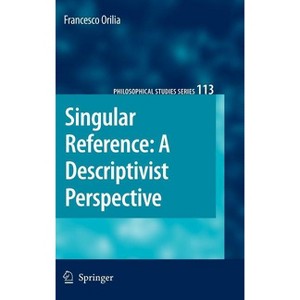
Singular Reference: A Descriptivist Perspective - (Philosophical Studies) by  Francesco Orilia (Hardcover) - 1 of 1

Singular Reference: A Descriptivist Perspective - (Philosophical Studies) by Francesco Orilia (Hardcover)

$169.99

In Stock

Free & easy returns
Free & easy returns
Return this item by mail or in store within 90 days for a full refund.
Eligible for registries and wish lists

About this item

Highlights

  • Singular reference to ourselves and the ordinary objects surrounding us is a most crucial philosophical topic, for it looms large in any attempt to understand how language and mind connect to the world.
  • About the Author: Francesco Orilia studied philosophy at the university of Palermo (M.A., 1979) and then, after being granted a Fulbright grant, at Indiana University, Bloomington (Ph.D., 1986), where he was a student of Hector-Neri Castañeda, Nino B. Cocchiarella and J. M. Dunn.
  • 290 Pages
  • Philosophy, Logic
  • Series Name: Philosophical Studies

Description


About the Book


Singular reference is a crucial philosophical topic. This book explains in detail why in the past some philosophers favored a descriptivist approach to this matter and why in more recent times others support a referentialist standpoint.


Book Synopsis


Singular reference to ourselves and the ordinary objects surrounding us is a most crucial philosophical topic, for it looms large in any attempt to understand how language and mind connect to the world. This book explains in detail why in the past philosophers such as Frege, Russell and Reichenbach have favoured a descriptivist approach to this matter and why in more recent times Donnellan, Kripke, Kaplan and others have rather favoured a referentialist standpoint. The now dominant referentialist theories however still have a hard time in addressing propositional attitudes and empty singular terms. Here a way out of this difficulty emerges in an approach that incorporates aspects of the old-fashioned descriptivist views of Frege, Russell and Reichenbach without succumbing to the anti-descriptivist arguments that back up the current referentialist trend. The resulting theory features a novel approach to the semantics and pragmatics of determiner phrases, definite descriptions, propernames and indexicals, all treated in uniform fashion in both their anaphoric and non-anaphoric uses.

This work will be of interest to researchers in philosophy of language, philosophy of mind and theoretical linguistics. The wealth of background information and detailed explanations that it provides makes it also accessible to graduate and upper level undergraduates and suitable as a reference book.


From the Back Cover


Singular reference to ourselves and the ordinary objects surrounding us is a most crucial philosophical topic, for it looms large in any attempt to understand how language and mind connect to the world. This book explains in detail why in the past philosophers such as Frege, Russell and Reichenbach have favoured a descriptivist approach to this matter and why in more recent times Donnellan, Kripke, Kaplan and others have rather favoured a referentialist standpoint. The now dominant referentialist theories however still have a hard time in addressing propositional attitudes and empty singular terms. Here a way out of this difficulty emerges in an approach that incorporates aspects of the old-fashioned descriptivist views of Frege, Russell and Reichenbach without succumbing to the anti-descriptivist arguments that back up the current referentialist trend. The resulting theory features a novel approach to the semantics and pragmatics of determiner phrases, definite descriptions, propernames and indexicals, all treated in uniform fashion in both their anaphoric and non-anaphoric uses.

This work will be of interest to researchers in philosophy of language, philosophy of mind and theoretical linguistics. The wealth of background information and detailed explanations that it provides makes it also accessible to graduate and upper level undergraduates and suitable as a reference book.


Review Quotes


"Orilia's volume, which for the detailed analysis of the problems and for the originality and the insights of the advanced solutions represents one of the most recommended texts for those who are interested in the debate between Descriptivism and Direct Reference Theory about singular reference devices." (Aldo Frigerio, Axiomathes, Vol. 27, 2017)


About the Author


Francesco Orilia studied philosophy at the university of Palermo (M.A., 1979) and then, after being granted a Fulbright grant, at Indiana University, Bloomington (Ph.D., 1986), where he was a student of Hector-Neri Castañeda, Nino B. Cocchiarella and J. M. Dunn. From 1987 to 1994 he was a researcher in artificial intelligence at the Olivetti research lab in Pisa and from July 1994 to July 1997 a researcher/lecturer in theoretical philosophy at the University of Cagliari. Since August 1997 he has been with the university of Macerata where he is currently professor of philosophy of language. He also had visiting positions at Indiana University, Bloomington (1986), University of Paris IV (2005), University of Iowa at Iowa City (2006), Cambridge University (2008). In the period 2000-2003 he was a member of the selection committee of the E. W. Beth Dissertation Prize for logic, language, and information and he is now in the editorial board of Metaphysica. He has written or co-edited a few books and published many papers in international journals such as Dialectica, Journal of Philosophical Logic, Journal of Symbolic Logic, Notre Dame Journal of Formal Logic, Minds and Machines, Synthese, Topoi.

Dimensions (Overall): 9.21 Inches (H) x 6.14 Inches (W) x .75 Inches (D)
Weight: 1.33 Pounds
Suggested Age: 22 Years and Up
Number of Pages: 290
Genre: Philosophy
Sub-Genre: Logic
Series Title: Philosophical Studies
Publisher: Springer
Format: Hardcover
Author: Francesco Orilia
Language: English
Street Date: December 10, 2009
TCIN: 1011489661
UPC: 9789048133116
Item Number (DPCI): 247-12-8886
Origin: Made in the USA or Imported
If the item details aren’t accurate or complete, we want to know about it.

Shipping details

Estimated ship dimensions: 0.75 inches length x 6.14 inches width x 9.21 inches height
Estimated ship weight: 1.33 pounds
We regret that this item cannot be shipped to PO Boxes.
This item cannot be shipped to the following locations: American Samoa (see also separate entry under AS), Guam (see also separate entry under GU), Northern Mariana Islands, Puerto Rico (see also separate entry under PR), United States Minor Outlying Islands, Virgin Islands, U.S., APO/FPO, Alaska, Hawaii

Return details

This item can be returned to any Target store or Target.com.
This item must be returned within 90 days of the date it was purchased in store, delivered to the guest, delivered by a Shipt shopper, or picked up by the guest.
See the return policy for complete information.

Additional product information and recommendations

Discover more options

Skip to next section

Best-selling All Book Genres

Skip to next section

Get top deals, latest trends, and more.