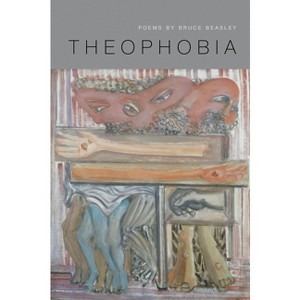
Theophobia is the latest volume in Bruce Beasley's ongoing spiritual meditation which forms a kind of postmodern devotional poetry in a reinvention of the tradition of John Donne, George Herbert, Emily Dickinson, Gerard Manley Hopkins, and T. S. Eliot.
About the Author: Bruce Beasley is the author of six collections of poems, most recently The Corpse Flower: New and Selected Poems (University of Washington Press, 2007).
112 Pages
Poetry, American
Description
About the Book
Theophobia continues Beasley's postmodern spiritual meditations in the tradition of John Donne, George Herbert, Emily Dickinson, and T.S. Eliot.
Book Synopsis
Theophobia is the latest volume in Bruce Beasley's ongoing spiritual meditation which forms a kind of postmodern devotional poetry in a reinvention of the tradition of John Donne, George Herbert, Emily Dickinson, Gerard Manley Hopkins, and T. S. Eliot. Theophobia is structured around a series of poems called "Pilgrim's Deviations" and forms a deviant and deviating pilgrimage through science, history, politics, and popular culture. Beasley seeks the Biblical Kingdom of God among Dolly the cloned sheep, the wonders and horrors of extremophilic creatures living in astonishing intensities of temperature, robotic phone operators, and Wikipedia's explanation of the mysteries of the Holy Spirit.

Bruce Beasley is the author of six poetry collections, most recently The Corpse Flower: New and Selected Poems (University of Washington Press, 2007). He has won fellowships from the NEA and the Artist Trust of Washington and three Pushcart Prizes.
Finalist for The Washington State Book Award
One of Poetry Northwest's Notable Books of 2014
Review Quotes
"Beasley outdoes his five prior collections with this spiky, thoughtful, elaborate, sometimes scary, sometimes funny set of verse essays, riffs, and meditations on the idea of a Christian creator-god, and on ideas from evolutionary and molecular biology about how life comes to be... Yet it's never just play: he wants answers, from divinity or from DNA, even if he believes that he will not get them, and so his variable, friable, unbalanced verse lines can morph into prayer... Careful, sympathetic attention will produce pleasure in Beasley's collisions between curiosity and doubt, as the newest oddities of the life sciences, and the oddest words he can find, crash into dark fears and grapple with ancient questions." -PUBLISHERS WEEKLY *Starred Review* "An investigation into the physical world and what lies beyond, this book will appeal to enthusiasts of poetry and the subjects that Beasley mines." --Library Journal "This is a book that wrestles with religious forms as well as religious notions, considering religious practice and experience in relation to current-day concerns. This includes not only the putting of lines on paper, but also waiting for customer service or meditating on the grand design of the Toxoplasma gondii lifecycle... what sets Theophobia apart--as a thick, varied, and always thoughtful exercise--is considering such a phenomena as a religious task, revealing of something essential to our understanding of God, as Augustine argued in relation to vipers and worms... Beasley casts a broad net, dredging deep in this important contemporary addition to poetic wrestling with the religious."--Spencer Dew, Rain Taxi "Beasley is, above all, a poet of spiritual ardor, a dyspeptic believer in the Geoffrey Hill mode ... Writing of Donne in a recent essay, Hill insists that for a certain breed of poet, style is faith, and Beasley may well be such a writer. His many allusions to the mystical esoteric - Meister Eckart, Julian of Norwich, the Gnostic gospels, and the Corpus Hermeticim (not to mention plain old Bible verse) - are evidence not merely of Beasley's learnedness, but also of his belief in the poem as a kind of heterodox spiritual exercise. He is a postmodern descendant of Herbert, Traherne, and Vaughn ... there are few contemporary poets who can keep such august company ... Like Robert Duncan, who was also powerfully drawn to Gnostic and Hermetic thought, Beasley's reading in mysticism has, above all, animated his lyrical acuity. He draws from these traditions not merely for their substance, but also to enhance his musical chops. And when he displays those chops, the results can be majestic ... a fluency and rhetorical control that no other poet of his generation can match." -DAVID WOJAHN, The Kenyon Review In Theophobia, one of Image's Top Ten of 2012, "the poet's belief and doubt are deconstructed and then uncertainly rebuilt. In his restless search for (and fear of) God, he combines the ambiguity of postmodernism, the precision of science, and the theology of mysticism into sprawling poems that add surprising twists to our images of divinity...For Beasley, language itself becomes a metaphor for the Incarnation; the joining of divinity with humanity is as messy, oblique, and mysterious as the relationship between a word and its meaning... You might be reaching for the dictionary more than once with this book, but trust us: this doesn't lessen its delight in the least." --Image "The poems succeed because this juxtaposition does indeed startle us toward fresh insights. Readers are presented with a mind thinking, a particularly energetic mind, one that enjoys the task. And despite my own initial hesitations, I found the poems ultimately hospitable ... I'm envious of Beasley's agility in this b
About the Author
Bruce Beasley is the author of six collections of poems, most recently The Corpse Flower: New and Selected Poems (University of Washington Press, 2007). His previous collection, Lord Brain, an extended meditation on neuroscience, cosmology, theology, and language, won the University of Georgia Press' Contemporary Poetry Series Award and was published in 2005. Beasley won the 1996 Colorado Prize for Poetry in 1996 for Summer Mystagogia, selected by Charles Wright, and the 1994 Ohio State University Press/Journal Award for The Creation. Wesleyan University Press published his books Spirituals (1988) and Signs and Abominations (2000). He has won fellowships from the National Endowment for the Arts and the Artist Trust of Washington and three Pushcart Prizes in poetry. His work also appears in The Pushcart Book of Poetry: The Best Poems from the First Thirty Years of the Pushcart Prize, as well as other anthologies including Lyric Postmodernisms: An Anthology of Contemporary Innovative Poetries; Under 35: The New Generation of American Poets; Under the Rock Umbrella: Contemporary Poets from 1951-1977; and American Alphabets: 25 Contemporary Poets. His poems appear widely in such journals as The Kenyon Review, Southern Review, New American Writing, Field, and Virginia Quarterly Review.
Dimensions (Overall): 8.9 Inches (H) x 5.9 Inches (W) x .4 Inches (D)
Weight: .35 Pounds
Suggested Age: 22 Years and Up
Number of Pages: 112
Genre: Poetry
Sub-Genre: American
Publisher: BOA Editions
Theme: General
Format: Paperback
Author: Bruce Beasley
Language: English
Street Date: September 18, 2012
TCIN: 1008940443
UPC: 9781934414910
Item Number (DPCI): 247-32-7215
Origin: Made in the USA or Imported
If the item details aren’t accurate or complete, we want to know about it.
Shipping details
Estimated ship dimensions: 0.4 inches length x 5.9 inches width x 8.9 inches height
Estimated ship weight: 0.35 pounds
We regret that this item cannot be shipped to PO Boxes.
This item cannot be shipped to the following locations: American Samoa (see also separate entry under AS), Guam (see also separate entry under GU), Northern Mariana Islands, Puerto Rico (see also separate entry under PR), United States Minor Outlying Islands, Virgin Islands, U.S., APO/FPO
Return details
This item can be returned to any Target store or Target.com.
This item must be returned within 90 days of the date it was purchased in store, delivered to the guest, delivered by a Shipt shopper, or picked up by the guest.