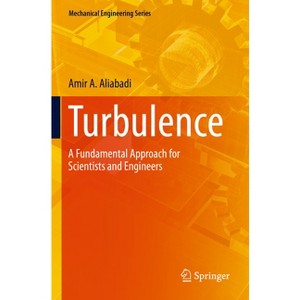
This textbook explains turbulent flows using an introductory but fundamental approach to teaching the core principles, striking a balance between theoretical and practical aspects of the topic without overwhelming the reader with mathematical detail.
About the Author: Dr. Amir A. Aliabadi is an Associate Professor in Environmental Engineering, School of Engineering, University of Guelph, CANADA.
297 Pages
Technology, Mechanical
Series Name: Mechanical Engineering
Description
Book Synopsis
This textbook explains turbulent flows using an introductory but fundamental approach to teaching the core principles, striking a balance between theoretical and practical aspects of the topic without overwhelming the reader with mathematical detail. It is aimed at students in various engineering disciplines--mechanical, civil, environmental--and the geosciences. It is divided in five parts. Part 1 provides the fundamentals of turbulence, main hypotheses, and analysis tools; Part 2 illustrates various measurement techniques used to study turbulent flows; Part 3 explains the modelling and simulation frameworks to study turbulent flows; Part 4 describes brief applications of turbulence in engineering and sciences; and Part 5 presents basic statistical, mathematical, and numerical tools.
Elucidates the theory behind turbulence in a concise yet rigorous manner
Combines theoretical, computational, experimental, and applied aspects of the topic
Reinforces concepts with practice problems at the end of each chapter
Provides brief chapters on statistics, mathematics, and numerical techniques
From the Back Cover
This textbook explains turbulent flows using an introductory but fundamental approach to teaching the core principles, striking a balance between theoretical and practical aspects of the topic without overwhelming the reader with mathematical detail. It is aimed at students in various engineering disciplines--mechanical, civil, environmental--and the geosciences. It is divided in five parts. Part 1 provides the fundamentals of turbulence, main hypotheses, and analysis tools; Part 2 illustrates various measurement techniques used to study turbulent flows; Part 3 explains the modelling and simulation frameworks to study turbulent flows; Part 4 describes brief applications of turbulence in engineering and sciences; and Part 5 presents basic statistical, mathematical, and numerical tools.
Elucidates the theory behind turbulence in a concise yet rigorous manner;
Combines theoretical, computational, experimental, and applied aspects of the topic;
Reinforces concepts with practice problems at the end of each chapter.
About the Author
Dr. Amir A. Aliabadi is an Associate Professor in Environmental Engineering, School of Engineering, University of Guelph, CANADA.
Dimensions (Overall): 9.21 Inches (H) x 6.14 Inches (W) x .66 Inches (D)
Weight: .98 Pounds
Suggested Age: 22 Years and Up
Number of Pages: 297
Genre: Technology
Sub-Genre: Mechanical
Series Title: Mechanical Engineering
Publisher: Springer
Format: Paperback
Author: Amir A Aliabadi
Language: English
Street Date: October 14, 2023
TCIN: 1012218588
UPC: 9783030954130
Item Number (DPCI): 247-23-7974
Origin: Made in the USA or Imported
If the item details aren’t accurate or complete, we want to know about it.
Shipping details
Estimated ship dimensions: 0.66 inches length x 6.14 inches width x 9.21 inches height
Estimated ship weight: 0.98 pounds
We regret that this item cannot be shipped to PO Boxes.
This item cannot be shipped to the following locations: American Samoa (see also separate entry under AS), Guam (see also separate entry under GU), Northern Mariana Islands, Puerto Rico (see also separate entry under PR), United States Minor Outlying Islands, Virgin Islands, U.S., APO/FPO, Alaska, Hawaii
Return details
This item can be returned to any Target store or Target.com.
This item must be returned within 90 days of the date it was purchased in store, delivered to the guest, delivered by a Shipt shopper, or picked up by the guest.