Target New ArrivalsFourth of JulyGift Ideas for DadClothing, Shoes & AccessoriesHome & DecorKitchen & DiningOutdoor Living & GardenGroceryHousehold EssentialsBabyBeautyPersonal CareSports & OutdoorsHealthWellnessLuggageSchool & Office SuppliesToys & GamesElectronicsVideo GamesMovies, Music & BooksParty SuppliesGift IdeasGift CardsPetsUlta Beauty at TargetShop by CommunityTarget OpticalDealsClearanceNew ArrivalsGift Ideas for DadBack to SchoolCollegeTop DealsTarget Circle DealsWeekly AdShop Order PickupShop Same Day DeliveryRegistryRedCardTarget CircleFind Stores
Wireless Network Simulation - (Paperback) - 1 of 1

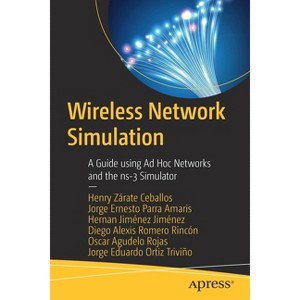
Wireless Network Simulation - (Paperback)

In Stock

Free & easy returns

Free & easy returns

Return this item by mail or in store within 90 days for a full refund.
Eligible for registries and wish lists

About this item

Highlights

  • Learn to run your own simulation by working with model analysis, mathematical background, simulation output data, and most importantly, a network simulator for wireless technology.
  • About the Author: Henry Zárate Ceballos received his PhD in Engineering Computing and Systems and Masters Degree in Telecommunications from the National University of Colombia.
  • 256 Pages
  • Technology, Telecommunications

Description


Book Synopsis


Learn to run your own simulation by working with model analysis, mathematical background, simulation output data, and most importantly, a network simulator for wireless technology. This book introduces the best practices of simulator use, the techniques for analyzing simulations with artificial agents and the integration with other technologies such as Power Line Communications (PLC).
Network simulation is a key technique used to test the future behavior of a network. It's a vital development component for the development of 5G, IoT, wireless sensor networks, and many more. This book explains the scope and evolution of the technology that has led to the development of dynamic systems such as Internet of Things and fog computing.
You'll focus on the ad hoc networks with stochastic behavior and dynamic nature, and the ns-3 simulator. These are useful open source tools for academics, researchers, students and engineers to deploy telecommunications experiments, proofs and new scenarios with a high degree of similarity with reality. You'll also benefit from a detailed explanation of the examples and the theoretical components needed to deploy wireless simulations or wired, if necessary.
What You'll Learn
  • Review best practices of simulator uses
  • Understand techniques for analyzing simulations with artificial agents
  • Apply simulation techniques and experiment design
  • Program on ns-3 simulator
  • Analyze simulation results
  • Create new modules or protocols for wired and wireless networks

Who This Book Is For
Undergraduate and postgraduate students, researchers and professors interested in network simulations. This book also includes theoretical components about simulation, which are useful for those interested in discrete event simulation DES, general theory of simulation, wireless simulation and ns-3 simulator.


From the Back Cover


earn to run your own simulation by working with model analysis, mathematical background, simulation output data, and most importantly, a network simulator for wireless technology. This book introduces the best practices of simulator use, the techniques for analyzing simulations with artificial agents and the integration with other technologies such as Power Line Communications (PLC).
Network simulation is a key technique used to test the future behavior of a network. It's a vital development component for the development of 5G, IoT, wireless sensor networks, and many more. This book explains the scope and evolution of the technology that has led to the development of dynamic systems such as Internet of Things and fog computing.
You'll focus on the ad hoc networks with stochastic behavior and dynamic nature, and the ns-3 simulator. These are useful open tools for academics, researchers, students and engineers to deploy telecommunications experiments, proofs and new scenarios with a high degree of similarity with reality. You'll also benefit from a detailed explanation of the examples and the theoretical components needed to deploy wireless simulations or wired, if necessary.
You will:
  • Review best practices of simulator uses
  • Understand techniques for analyzing simulations with artificial agents
  • Apply simulation techniques and experiment design
  • Program on ns-3 simulator
  • Analyze simulation results
  • Create new modules or protocols for wired and wireless networks


About the Author


Henry Zárate Ceballos received his PhD in Engineering Computing and Systems and Masters Degree in Telecommunications from the National University of Colombia. Henry is currently a researcher with the TLÖN Group. Henry has worked extesensively with the Ns-2 and Ns-3 simulators and wireless distributed operative systems.
Jorge Ernesto Parra Amaris received his Masters Degree in Telecommunication from the National University of Colombia, and is an Electronics Engineer from the Colombian School of Engineering Julio Garavito. Jorge's Masters thesis proposed a unique algorithm which was validated through simulation using NS-3.
Hernán Jiménez Jiménez received his postgraduate Masters in Telecommunications from the National University of Colombia. Hernán is currently a researcher at TLÖN Group.
Diego Alexis Romero Rincón received his Masters in Electronics from the National University of Colombia and is currently a researcher with the TLÖN Group. Diego focused his Masters thesis on on the NS-3 simulator. Deigo is currently a lecturer at the National University of Colombia.
Oscar Agudelo Rojas is a systems engineer and lecturer at the National University of Colombia, where he also received his Masters degree in Telecommunications. His research work includes networks (wired and wireless), network coding, simulation (ns2-ns3) and parallel and distributed systems.
Jorge Eduardo Ortiz Triviño received his PhD in Engineering Computing Systems and Masters Degrees in Telecommunications, Statistics, and Philosophy from the National University of Colombia. Jorge is currently a professor at the National University of Colombia, while also working as a network specialist.
Dimensions (Overall): 9.21 Inches (H) x 6.14 Inches (W) x .58 Inches (D)
Weight: .85 Pounds
Suggested Age: 22 Years and Up
Number of Pages: 256
Genre: Technology
Sub-Genre: Telecommunications
Publisher: Apress
Format: Paperback
Author: Henry Zárate Ceballos & Jorge Ernesto Parra Amaris & Hernan Jiménez Jiménez & Diego Alexis Romero Rincón & Oscar Agudelo Rojas & Jorge Eduardo Ortiz Triviño
Language: English
Street Date: May 6, 2021
TCIN: 1011990339
UPC: 9781484268483
Item Number (DPCI): 247-20-9126
Origin: Made in the USA or Imported
If the item details aren’t accurate or complete, we want to know about it.

Shipping details

Estimated ship dimensions: 0.58 inches length x 6.14 inches width x 9.21 inches height
Estimated ship weight: 0.85 pounds
We regret that this item cannot be shipped to PO Boxes.
This item cannot be shipped to the following locations: American Samoa (see also separate entry under AS), Guam (see also separate entry under GU), Northern Mariana Islands, Puerto Rico (see also separate entry under PR), United States Minor Outlying Islands, Virgin Islands, U.S., APO/FPO, Alaska, Hawaii

Return details

This item can be returned to any Target store or Target.com.
This item must be returned within 90 days of the date it was purchased in store, delivered to the guest, delivered by a Shipt shopper, or picked up by the guest.
See the return policy for complete information.

Q: What simulator is primarily discussed in the book?

submitted by AI Shopping Assistant - 7 days ago
  • A: The book primarily discusses the ns-3 simulator, which is an open-source tool for telecommunications experiments.

    submitted byAI Shopping Assistant - 7 days ago
    Ai generated

Q: What skills can readers expect to gain from this book?

submitted by AI Shopping Assistant - 7 days ago
  • A: Readers will learn to analyze simulations, program on ns-3, and create new modules or protocols for networks.

    submitted byAI Shopping Assistant - 7 days ago
    Ai generated

Q: Who is the target audience for this book?

submitted by AI Shopping Assistant - 7 days ago
  • A: The book is aimed at undergraduate and postgraduate students, researchers, and professors interested in network simulations.

    submitted byAI Shopping Assistant - 7 days ago
    Ai generated

Q: What is the significance of network simulation in technology?

submitted by AI Shopping Assistant - 7 days ago
  • A: Network simulation is crucial for testing future network behaviors, especially for developments in 5G, IoT, and wireless sensor networks.

    submitted byAI Shopping Assistant - 7 days ago
    Ai generated

Q: What topics are covered in the book on wireless simulation?

submitted by AI Shopping Assistant - 7 days ago
  • A: The book covers model analysis, simulation techniques, artificial agents, and integration with technologies like Power Line Communications.

    submitted byAI Shopping Assistant - 7 days ago
    Ai generated

Additional product information and recommendations

Discover more options

Best-selling Computers & Technology Books

Get top deals, latest trends, and more.

Privacy policy