Target New ArrivalsGift Ideas for DadClothing, Shoes & AccessoriesHome & DecorKitchen & DiningOutdoor Living & GardenGroceryHousehold EssentialsBabyBeautyPersonal CareSports & OutdoorsHealthWellnessLuggageSchool & Office SuppliesToysElectronicsVideo GamesMovies, Music & BooksParty SuppliesGift IdeasGift CardsPetsUlta Beauty at TargetShop by CommunityTarget OpticalDealsClearanceNew ArrivalsGift Ideas for DadBack to SchoolCollegeTop DealsTarget Circle DealsWeekly AdShop Order PickupShop Same Day DeliveryRegistryRedCardTarget CircleFind Stores
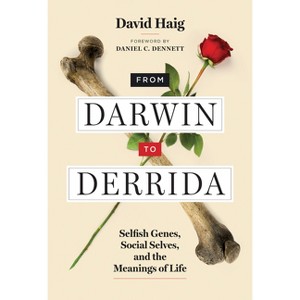
From Darwin to Derrida - by  David Haig (Paperback) - 1 of 1

From Darwin to Derrida - by David Haig (Paperback)

$28.00Save $11.95 (30% off)

In Stock

Free & easy returns

Free & easy returns

Return this item by mail or in store within 90 days for a full refund.
Eligible for registries and wish lists

About this item

Highlights

  • How the meaningless process of natural selection produces purposeful beings who find meaning in the world.
  • About the Author: David A. Haig is George Putnam Professor of Organismic and Evolutionary Biology at Harvard University.
  • 512 Pages
  • Science, Life Sciences

Description


Book Synopsis


How the meaningless process of natural selection produces purposeful beings who find meaning in the world.

In From Darwin to Derrida, evolutionary biologist David Haig explains how a physical world of matter in motion gave rise to a living world of purpose and meaning. Natural selection, a process without purpose, gives rise to purposeful beings who find meaning in the world. The key to this, Haig proposes, is the origin of mutable "texts"--genes--that preserve a record of what has worked in the world. These texts become the specifications for the intricate mechanisms of living beings.

Haig draws on a wide range of sources--from Laurence Sterne's Tristram Shandy to Immanuel Kant's Critique of the Power of Judgment to the work of Jacques Derrida to the latest findings on gene transmission, duplication, and expression--to make his argument. Genes and their effects, he explains, are like eggs and chickens. Eggs exist for the sake of becoming chickens and chickens for the sake of laying eggs. A gene's effects have a causal role in determining which genes are copied. A gene (considered as a lineage of material copies) persists if its lineage has been consistently associated with survival and reproduction. Organisms can be understood as interpreters that link information from the environment to meaningful action in the environment. Meaning, Haig argues, is the output of a process of interpretation; there is a continuum from the very simplest forms of interpretation, instantiated in single RNA molecules near the origins of life, to the most sophisticated. Life is interpretation--the use of information in choice.


Review Quotes


"A challenging though rewarding exploration of the meaning and purpose of life."
--Kirkus Reviews

"What, Haig asks, is the teleological purpose of consciousness? In the case of human beings, our consciousness is designed to interpret, through an evolved instinct of sympathy, the subjective attitudes and intentions of others."
--CHOICE

"David Haig's powerful mind and trenchant wit are fully matched by his caring heart and his gracious style. I shall be recommending this book to my students, giving it to my friends, and sampling it repeatedly."
--Stephen C. Stearns, Edward P. Bass Professor of Ecology and Evolutionary Biology at Yale University; author of Evolutionary Medicine

"Haig's book could be a game-changer in the fraught relation between the biological sciences and philosophy. Its intriguing moral may be his dauntingly scientific first thirteen chapters legitimize and actually call for the kind of philosophical thinking that his last chapters unabashedly exemplify."
--Richard Schacht, Jubilee Professor of Philosophy (Emeritus), University of Illinois

"In this profound and witty book, David Haig rediscovers Aristotle's four causes and tackles the foundations of biology and philosophy (and their joint history). He offers a subtle yet far-reaching, reinterpretation of genetics, culture, and the nature and meaning of meaning. Read it; he writes, and rewrites, all of us."
--Eric Schliesser, Professor, Political Science, University of Amsterdam, and Visiting Scholar, Smith Institute for Political Economy and Philosophy, Chapman University


About the Author


David A. Haig is George Putnam Professor of Organismic and Evolutionary Biology at Harvard University.

Daniel C. Dennett is University Professor Codirector of the Center for Cognitive Studies at Tufts University. He is the author of Brainchildren: Essays on Designing Minds; Sweet Dreams: Philosophical Obstacles to a Science of Consciousness; Elbow Room The Varieties of Free Will Worth Wanting; Sweet Dreams: Philosophical Obstacles to a Science of Consciousness (all published by the MIT Press), From Bacteria to Bach and Back: The Evolution of Mind, and other books.

Dimensions (Overall): 8.04 Inches (H) x 5.36 Inches (W) x 1.43 Inches (D)
Weight: .92 Pounds
Suggested Age: 22 Years and Up
Number of Pages: 512
Genre: Science
Sub-Genre: Life Sciences
Publisher: MIT Press
Theme: Biochemistry
Format: Paperback
Author: David Haig
Language: English
Street Date: February 17, 2026
TCIN: 1007683341
UPC: 9780262057196
Item Number (DPCI): 247-35-2900
Origin: Made in the USA or Imported
If the item details aren’t accurate or complete, we want to know about it.

Shipping details

Estimated ship dimensions: 1.43 inches length x 5.36 inches width x 8.04 inches height
Estimated ship weight: 0.92 pounds
We regret that this item cannot be shipped to PO Boxes.
This item cannot be shipped to the following locations: American Samoa (see also separate entry under AS), Guam (see also separate entry under GU), Northern Mariana Islands, Puerto Rico (see also separate entry under PR), United States Minor Outlying Islands, Virgin Islands, U.S., APO/FPO, Alaska, Hawaii

Return details

This item can be returned to any Target store or Target.com.
This item must be returned within 90 days of the date it was purchased in store, delivered to the guest, delivered by a Shipt shopper, or picked up by the guest.
See the return policy for complete information.

Q: What academic fields does the book cover?

submitted by AI Shopping Assistant - 10 days ago
  • A: It covers science and life sciences, particularly focusing on biochemistry and evolutionary biology.

    submitted byAI Shopping Assistant - 10 days ago
    Ai generated

Q: What is the main theme of the book?

submitted by AI Shopping Assistant - 10 days ago
  • A: The book explores how natural selection leads to purposeful beings that find meaning in the world.

    submitted byAI Shopping Assistant - 10 days ago
    Ai generated

Q: What kind of sources does Haig draw upon in his arguments?

submitted by AI Shopping Assistant - 10 days ago
  • A: He references a variety of sources, including literature, philosophy, and recent scientific findings on genetics.

    submitted byAI Shopping Assistant - 10 days ago
    Ai generated

Q: Who is the author of this book?

submitted by AI Shopping Assistant - 10 days ago
  • A: The author is David A. Haig, a professor at Harvard University.

    submitted byAI Shopping Assistant - 10 days ago
    Ai generated

Q: How does the author relate genes to meaning?

submitted by AI Shopping Assistant - 10 days ago
  • A: Haig argues that genes act as mutable texts that preserve information crucial for survival and reproduction.

    submitted byAI Shopping Assistant - 10 days ago
    Ai generated

Additional product information and recommendations

Discover more options

Get top deals, latest trends, and more.

Privacy policy