Target New ArrivalsGift Ideas for DadClothing, Shoes & AccessoriesHome & DecorKitchen & DiningOutdoor Living & GardenGroceryHousehold EssentialsBabyBeautyPersonal CareSports & OutdoorsHealthWellnessLuggageSchool & Office SuppliesToysElectronicsVideo GamesMovies, Music & BooksParty SuppliesGift IdeasGift CardsPetsUlta Beauty at TargetShop by CommunityTarget OpticalDealsClearanceNew ArrivalsGift Ideas for DadBack to SchoolCollegeTop DealsTarget Circle DealsWeekly AdShop Order PickupShop Same Day DeliveryRegistryRedCardTarget CircleFind Stores
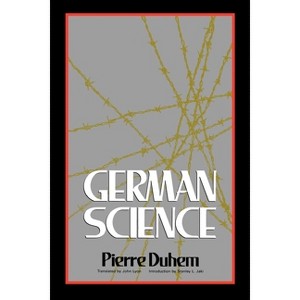
German Science - by  Pierre Duhem (Paperback) - 1 of 1

German Science - by Pierre Duhem (Paperback)

$19.95

In Stock

Free & easy returns

Free & easy returns

Return this item by mail or in store within 90 days for a full refund.
Eligible for registries and wish lists

About this item

Highlights

  • More than any other major twentieth-century writer, Pierre Duhem has been the victim of ill-informed guesswork.
  • Author(s): Pierre Duhem
  • 164 Pages
  • Science, History

Description


About the Book


More than any other major twentieth-century writer, Pierre Duhem has been the victim of ill-informed guesswork. For instance, many references to Duhem stress the importance of his Catholic faith, but nearly all of them draw the obvious -- and entirely erroneous -- conclusions about the role of Catholicism in Duhem's thinking.
Dr. Martin's study of Pierre Duhem's work is the fruit of many years of painstaking research. The author's approach is cautious, yet his conclusions are surprising, and refute many prevailing legends abut Duhem. The real Duhem, however, is even more fascinating than the legendary one.
This book pays particular attention to the political and intellectual context of French Catholicism, wracked as it was by tensions of the Dreyfuss affair and the so-called modernistic crisis. Duhem took his inspiration, not from the papally-sponsored revival of the thought of St. Thomas Aquinas, but from Pascal, a fact that aroused suspicions of skepticism in the minds of conservative Catholics. The tensions between Duhem's work and authoritarian Catholic positions became more explicit as his historical work unfolded.
Most famous for his denial of the possibility of a crucial experiment which could unambiguously decide between contending scientific theories, Duhem has often been interpreted as a mere instrumentalist or conventionalist, denying the meaningfulness of a reality behind the theory. Dr. Martin shows that Duhem was a Pascalian who argued for both logic and intuition as indispensable in approaching the truth.
Duhem argued that physics could not legitimately be used to attack Christianity, but he held that physics was equally useless for the defense of Christianity, a position which made him unpopular with many Catholics.
Duhem is now well-known for his historical work refuting the myth that there was no medieval science. Duhem demonstrated that figures like Leonardo and Galileo were not isolated pioneers; far from being the founder of a new science, they were continuing a tradition of the scientific work that had been developing for centuries. It has been surmised that Duhem was predisposed to rehabilitate medieval science for apologetic motives. Martin shows that Duhem's discovery of medieval science can be dated to within a month, and came as a complete surprise to him, changing the whole course of his work, and introducing an abrupt discontinuity between his earlier and his later preoccupations. Furthermore, Duhem's findings in medieval intellectual history have proved indigestible ever since, to believers and unbelievers alike.


Book Synopsis


More than any other major twentieth-century writer, Pierre Duhem has been the victim of ill-informed guesswork. For instance, many references to Duhem stress the importance of his Catholic faith, but nearly all of them draw the obvious -- and entirely erroneous -- conclusions about the role of Catholicism in Duhem's thinking.

Dr. Martin's study of Pierre Duhem's work is the fruit of many years of painstaking research. The author's approach is cautious, yet his conclusions are surprising, and refute many prevailing legends abut Duhem. The real Duhem, however, is even more fascinating than the legendary one.

This book pays particular attention to the political and intellectual context of French Catholicism, wracked as it was by tensions of the Dreyfuss affair and the so-called modernistic crisis. Duhem took his inspiration, not from the papally-sponsored revival of the thought of St. Thomas Aquinas, but from Pascal, a fact that aroused suspicions of skepticism in the minds of conservative Catholics. The tensions between Duhem's work and authoritarian Catholic positions became more explicit as his historical work unfolded.

Most famous for his denial of the possibility of a crucial experiment which could unambiguously decide between contending scientific theories, Duhem has often been interpreted as a mere instrumentalist or conventionalist, denying the meaningfulness of a reality behind the theory. Dr. Martin shows that Duhem was a Pascalian who argued for both logic and intuition as indispensable in approaching the truth.

Duhem argued that physics could not legitimately be used to attack Christianity, but he held that physics was equally useless for the defense of Christianity, a position which made him unpopular with many Catholics.

Duhem is now well-known for his historical work refuting the myth that there was no medieval science. Duhem demonstrated that figures like Leonardo and Galileo were not isolated pioneers; far from being the founder of a new science, they were continuing a tradition of the scientific work that had been developing for centuries. It has been surmised that Duhem was predisposed to rehabilitate medieval science for apologetic motives. Martin shows that Duhem's discovery of medieval science can be dated to within a month, and came as a complete surprise to him, changing the whole course of his work, and introducing an abrupt discontinuity between his earlier and his later preoccupations. Furthermore, Duhem's findings in medieval intellectual history have proved indigestible ever since, to believers and unbelievers alike.

Dimensions (Overall): 9.14 Inches (H) x 6.12 Inches (W) x .47 Inches (D)
Weight: .57 Pounds
Suggested Age: 22 Years and Up
Number of Pages: 164
Genre: Science
Sub-Genre: History
Publisher: Open Court
Format: Paperback
Author: Pierre Duhem
Language: English
Street Date: May 10, 1991
TCIN: 1011760260
UPC: 9780812691245
Item Number (DPCI): 247-05-8292
Origin: Made in the USA or Imported
If the item details aren’t accurate or complete, we want to know about it.

Shipping details

Estimated ship dimensions: 0.47 inches length x 6.12 inches width x 9.14 inches height
Estimated ship weight: 0.57 pounds
We regret that this item cannot be shipped to PO Boxes.
This item cannot be shipped to the following locations: American Samoa (see also separate entry under AS), Guam (see also separate entry under GU), Northern Mariana Islands, Puerto Rico (see also separate entry under PR), United States Minor Outlying Islands, Virgin Islands, U.S., APO/FPO, Alaska, Hawaii

Return details

This item can be returned to any Target store or Target.com.
This item must be returned within 90 days of the date it was purchased in store, delivered to the guest, delivered by a Shipt shopper, or picked up by the guest.
See the return policy for complete information.

Q: What is the main focus of Dr. Martin's study on Duhem?

submitted by AI Shopping Assistant - 3 days ago
  • A: Dr. Martin's study focuses on refuting misconceptions about Duhem's work and exploring the political and intellectual context of his ideas.

    submitted byAI Shopping Assistant - 3 days ago
    Ai generated

Q: What philosophical stance did Duhem take regarding scientific theories?

submitted by AI Shopping Assistant - 3 days ago
  • A: Duhem denied the possibility of a crucial experiment to decisively choose between competing scientific theories, advocating for both logic and intuition.

    submitted byAI Shopping Assistant - 3 days ago
    Ai generated

Q: What significant historical contributions did Duhem make?

submitted by AI Shopping Assistant - 3 days ago
  • A: Duhem contributed to the understanding of medieval science, demonstrating that it was a continuous tradition rather than an isolated phenomenon.

    submitted byAI Shopping Assistant - 3 days ago
    Ai generated

Q: How does Duhem's faith influence his scientific views?

submitted by AI Shopping Assistant - 3 days ago
  • A: Duhem's Catholic faith influenced his views, but he argued that physics could neither attack nor defend Christianity effectively.

    submitted byAI Shopping Assistant - 3 days ago
    Ai generated

Q: What inspired Duhem's work in science and history?

submitted by AI Shopping Assistant - 3 days ago
  • A: Duhem was inspired by Pascal rather than the revival of St. Thomas Aquinas, which shaped his unique approach to science and history.

    submitted byAI Shopping Assistant - 3 days ago
    Ai generated

Additional product information and recommendations

Discover more options

Get top deals, latest trends, and more.

Privacy policy