Target New ArrivalsGift Ideas for DadClothing, Shoes & AccessoriesHome & DecorKitchen & DiningOutdoor Living & GardenGroceryHousehold EssentialsBabyBeautyPersonal CareSports & OutdoorsHealthWellnessLuggageSchool & Office SuppliesToysElectronicsVideo GamesMovies, Music & BooksParty SuppliesGift IdeasGift CardsPetsUlta Beauty at TargetShop by CommunityTarget OpticalDealsClearanceNew ArrivalsGift Ideas for DadBack to SchoolCollegeTop DealsTarget Circle DealsWeekly AdShop Order PickupShop Same Day DeliveryRegistryRedCardTarget CircleFind Stores
Guide to Numerical Algorithm Design and Development - (Texts in Computer Science) by  George Delic (Hardcover) - 1 of 1

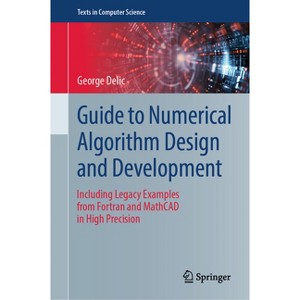
Guide to Numerical Algorithm Design and Development - (Texts in Computer Science) by George Delic (Hardcover)

$84.99

In Stock

Free & easy returns

Free & easy returns

Return this item by mail or in store within 90 days for a full refund.
Eligible for registries and wish lists

About this item

Highlights

  • The focus of this unique textbook/reference is on numerical algorithms that are stable and provide high precision in common numerical problems encountered in large-scale modeling projects.
  • About the Author: Dr. Delic majored in Physics for the B.S. (University of New South Wales) and received a Ph.D. in Theoretical Physics (Australian National University).
  • 243 Pages
  • Computers + Internet, Computer Science
  • Series Name: Texts in Computer Science

Description


Book Synopsis


The focus of this unique textbook/reference is on numerical algorithms that are stable and provide high precision in common numerical problems encountered in large-scale modeling projects.

The techniques presented are based on algorithms developed by the author over six decades of research and publications in peer-reviewed journals. The exposition includes topics typical of numerical analysis courses and is supplemented with examples of algorithms demonstrated in an engineering worksheet that is easy to read and comprehend. Each chapter ends with exercises and programming problems. Additional examples are available as downloadable Fortran code based on the author's large-scale models in computational physics. The limitations of commodity processors and modern compilers is discussed, with advice provided on how to control them in an algorithm's code design. An ample bibliography of over 200 citations provides a guide to further reading.

Topics, features, and emphases:

- Stability: knowing the range of algorithm parameters for producing reliable results

- Accuracy: understanding convergence to a result through quantitative metrics

- Precision: advance knowledge of the expected numerical precision and how to control it

- Efficiency: translating an algorithm into code with limited redundant computation

The primary target audience of this textbook/guide are senior graduate (or postgraduate) students in computer science and scientific or engineering fields who are starting on a career path as the next generation of model developers for high-performance computing (HPC). Additionally, the book will appeal to professionals engaged in large-scale computer model development who could use the volume as a course supplement or reference.

The author is an Honorary Fellow of the University of Wollongong, New South Wales, Australia. He is active as a private consultant in HPC and CEO of HiPERiSM Consulting, LLC, in the United States of America.


From the Back Cover


The focus of this unique textbook/reference is on numerical algorithms that are stable and provide high precision in common numerical problems encountered in large-scale modeling projects.

The techniques presented are based on algorithms developed by the author over six decades of research and publications in peer-reviewed journals. The exposition includes topics typical of numerical analysis courses and is supplemented with examples of algorithms demonstrated in an engineering worksheet that is easy to read and comprehend. Each chapter ends with exercises and programming problems. Additional examples are available as downloadable Fortran code based on the author's large-scale models in computational physics. The limitations of commodity processors and modern compilers is discussed, with advice provided on how to control them in an algorithm's code design. An ample bibliography of over 200 citations provides a guide to further reading.

Topics, features, and emphases:

- Stability: knowing the range of algorithm parameters for producing reliable results

- Accuracy: understanding convergence to a result through quantitative metrics

- Precision: advance knowledge of the expected numerical precision and how to control it

- Efficiency: translating an algorithm into code with limited redundant computation

The primary target audience of this textbook/guide are senior graduate (or postgraduate) students in computer science and scientific or engineering fields who are starting on a career path as the next generation of model developers for high-performance computing (HPC). Additionally, the book will appeal to professionals engaged in large-scale computer model development who could use the volume as a course supplement or reference.

The author is an Honorary Fellow of the University of Wollongong, New South Wales, Australia. He is active as a private consultant in HPC and CEO of HiPERiSM Consulting, LLC, in the United States of America.


About the Author


Dr. Delic majored in Physics for the B.S. (University of New South Wales) and received a Ph.D. in Theoretical Physics (Australian National University). He went on to establish a career in computational physics that spanned work at research and development centers in Europe and the USA. After this a tenured faculty appointment followed with academic duties in service, teaching and research. Dr. Delic's research record of over 50 peer-reviewed publications demonstrates a wide range of interests centered in advanced numerical algorithms for high performance computational platforms. He has more than three decades of programmer/analyst experience on serial, vector, Shared Memory Parallel and Distributed Memory Parallel computer platforms. After arrival in the USA Dr. Delic developed skills (and a training program) in vector Supercomputing and published research on Supercomputer work-load performance. He then entered into Government contracting where he acted as a Key Appointment in establishing the U.S. EPA Scientific Customer Support group at the EPA's Supercomputer Center. During this tenure Dr. Delic acted as project lead in software development, conducted outreach/training at customer sites, and organized/edited technical conferences/proceedings on Supercomputing and high performance algorithms for environmental models. Dr. Delic has applied his extensive experience in Government contracting to establish a consultancy (HiPERiSM Consulting, LLC) that specializes in technology transfer to enhance programmer skill levels in OpenMP, MPI and hybrid OpenMP+MPI programming. Specialized courses have sensitized stake-holders in legacy codes to the need for code and performance portability across current and future computer architectures. The importance of software tools and the programming environment as a whole have been major components of the consultancy. Dr. Delic's current interests include, evaluation of compiler performance, portability across parallel computer architectures, and hybrid programming models that match trends in clustered parallel computing.

Dimensions (Overall): 8.9 Inches (H) x 6.2 Inches (W) x .9 Inches (D)
Weight: 1.15 Pounds
Suggested Age: 22 Years and Up
Number of Pages: 243
Genre: Computers + Internet
Sub-Genre: Computer Science
Series Title: Texts in Computer Science
Publisher: Springer
Format: Hardcover
Author: George Delic
Language: English
Street Date: October 28, 2025
TCIN: 1011913735
UPC: 9783031901775
Item Number (DPCI): 247-42-4406
Origin: Made in the USA or Imported
If the item details aren’t accurate or complete, we want to know about it.

Shipping details

Estimated ship dimensions: 0.9 inches length x 6.2 inches width x 8.9 inches height
Estimated ship weight: 1.15 pounds
We regret that this item cannot be shipped to PO Boxes.
This item cannot be shipped to the following locations: American Samoa (see also separate entry under AS), Guam (see also separate entry under GU), Northern Mariana Islands, Puerto Rico (see also separate entry under PR), United States Minor Outlying Islands, Virgin Islands, U.S., APO/FPO, Alaska, Hawaii

Return details

This item can be returned to any Target store or Target.com.
This item must be returned within 90 days of the date it was purchased in store, delivered to the guest, delivered by a Shipt shopper, or picked up by the guest.
See the return policy for complete information.

Q: What topics are covered in the exercises at the end of each chapter?

submitted by AI Shopping Assistant - 2 days ago
  • A: Each chapter concludes with exercises and programming problems related to numerical algorithms and their applications.

    submitted byAI Shopping Assistant - 2 days ago
    Ai generated

Q: What programming language examples are provided in the book?

submitted by AI Shopping Assistant - 2 days ago
  • A: The book includes downloadable Fortran code examples based on the author's large-scale models in computational physics.

    submitted byAI Shopping Assistant - 2 days ago
    Ai generated

Q: What is the main focus of this textbook?

submitted by AI Shopping Assistant - 2 days ago
  • A: The textbook focuses on stable numerical algorithms that provide high precision for large-scale modeling projects.

    submitted byAI Shopping Assistant - 2 days ago
    Ai generated

Q: Who is the target audience for this book?

submitted by AI Shopping Assistant - 2 days ago
  • A: The primary audience includes senior graduate students and professionals in computer science and engineering fields.

    submitted byAI Shopping Assistant - 2 days ago
    Ai generated

Q: What experience does the author have in computational physics?

submitted by AI Shopping Assistant - 2 days ago
  • A: The author has over three decades of experience in computational physics, including work in research and development centers.

    submitted byAI Shopping Assistant - 2 days ago
    Ai generated

Additional product information and recommendations

Discover more options

Get top deals, latest trends, and more.

Privacy policy