Target New ArrivalsFourth of JulyGift Ideas for DadClothing, Shoes & AccessoriesHome & DecorKitchen & DiningOutdoor Living & GardenGroceryHousehold EssentialsBabyBeautyPersonal CareSports & OutdoorsHealthWellnessLuggageSchool & Office SuppliesToys & GamesElectronicsVideo GamesMovies, Music & BooksParty SuppliesGift IdeasGift CardsPetsUlta Beauty at TargetShop by CommunityTarget OpticalDealsClearanceNew ArrivalsGift Ideas for DadBack to SchoolCollegeTop DealsTarget Circle DealsWeekly AdShop Order PickupShop Same Day DeliveryRegistryRedCardTarget CircleFind Stores
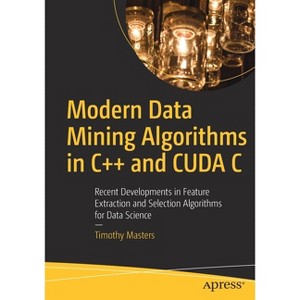
Modern Data Mining Algorithms in C++ and Cuda C - by  Timothy Masters (Paperback) - 1 of 1

Modern Data Mining Algorithms in C++ and Cuda C - by Timothy Masters (Paperback)

$50.82Save $19.17 (27% off)

In Stock

Free & easy returns

Free & easy returns

Return this item by mail or in store within 90 days for a full refund.
Eligible for registries and wish lists

About this item

Highlights

  • Discover a variety of data-mining algorithms that are useful for selecting small sets of important features from among unwieldy masses of candidates, or extracting useful features from measured variables.
  • About the Author: Timothy Masters has a PhD in statistics and is an experienced programmer.
  • 228 Pages
  • Computers + Internet,

Description


Book Synopsis


Discover a variety of data-mining algorithms that are useful for selecting small sets of important features from among unwieldy masses of candidates, or extracting useful features from measured variables.

As a serious data miner you will often be faced with thousands of candidate features for your prediction or classification application, with most of the features being of little or no value. You'll know that many of these features may be useful only in combination with certain other features while being practically worthless alone or in combination with most others. Some features may have enormous predictive power, but only within a small, specialized area of the feature space. The problems that plague modern data miners are endless. This book helps you solve this problem by presenting modern feature selection techniques and the code to implement them. Some of these techniques are:

  • Forward selection component analysis
  • Local feature selection
  • Linking features and a target with a hidden Markov model
  • Improvements on traditional stepwise selection
  • Nominal-to-ordinal conversion

All algorithms are intuitively justified and supported by the relevant equations and explanatory material. The author also presents and explains complete, highly commented source code.

The example code is in C++ and CUDA C but Python or other code can be substituted; the algorithm is important, not the code that's used to write it.

What You Will Learn

  • Combine principal component analysis with forward and backward stepwise selection to identify a compact subset of a large collection of variables that captures the maximum possible variation within the entire set.
  • Identify features that may have predictive power over only a small subset of the feature domain. Such features can be profitably used by modern predictive models but may be missed by other feature selection methods.
  • Find an underlying hidden Markov model that controls the distributions of feature variables and the target simultaneously. The memory inherent in this method is especially valuable in high-noise applications such as prediction of financial markets.
  • Improve traditional stepwise selection in three ways: examine a collection of 'best-so-far' feature sets; test candidate features for inclusion with cross validation to automatically and effectively limit model complexity; and at each step estimate the probability that our results so far could be just the product of random good luck. We also estimate the probability that the improvement obtained by adding a new variable could have been just good luck. Take a potentially valuable nominal variable (a category or class membership) that is unsuitable for input to a prediction model, and assign to each category a sensible numeric value that can be used as a model input.

Who This Book Is For

Intermediate to advanced data science programmers and analysts.


From the Back Cover


As a serious data miner you will often be faced with thousands of candidate features for your prediction or classification application, with most of the features being of little or no value. You'll know that many of these features may be useful only in combination with certain other features while being practically worthless alone or in combination with most others. Some features may have enormous predictive power, but only within a small, specialized area of the feature space. The problems that plague modern data miners are endless. This book helps you solve this problem by presenting modern feature selection techniques and the code to implement them. Some of these techniques are:

    Forward selection component analysis
  • Local feature selection
  • Linking features and a target with a hidden Markov model
  • Improvements on traditional stepwise selection
  • Nominal-to-ordinal conversion
All algorithms are intuitively justified and supported by the relevant equations and explanatory material. The author also presents and explains complete, highly commented source code.

The example code is in C++ and CUDA C but Python or other code can be substituted; the algorithm is important, not the code that's used to write it.

You will:

  • Combine principal component analysis with forward and backward stepwise selection to identify a compact subset of a large collection of variables that captures the maximum possible variation within the entire set.
  • Identify features that may have predictive power over only a small subset of the feature domain. Such features can be profitably used by modern predictive models but may be missed by other feature selection methods.
  • Find an underlying hidden Markov model that controls the distributions of feature variables and the target simultaneously. The memory inherent in this method is especially valuable in high-noise applications such as predictionof financial markets.
  • Improve traditional stepwise selection in three ways: examine a collection of 'best-so-far' feature sets; test candidate features for inclusion with cross validation to automatically and effectively limit model complexity; and at each step estimate the probability that our results so far could be just the product of random good luck. We also estimate the probability that the improvement obtained by adding a new variable could have been just good luck.
  • Take a potentially valuable nominal variable (a category or class membership) that is unsuitable for input to a prediction model, and assign to each category a sensible numeric value that can be used as a model input.


  • Review Quotes


    "This is an excellent book directed toward those who are already working in data mining." (Anthony J. Duben, Computing Reviews, May 5, 2021)


    About the Author


    Timothy Masters has a PhD in statistics and is an experienced programmer. His dissertation was in image analysis. His career moved in the direction of signal processing, and for the last 25 years he's been involved in the development of automated trading systems in various financial markets.

    Dimensions (Overall): 10.0 Inches (H) x 7.0 Inches (W) x .51 Inches (D)
    Weight: .93 Pounds
    Suggested Age: 22 Years and Up
    Number of Pages: 228
    Genre: Computers + Internet
    Publisher: Apress
    Format: Paperback
    Author: Timothy Masters
    Language: English
    Street Date: June 6, 2020
    TCIN: 1008783563
    UPC: 9781484259870
    Item Number (DPCI): 247-26-0897
    Origin: Made in the USA or Imported
    If the item details aren’t accurate or complete, we want to know about it.

    Shipping details

    Estimated ship dimensions: 0.51 inches length x 7 inches width x 10 inches height
    Estimated ship weight: 0.93 pounds
    We regret that this item cannot be shipped to PO Boxes.
    This item cannot be shipped to the following locations: American Samoa (see also separate entry under AS), Guam (see also separate entry under GU), Northern Mariana Islands, Puerto Rico (see also separate entry under PR), United States Minor Outlying Islands, Virgin Islands, U.S., APO/FPO, Alaska, Hawaii

    Return details

    This item can be returned to any Target store or Target.com.
    This item must be returned within 90 days of the date it was purchased in store, delivered to the guest, delivered by a Shipt shopper, or picked up by the guest.
    See the return policy for complete information.

    Q: What background does the author have?

    submitted by AI Shopping Assistant - 7 days ago
    • A: The author, Timothy Masters, holds a PhD in statistics and has extensive experience in programming and data mining.

      submitted byAI Shopping Assistant - 7 days ago
      Ai generated

    Q: Who is the target audience for this book?

    submitted by AI Shopping Assistant - 7 days ago
    • A: This book is aimed at intermediate to advanced data science programmers and analysts.

      submitted byAI Shopping Assistant - 7 days ago
      Ai generated

    Q: What algorithms are covered in this book?

    submitted by AI Shopping Assistant - 7 days ago
    • A: The book covers various data-mining algorithms, including forward selection, local feature selection, and hidden Markov models.

      submitted byAI Shopping Assistant - 7 days ago
      Ai generated

    Q: What programming languages are used in the example code?

    submitted by AI Shopping Assistant - 7 days ago
    • A: The example code is primarily in C++ and CUDA C, but can be adapted to Python or other languages.

      submitted byAI Shopping Assistant - 7 days ago
      Ai generated

    Q: What is the main focus of the book?

    submitted by AI Shopping Assistant - 7 days ago
    • A: The book focuses on modern feature selection techniques to improve predictive modeling in data mining.

      submitted byAI Shopping Assistant - 7 days ago
      Ai generated

    Additional product information and recommendations

    Discover more options

    Frequently bought together

    Best-selling Computers & Technology Books

    Get top deals, latest trends, and more.

    Privacy policy