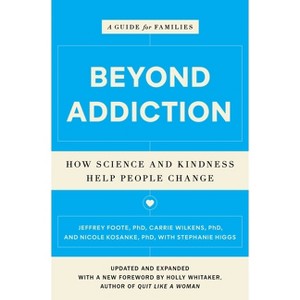
Beyond Addiction - by Jeffrey Foote & Carrie Wilkens & Nicole Kosanke & Stephanie Higgs (Paperback)
$11.19Save $8.80 (44% off)
In Stock

Free & easy returns
Return this item by mail or in store within 90 days for a full refund.
Eligible for registries and wish lists
About this item
Additional product information and recommendations
Discover more options
- $15.39 - $17.00MSRP $20.99 - $29.99
- $9.89 - $16.23MSRP $10.99 - $28.99
- $10.48MSRP $18.99
- $16.69MSRP $30.00
- $7.80 - $18.10MSRP $10.99 - $28.995 out of 5 stars with 1 ratings
- $28.96MSRP $30.00
- $16.75MSRP $30.00
- $18.07MSRP $19.99
- $14.13MSRP $16.99
- $17.37 - $22.49MSRP $22.00 - $31.00
- $20.99 - $25.74MSRP $20.00 - $30.005 out of 5 stars with 1 ratings
- $20.97 - $21.49MSRP $21.00 - $31.00
- $17.05 - $17.99MSRP $18.00 - $26.99
- $16.98 - $18.14MSRP $20.00 - $32.00
- $13.00 - $17.49MSRP $19.99 - $28.99
- $18.00 - $18.74MSRP $18.00 - $27.99 Lower price on select items










Frequently bought together
- $17.57MSRP $20.99
- $12.89MSRP $19.00
- $23.99MSRP $29.95
- $10.48MSRP $18.99
- $8.60 - $16.14MSRP $9.99 - $18.99
- $7.50MSRP $12.95
- $10.58MSRP $18.99
- $8.38MSRP $9.99





Guests also viewed
- $14.43was $16.98 New lower price
- $16.89MSRP $20.00
- $14.69 - $15.99MSRP $19.99 - $27.994.8 out of 5 stars with 54 ratings
- $12.34MSRP $19.99
- $20.30MSRP $29.00
- $24.00MSRP $29.99
- $18.99 - $21.24MSRP $19.99 - $27.99 Lower price on select items5 out of 5 stars with 1 ratings
- $16.10MSRP $20.00
- $10.99MSRP $18.00
- $13.76MSRP $19.00
- $14.49MSRP $22.99

Related Categories
5.0 out of 5 stars with 3 reviews
100% would recommend
1 recommendations
5 out of 5 stars
Thumbs up graphic, would recommend
17 March, 2022
Not another preachy book that tells you to "get tough" with your loved one.
This is an awesome book! I’m in long term recovery from addiction and am now finishing my first year in a Master’s program in Addictions Counseling. I am always looking for more helping strategies. I also have a close family member struggling with addiction right now, so I like the focus on supporting a friend or family member. This book IS more for a support person than the person struggling with addiction. I found it helpful for honing my personal recovery skills, but if I was just beginning to seek help for an active addiction, or had newly quit, I think I would want something more focused on my personal experience. This is perfect for anyone with a friend or loved one they would like to help, or someone who works with people and encounters people struggling with addiction, such as counselors, advocates, criminal justice workers, teachers, human service workers, etc. You do not need any special training to follow this book. It is accessible for laypeople. I really loved this book! If these ideas had been around when I went through treatment, I think I would have had a less scary and stigmatizing experience. Because I did find treatment scary and mortifying, though, I have never liked labels. I don’t call people “addicts,” but use person-first language (eg. “person struggling with an addiction”). I’m so excited that this book states, “Labels aren’t necessary.” It introduces new ideas about allowing people to set their own goals for change and using respect and kindness, rather than the confrontations and tough love in traditional treatment approaches. I believe that it does increase motivation to have more patient involvement in their care, and less coercive control. This book is not the melodramatic, black and white approach where anything besides 100% abstinence is failure, where you have to hit rock bottom, where you need to admit that you have a terminal disease that you can’t cure but can possibly put on hold, and you are full of character defects (as in the AA/NA trope). It reframes addiction as a behavior, like many others, which you can work to change. You can be helped, and help yourself, at any time. There are multiple possible goals, and multiple possible strategies to meet your goals. The idea is to keep the person with the problem motivated to find a solution. There are exercises for reflection and approaching behavior change (and life) as an ongoing experiment. There is no preaching, no labeling family members, “enablers.” Just real tools to help in positive ways! The main thing is that people are allowed to keep their respect, dignity, and autonomy in the process of behavior change. This is one of the first approaches to addiction that follows the Hippocratic oath, “first do no harm.” If you want to preserve your friendships and relationships, while helping someone with the difficult task of beating an addiction, this book is for you!