Target New ArrivalsGift Ideas for DadClothing, Shoes & AccessoriesHome & DecorKitchen & DiningOutdoor Living & GardenGroceryHousehold EssentialsBabyBeautyPersonal CareSports & OutdoorsHealthWellnessLuggageSchool & Office SuppliesToysElectronicsVideo GamesMovies, Music & BooksParty SuppliesGift IdeasGift CardsPetsUlta Beauty at TargetShop by CommunityTarget OpticalDealsClearanceNew ArrivalsGift Ideas for DadBack to SchoolCollegeTop DealsTarget Circle DealsWeekly AdShop Order PickupShop Same Day DeliveryRegistryRedCardTarget CircleFind Stores
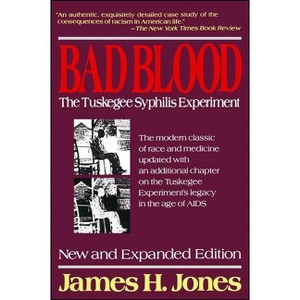
Bad Blood - by  James H Jones (Paperback) - 1 of 1

Bad Blood - by James H Jones (Paperback)

$15.33Save $4.66 (23% off)

In Stock

Free & easy returns

Free & easy returns

Return this item by mail or in store within 90 days for a full refund.
Eligible for registries and wish lists

About this item

Highlights

  • From 1932 to 1972, the United States Public Health Service conducted a non-therapeutic experiment involving over 400 black male sharecroppers infected with syphilis.
  • About the Author: James H. Jones is associate professor of history at the University of Houston.
  • 336 Pages
  • Social Science, Ethnic Studies

Description


Book Synopsis


From 1932 to 1972, the United States Public Health Service conducted a non-therapeutic experiment involving over 400 black male sharecroppers infected with syphilis. The Tuskegee Study had nothing to do with treatment. Its purpose was to trace the spontaneous evolution of the disease in order to learn how syphilis affected black subjects.

From 1932 to 1972, the United States Public Health Service conducted a non-therapeutic experiment involving over 400 black male sharecroppers infected with syphilis. The Tuskegee Study had nothing to do with treatment. Its purpose was to trace the spontaneous evolution of the disease in order to learn how syphilis affected black subjects.

The men were not told they had syphilis; they were not warned about what the disease might do to them; and, with the exception of a smattering of medication during the first few months, they were not given health care. Instead of the powerful drugs they required, they were given aspirin for their aches and pains. Health officials systematically deceived the men into believing they were patients in a government study of "bad blood", a catch-all phrase black sharecroppers used to describe a host of illnesses. At the end of this 40 year deathwatch, more than 100 men had died from syphilis or related complications.

"Bad Blood" provides compelling answers to the question of how such a tragedy could have been allowed to occur. Tracing the evolution of medical ethics and the nature of decision making in bureaucracies, Jones attempted to show that the Tuskegee Study was not, in fact, an aberration, but a logical outgrowth of race relations and medical practice in the United States.

Now, in this revised edition of "Bad Blood", Jones traces the tragic consequences of the Tuskegee Study over the last decade. A new introduction explains why the Tuskegee Study has become a symbol of black oppression and a metaphor for medical neglect, inspiring a prize-winning play, a Nova special, and a motion picture. A new concluding chapter shows how the black community's wide-spread anger and distrust caused by the Tuskegee Study has hampered efforts by health officials to combat AIDS in the black community. "Bad Blood" was nominated for the Pulitzer Prize and was one of the "N.Y. Times" 12 best books of the year.


Review Quotes


The New York Times Book Review As an authentic, exquisitely detailed case study of the consequences of racism in American life, this book should be read by everyone who worries about the racial meanings of government policy and social practice in the United States.


About the Author


James H. Jones is associate professor of history at the University of Houston. He lives in Houston, Texas. He received his Ph.D. in history from Indiana University and has held a Kennedy Fellowship in Bioethics at Harvard University, served as a senior research fellow at the Kennedy Institute of Ethics at Georgetown University, and recently held senior fellowships from both the National Endowment for the Humanities and the Rockefeller Foundation. He published the first edition of Bad Blood in 1981 to critical acclaim. It was a Main Selection of the History Book Club and a New York Times Best Books of 1981 and has inspired a play, a PBS Nova special, and a motion picture.
Dimensions (Overall): 9.24 Inches (H) x 6.28 Inches (W) x .84 Inches (D)
Weight: .85 Pounds
Suggested Age: 22 Years and Up
Number of Pages: 336
Genre: Social Science
Sub-Genre: Ethnic Studies
Publisher: Free Press
Format: Paperback
Author: James H Jones
Language: English
Street Date: December 5, 1992
TCIN: 86443486
UPC: 9780029166765
Item Number (DPCI): 247-36-2632
Origin: Made in the USA or Imported
If the item details aren’t accurate or complete, we want to know about it.

Shipping details

Estimated ship dimensions: 0.84 inches length x 6.28 inches width x 9.24 inches height
Estimated ship weight: 0.85 pounds
We regret that this item cannot be shipped to PO Boxes.
This item cannot be shipped to the following locations: American Samoa (see also separate entry under AS), Guam (see also separate entry under GU), Northern Mariana Islands, Puerto Rico (see also separate entry under PR), United States Minor Outlying Islands, Virgin Islands, U.S., APO/FPO, Alaska, Hawaii

Return details

This item can be returned to any Target store or Target.com.
This item must be returned within 90 days of the date it was purchased in store, delivered to the guest, delivered by a Shipt shopper, or picked up by the guest.
See the return policy for complete information.

Q: What themes are explored in Bad Blood?

submitted by AI Shopping Assistant - 12 days ago
  • A: The book explores themes of race relations, medical ethics, and the consequences of systemic racism in healthcare.

    submitted byAI Shopping Assistant - 12 days ago
    Ai generated

Q: What significant historical event does the book discuss?

submitted by AI Shopping Assistant - 12 days ago
  • A: It discusses the Tuskegee Study, which lasted from 1932 to 1972 and involved unethical medical practices.

    submitted byAI Shopping Assistant - 12 days ago
    Ai generated

Q: Who is the author of this book?

submitted by AI Shopping Assistant - 12 days ago
  • A: The author is James H. Jones, an associate professor of history at the University of Houston.

    submitted byAI Shopping Assistant - 12 days ago
    Ai generated

Q: What impact did the Tuskegee Study have on the black community?

submitted by AI Shopping Assistant - 12 days ago
  • A: The study fostered widespread anger and distrust, complicating public health efforts, particularly in combating AIDS.

    submitted byAI Shopping Assistant - 12 days ago
    Ai generated

Q: What is the main focus of the book?

submitted by AI Shopping Assistant - 12 days ago
  • A: The book examines the Tuskegee Study, a non-therapeutic experiment on black male sharecroppers infected with syphilis.

    submitted byAI Shopping Assistant - 12 days ago
    Ai generated

Additional product information and recommendations

Discover more options

Get top deals, latest trends, and more.

Privacy policy