Target New ArrivalsGift Ideas for DadClothing, Shoes & AccessoriesHome & DecorKitchen & DiningOutdoor Living & GardenGroceryHousehold EssentialsBabyBeautyPersonal CareSports & OutdoorsHealthWellnessLuggageSchool & Office SuppliesToysElectronicsVideo GamesMovies, Music & BooksParty SuppliesGift IdeasGift CardsPetsUlta Beauty at TargetShop by CommunityTarget OpticalDealsClearanceNew ArrivalsGift Ideas for DadBack to SchoolCollegeTop DealsTarget Circle DealsWeekly AdShop Order PickupShop Same Day DeliveryRegistryRedCardTarget CircleFind Stores
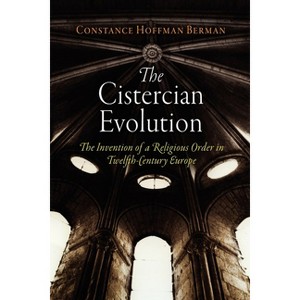
The Cistercian Evolution - (Middle Ages) by  Constance Hoffman Berman (Paperback) - 1 of 1

The Cistercian Evolution - (Middle Ages) by Constance Hoffman Berman (Paperback)

$39.95

In Stock

Free & easy returns

Free & easy returns

Return this item by mail or in store within 90 days for a full refund.
Eligible for registries and wish lists

About this item

Highlights

  • According to the received history, the Cistercian order was founded in Cîteaux, France, in 1098 by a group of Benedictine monks who wished for a stricter community.
  • About the Author: Constance Hoffman Berman is Professor of History at the University of Iowa.
  • 408 Pages
  • Religion + Beliefs, Institutions & Organizations
  • Series Name: Middle Ages

Description


About the Book


Reveals the true story behind the growth of the Cistercian order.


Book Synopsis


According to the received history, the Cistercian order was founded in Cîteaux, France, in 1098 by a group of Benedictine monks who wished for a stricter community. They sought a monastic life that called for extreme asceticism, rejection of feudal revenues, and manual labor for monks. Their third leader, Stephen Harding, issued a constitution, the Carta Caritatis, that called for the uniformity of custom in all Cistercian monasteries and the establishment of an annual general chapter meeting at Cîteaux.

The Cistercian order grew phenomenally in the mid-twelfth century, reaching beyond France to Portugal in the west, Sweden in the north, and the eastern Mediterranean, ostensibly through a process of apostolic gestation, whereby members of a motherhouse would go forth to establish a new house. The abbey at Clairvaux, founded by Bernard in 1115, was alone responsible for founding 68 of the 338 Cistercian abbeys in existence by 1153. But this well-established view of a centrally organized order whose founders envisioned the shape and form of a religious order at its prime is not borne out in the historical record.

Through an investigation of early Cistercian documents, Constance Hoffman Berman proves that no reliable reference to Stephen's Carta Caritatis appears before the mid-twelfth century, and that the document is more likely to date from 1165 than from 1119. The implications of this fact are profound. Instead of being a charter by which more than 300 Cistercian houses were set up by a central authority, the document becomes a means of bringing under centralized administrative control a large number of loosely affiliated and already existing monastic houses of monks as well as nuns who shared Cistercian customs. The likely reason for this administrative structuring was to check the influence of the overdominant house of Clairvaux, which threatened the authority of Cîteaux through Bernard's highly successful creation of new monastic communities.

For centuries the growth of the Cistercian order has been presented as a spontaneous spirituality that swept western Europe through the power of the first house at Cîteaux. Berman suggests instead that the creation of the religious order was a collaborative activity, less driven by centralized institutions; its formation was intended to solve practical problems about monastic administration. With the publication of The Cistercian Evolution, for the first time the mechanisms are revealed by which the monks of Cîteaux reshaped fact to build and administer one of the most powerful and influential religious orders of the Middle Ages.


Review Quotes


"[Berman's] book changes our understanding of the early Cistercians. It will shape our research for some time to come. Berman's questioning of Cistercian documents, her new picture of Cistercian growth, her warnings about reading thirteenth-century administrative structures and ideas back on to the twelfth, and especially, her insistence that we consider houses of both men and women, make this book an important contribution to the history of religious institutions in the central Middle Ages."-- "Catholic Historical Review"

"A significant contribution to the study of the history of monasticism in the twelfth century."-- "EHR"

"An extremely important book, one that will redefine the ways we conceive of medieval religiosity and politics."-- "Virginia Quarterly Review"

"An important and provocative book: important because it challenges scholars to rethink a central medieval theme, the creation and expansion of the Cistercian order in twelfth-century Europe; provocative because it brazenly upends received narratives, two generations of accumulated monastic scholarship."-- "Speculum"

"Stimulating, controversial, and compelling, Constance Berman's major revisions of early Cistercian history, The Cistercian Evolution, should be read by historians of monasticism and will greatly interest scholars in the institutional and religious history of the twelfth century as well as those who study the experience of women in that period."-- "The Medieval Review"

"This important work builds on and continues Berman's solid, indeed splendid, scholarship on the institutional history of the Cistercians in southern France. She explores and rejects much traditional thinking in fields as diverse as the supposed uniformity of Cistercian architecture and the propagation of the order through colonization or 'apostolic foundation, ' pointing out that much Cistercian expansion was by incorporation of existing communities."-- "Church History"


About the Author


Constance Hoffman Berman is Professor of History at the University of Iowa.
Dimensions (Overall): 9.0 Inches (H) x 6.0 Inches (W) x 1.1 Inches (D)
Weight: 1.35 Pounds
Suggested Age: 22 Years and Up
Number of Pages: 408
Genre: Religion + Beliefs
Sub-Genre: Institutions & Organizations
Series Title: Middle Ages
Publisher: University of Pennsylvania Press
Format: Paperback
Author: Constance Hoffman Berman
Language: English
Street Date: March 23, 2010
TCIN: 1011331783
UPC: 9780812221022
Item Number (DPCI): 247-09-8797
Origin: Made in the USA or Imported
If the item details aren’t accurate or complete, we want to know about it.

Shipping details

Estimated ship dimensions: 1.1 inches length x 6 inches width x 9 inches height
Estimated ship weight: 1.35 pounds
We regret that this item cannot be shipped to PO Boxes.
This item cannot be shipped to the following locations: American Samoa (see also separate entry under AS), Guam (see also separate entry under GU), Northern Mariana Islands, Puerto Rico (see also separate entry under PR), United States Minor Outlying Islands, Virgin Islands, U.S., APO/FPO, Alaska, Hawaii

Return details

This item can be returned to any Target store or Target.com.
This item must be returned within 90 days of the date it was purchased in store, delivered to the guest, delivered by a Shipt shopper, or picked up by the guest.
See the return policy for complete information.

Q: Who is the author of this book?

submitted by AI Shopping Assistant - 9 days ago
  • A: The author is Constance Hoffman Berman, a Professor of History at the University of Iowa.

    submitted byAI Shopping Assistant - 9 days ago
    Ai generated

Q: What time period does the book cover?

submitted by AI Shopping Assistant - 9 days ago
  • A: The book covers the history of the Cistercian order during the Middle Ages, particularly the twelfth century.

    submitted byAI Shopping Assistant - 9 days ago
    Ai generated

Q: What is the main focus of the book?

submitted by AI Shopping Assistant - 9 days ago
  • A: The book explores the true story behind the growth and administration of the Cistercian order during the Middle Ages.

    submitted byAI Shopping Assistant - 9 days ago
    Ai generated

Q: What does the book reveal about Cistercian expansion?

submitted by AI Shopping Assistant - 9 days ago
  • A: It reveals that Cistercian expansion was more about incorporating existing communities than a centrally organized effort.

    submitted byAI Shopping Assistant - 9 days ago
    Ai generated

Q: What significant document is discussed in the book?

submitted by AI Shopping Assistant - 9 days ago
  • A: The book discusses the Carta Caritatis, which is central to understanding Cistercian monastic administration.

    submitted byAI Shopping Assistant - 9 days ago
    Ai generated

Additional product information and recommendations

Discover more options

Get top deals, latest trends, and more.

Privacy policy