Target New ArrivalsFourth of JulyBack to SchoolCollegeClothing, Shoes & AccessoriesHome & DecorKitchen & DiningOutdoor Living & GardenGroceryHousehold EssentialsBabyBeautyPersonal CareSports & OutdoorsHealthWellnessSchool & Office SuppliesToys & GamesElectronicsVideo GamesMovies, Music & BooksParty SuppliesGift IdeasGift CardsPetsUlta Beauty at TargetShop by CommunityTarget OpticalDealsClearanceNew ArrivalsBack to SchoolCollegeTop DealsTarget Circle DealsWeekly AdShop Order PickupShop Same Day DeliveryRegistryRedCardTarget CircleFind Stores
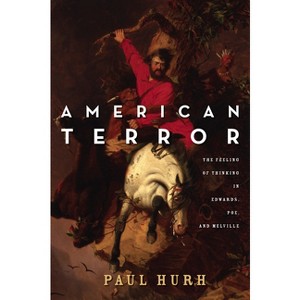
American Terror - by  Paul Hurh (Paperback) - 1 of 1

American Terror - by Paul Hurh (Paperback)

$32.49

In Stock

Free & easy returns
Free & easy returns
Return this item by mail or in store within 90 days for a full refund.
Eligible for registries and wish lists

About this item

Highlights

  • If America is a nation founded upon Enlightenment ideals, then why are so many of its most celebrated pieces of literature so dark?
  • About the Author: Paul Hurh is Associate Professor of English at the University of Arizona.
  • 312 Pages
  • Literary Criticism, American

Description


About the Book


Contrary to accounts that interpret terror in opposition to reason, this book shows how three authors famous for their works and theories of terror--Jonathan Edwards, Edgar Allan Poe, and Herman Melville--developed a terror that incorporates, theorizes, and extends the Enlightenment claims of reason as feeling.


Book Synopsis


If America is a nation founded upon Enlightenment ideals, then why are so many of its most celebrated pieces of literature so dark? American Terror returns to the question of American literature's distinctive tone of terror through a close study of three authors--Jonathan Edwards, Edgar Allan Poe, and Herman Melville--who not only wrote works of terror, but who defended, theorized, and championed it.

Combining updated historical perspectives with close reading, Paul Hurh shows how these authors developed terror as a special literary affect informed by the way the concept of thinking becomes, in the wake of Enlightenment empiricism, increasingly defined by a set of austere mechanic processes, such as the scientific method and the algebraic functions of analytical logic. Rather than trying to find a feeling that would transcend thinking by subtending reason to emotion, these writers found in terror the feeling of thinking, the peculiar feeling of reason's authority over emotional schemes. In so doing, they grappled with a shared set of enduring questions: What is the difference between thinking and feeling? Why does it seem impossible to reason oneself out of an irrational fear? And what becomes of the freedom of the will when we discover that affects can push it around?


Review Quotes


"American Terror is easily one of the most exciting works of Americanist criticism I have read in a long while. It is a strikingly original piece of scholarship; argued with great rigor, care, and verve; as attentive to its texts' literary dimensions as to their epistemological ones; and able in a way that very few studies are to explicate the ways in which these intertwine."--Jennifer Fleissner "Indiana University"

"Hurh asks why terror so often accompanies the philosophical provocations of Edwards, Poe, and Melville. His compelling answer is that their obsessions with method (thinking about thinking) not only reveal the limitations and unresolvable contradictions of reason in terrifying ways, but more importantly show the affect of terror to be constitutive of knowledge-seeking itself."--Maurice Lee "Boston University"

"Hurh makes a case for American literature's vibrant contribution to post-Enlightenment philosophy, even going so far as to locate the seeds of post-structural thought in the terrors of, for example, Poe's representation of the trapped and fractured self. There is both excitement and terror here in the dawning realization that he is right."--Kevin Corstorphine "Journal of American Studies"

"In this fascinating study, Hurh explores the philosophical and historical foundations of the 'distinctive tone of terror' in the work of Jonathan Edwards, Edgar Allan Poe, and Herman Melville . . . The book is meticulously researched, and Hurh displays a wide-ranging knowledge of history, philosophy, and literary theory. Advanced readers will appreciate Hurh's attention to detail and his ability to convey complicated ideas in a straightforward manner . . . Highly recommended."--J. W. Miller "CHOICE"


About the Author


Paul Hurh is Associate Professor of English at the University of Arizona.
Dimensions (Overall): 8.9 Inches (H) x 6.0 Inches (W) x .8 Inches (D)
Weight: .95 Pounds
Suggested Age: 22 Years and Up
Number of Pages: 312
Genre: Literary Criticism
Sub-Genre: American
Publisher: Stanford University Press
Theme: General
Format: Paperback
Author: Paul Hurh
Language: English
Street Date: December 12, 2017
TCIN: 1011235944
UPC: 9781503604186
Item Number (DPCI): 247-20-1328
Origin: Made in the USA or Imported
If the item details aren’t accurate or complete, we want to know about it.

Shipping details

Estimated ship dimensions: 0.8 inches length x 6 inches width x 8.9 inches height
Estimated ship weight: 0.95 pounds
We regret that this item cannot be shipped to PO Boxes.
This item cannot be shipped to the following locations: American Samoa (see also separate entry under AS), Guam (see also separate entry under GU), Northern Mariana Islands, Puerto Rico (see also separate entry under PR), United States Minor Outlying Islands, Virgin Islands, U.S., APO/FPO, Alaska, Hawaii

Return details

This item can be returned to any Target store or Target.com.
This item must be returned within 90 days of the date it was purchased in store, delivered to the guest, delivered by a Shipt shopper, or picked up by the guest.
See the return policy for complete information.

Q: What is the author's academic background?

submitted by AI Shopping Assistant - 8 days ago
  • A: Paul Hurh is an Associate Professor of English at the University of Arizona.

    submitted byAI Shopping Assistant - 8 days ago
    Ai generated

Q: What is the primary focus of the literary criticism?

submitted by AI Shopping Assistant - 8 days ago
  • A: The primary focus is on how terror is represented and theorized in American literature post-Enlightenment.

    submitted byAI Shopping Assistant - 8 days ago
    Ai generated

Q: What themes are explored in this book?

submitted by AI Shopping Assistant - 8 days ago
  • A: The book explores themes of terror, reason, and the relationship between thinking and feeling in American literature.

    submitted byAI Shopping Assistant - 8 days ago
    Ai generated

Q: Who are the main authors discussed in the book?

submitted by AI Shopping Assistant - 8 days ago
  • A: The main authors discussed are Jonathan Edwards, Edgar Allan Poe, and Herman Melville.

    submitted byAI Shopping Assistant - 8 days ago
    Ai generated

Q: How does the book relate terror to Enlightenment ideals?

submitted by AI Shopping Assistant - 8 days ago
  • A: It examines how terror in literature reflects and challenges Enlightenment ideals of reason and emotion.

    submitted byAI Shopping Assistant - 8 days ago
    Ai generated

Additional product information and recommendations

Discover more options

Best-selling Paperback Books

Get top deals, latest trends, and more.

Privacy policy