Target New ArrivalsGift Ideas for DadClothing, Shoes & AccessoriesHome & DecorKitchen & DiningOutdoor Living & GardenGroceryHousehold EssentialsBabyBeautyPersonal CareSports & OutdoorsHealthWellnessLuggageSchool & Office SuppliesToysElectronicsVideo GamesMovies, Music & BooksParty SuppliesGift IdeasGift CardsPetsUlta Beauty at TargetShop by CommunityTarget OpticalDealsClearanceNew ArrivalsGift Ideas for DadBack to SchoolCollegeTop DealsTarget Circle DealsWeekly AdShop Order PickupShop Same Day DeliveryRegistryRedCardTarget CircleFind Stores
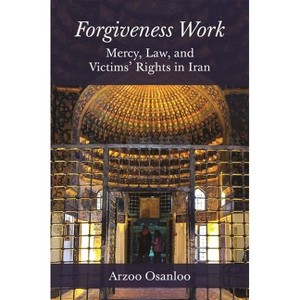
Forgiveness Work - by  Arzoo Osanloo (Paperback) - 1 of 1

Forgiveness Work - by Arzoo Osanloo (Paperback)

$39.00

In Stock

Free & easy returns

Free & easy returns

Return this item by mail or in store within 90 days for a full refund.
Eligible for registries and wish lists

About this item

Highlights

  • A remarkable look at an understudied feature of the Iranian justice system, where forgiveness is as much a right of victims as retribution Iran's criminal courts are notorious for meting out severe sentences--according to Amnesty International, the country has the world's highest rate of capital punishment per capita.
  • About the Author: Arzoo Osanloo is associate professor in the Department of Law, Societies, and Justice and the director of the Middle East Center at the University of Washington.
  • 358 Pages
  • Social Science, Islamic Studies

Description


About the Book


"A remarkable look at an understudied feature of the Iranian justice system, where forgiveness is as much a right of victims as retribution. Iran's criminal courts are notorious for meting out severe sentences-according to Amnesty International, the country has the world's highest rate of capital punishment per capita. Less known to outside observers, however, is the Iranian criminal code's recognition of forgiveness, where victims of violent crimes, or the families of murder victims, can request the state to forgo punishing the criminal. Forgiveness Work shows that in the Iranian justice system, forbearance is as much a right of victims as retribution. Drawing on extended interviews and first-hand observations of more than eighty murder trials, Arzoo Osanloo explores why some families of victims forgive perpetrators and how a wide array of individuals contribute to the fraught business of negotiating reconciliation. Based on Qur'anic principles, Iran's criminal codes encourage mercy and compel judicial officials to help parties reach a settlement. As no formal regulations exist to guide those involved, an informal cottage industry has grown around forgiveness advocacy. Interested parties-including attorneys, judges, social workers, the families of victims and perpetrators, and even performing artists-intervene in cases, drawing from such sources as scripture, ritual, and art to stir feelings of forgiveness. These actors forge new and sometimes conflicting strategies to secure forbearance, and some aim to reform social attitudes and laws on capital punishment. Forgiveness Work examines how an Islamic victim-centered approach to justice sheds light on the conditions of mercy"--


Book Synopsis


A remarkable look at an understudied feature of the Iranian justice system, where forgiveness is as much a right of victims as retribution

Iran's criminal courts are notorious for meting out severe sentences--according to Amnesty International, the country has the world's highest rate of capital punishment per capita. Less known to outside observers, however, is the Iranian criminal code's recognition of forgiveness, where victims of violent crimes, or the families of murder victims, can request the state to forgo punishing the criminal. Forgiveness Work shows that in the Iranian justice system, forbearance is as much a right of victims as retribution. Drawing on extended interviews and first-hand observations of more than eighty murder trials, Arzoo Osanloo explores why some families of victims forgive perpetrators and how a wide array of individuals contribute to the fraught business of negotiating reconciliation.

Based on Qur'anic principles, Iran's criminal codes encourage mercy and compel judicial officials to help parties reach a settlement. As no formal regulations exist to guide those involved, an informal cottage industry has grown around forgiveness advocacy. Interested parties--including attorneys, judges, social workers, the families of victims and perpetrators, and even performing artists--intervene in cases, drawing from such sources as scripture, ritual, and art to stir feelings of forgiveness. These actors forge new and sometimes conflicting strategies to secure forbearance, and some aim to reform social attitudes and laws on capital punishment.

Forgiveness Work examines how an Islamic victim-centered approach to justice sheds light on the conditions of mercy.


Review Quotes


"An impressive achievement which combines ethnography, law and philosophy to propose a sensitive and informed account of a phenomenon reflecting the complexities of the Iranian society while at the same time accompanying its transformations. It is also an important contribution to the law-and-society theory."---Baudouin Dupret, Arab Law Quarterly

"Honorable Mention for the Association for Political and Legal Anthropology Book Prize in Critical Anthropology"

"Honorable Mention for the Clifford Geertz Book Award, Society for the Anthropology of Religion"

"Winner of the Herbert Jacob Book Prize, Law and Society Association"


About the Author


Arzoo Osanloo is associate professor in the Department of Law, Societies, and Justice and the director of the Middle East Center at the University of Washington. She is the author of The Politics of Women's Rights in Iran (Princeton).
Dimensions (Overall): 9.1 Inches (H) x 6.0 Inches (W) x .9 Inches (D)
Weight: 1.15 Pounds
Suggested Age: 22 Years and Up
Number of Pages: 358
Genre: Social Science
Sub-Genre: Islamic Studies
Publisher: Princeton University Press
Format: Paperback
Author: Arzoo Osanloo
Language: English
Street Date: June 23, 2020
TCIN: 1010782861
UPC: 9780691172040
Item Number (DPCI): 247-33-6151
Origin: Made in the USA or Imported
If the item details aren’t accurate or complete, we want to know about it.

Shipping details

Estimated ship dimensions: 0.9 inches length x 6 inches width x 9.1 inches height
Estimated ship weight: 1.15 pounds
We regret that this item cannot be shipped to PO Boxes.
This item cannot be shipped to the following locations: American Samoa (see also separate entry under AS), Guam (see also separate entry under GU), Northern Mariana Islands, Puerto Rico (see also separate entry under PR), United States Minor Outlying Islands, Virgin Islands, U.S., APO/FPO, Alaska, Hawaii

Return details

This item can be returned to any Target store or Target.com.
This item must be returned within 90 days of the date it was purchased in store, delivered to the guest, delivered by a Shipt shopper, or picked up by the guest.
See the return policy for complete information.

Q: What types of individuals engage in forgiveness advocacy?

submitted by AI Shopping Assistant - 1 month ago
  • A: Attorneys, judges, social workers, victims' families, and performing artists contribute to negotiating forgiveness and reconciliation.

    submitted byAI Shopping Assistant - 1 month ago
    Ai generated

Q: What topics does the book cover regarding the Iranian justice system?

submitted by AI Shopping Assistant - 1 month ago
  • A: The book explores forgiveness as a right of victims and the complexities of Iran's criminal justice practices.

    submitted byAI Shopping Assistant - 1 month ago
    Ai generated

Q: What is the role of forgiveness in Iranian criminal law?

submitted by AI Shopping Assistant - 1 month ago
  • A: Forgiveness allows victims' families to request the state to forgo punishing the perpetrator, emphasizing mercy.

    submitted byAI Shopping Assistant - 1 month ago
    Ai generated

Q: Who conducted the research for this book?

submitted by AI Shopping Assistant - 1 month ago
  • A: Arzoo Osanloo conducted extensive interviews and observations during over eighty murder trials in Iran.

    submitted byAI Shopping Assistant - 1 month ago
    Ai generated

Q: How does the book approach the concept of mercy?

submitted by AI Shopping Assistant - 1 month ago
  • A: It examines how Islamic principles and judicial practices encourage mercy and negotiation in conflict resolution.

    submitted byAI Shopping Assistant - 1 month ago
    Ai generated

Additional product information and recommendations

Discover more options

Get top deals, latest trends, and more.

Privacy policy