Target New ArrivalsGift Ideas for DadClothing, Shoes & AccessoriesHome & DecorKitchen & DiningOutdoor Living & GardenGroceryHousehold EssentialsBabyBeautyPersonal CareSports & OutdoorsHealthWellnessLuggageSchool & Office SuppliesToysElectronicsVideo GamesMovies, Music & BooksParty SuppliesGift IdeasGift CardsPetsUlta Beauty at TargetShop by CommunityTarget OpticalDealsClearanceNew ArrivalsGift Ideas for DadBack to SchoolCollegeTop DealsTarget Circle DealsWeekly AdShop Order PickupShop Same Day DeliveryRegistryRedCardTarget CircleFind Stores
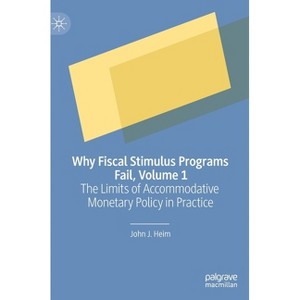
Why Fiscal Stimulus Programs Fail, Volume 1 - by  John J Heim (Hardcover) - 1 of 1

Why Fiscal Stimulus Programs Fail, Volume 1 - by John J Heim (Hardcover)

$129.99

In Stock

Free & easy returns

Free & easy returns

Return this item by mail or in store within 90 days for a full refund.
Eligible for registries and wish lists

About this item

Highlights

  • This book offers a series of statistical tests to determine if the "crowd out" problem, known to hinder the effectiveness of Keynesian economic stimulus programs, can be overcome by monetary programs.
  • About the Author: John J. Heim is Visiting Professor at University of Albany-SUNY, and retired Clinical Professor of Economics at Rensselaer Polytechnic Institute, both in New York, USA.
  • 577 Pages
  • Business + Money Management, Economics

Description


Book Synopsis


This book offers a series of statistical tests to determine if the "crowd out" problem, known to hinder the effectiveness of Keynesian economic stimulus programs, can be overcome by monetary programs. It concludes there are programs that can do this, specifically "accommodative monetary policy." They were not used to any great extent prior to the Quantitative Easing program in 2008, causing the failure of many fiscal stimulus programs through no fault of their own. The book includes exhaustive statistical tests to prove this point. There is also a policy analysis section of the book. It examines how effectively the Federal Reserve's anti-crowd out programs have actually worked, to the extent they were undertaken at all. It finds statistical evidence that using commercial and savings banks instead of investment banks when implementing accommodating monetary policy would have markedly improved their effectiveness. This volume, with its companion volume Why Fiscal Stimulus Programs Fail, Volume 2: Statistical Tests Comparing Monetary Policy to Growth, provides 1000 separate statistical tests on the US economy to prove these assertions.


From the Back Cover


"Using sophisticated econometric techniques, Heim is able to achieve a dual result: to show that the Keynesian approach to economic stabilization is theoretically valid; but that its practical application in the past has proved quantitatively problematic. It may well be that he is vindicated by the unprecedented measures applied in the last two downturns." -Paul Hohenberg, 2007 President, Economic History Association

"Keynesian macro policy has been thought to fail because of crowding out... this book shows that Keynesian macro policy was not the failure, it was the accommodating monetary policies that failed;...Furthermore, it appears that the use of investment banks, rather than commercial and savings and loans banks, significantly obstructed the effectiveness of the accommodative policies." -John Polimeni, Associate Professor of Economics, Albany College of Pharmacy.

"Why Fiscal Stimulus Fails (Vol. 1) succeeds in its quest to establish therelationship between government deficits, crowding out, and monetary policy. The treatise benefits further from Heim's requirements that economic models be replicable... the thoroughness and clarity of Heim's presentation makes the work accessible to anyone."-Robert Jones, Rensselaer Polytechnic Institute

This book offers a series of statistical tests to determine if the "crowd out" problem, known to hinder the effectiveness of Keynesian economic stimulus programs, can be overcome by monetary programs. It concludes there are programs that can do this, specifically "accommodative monetary policy." They were not used to any great extent prior to the Quantitative Easing program in 2008, causing the failure of many fiscal stimulus programs through no fault of their own. The book includes exhaustive statistical tests to prove this point. There is also a policy analysis section of the book. It examines how effectively the Federal Reserve's anti-crowd out programs have actually worked, to the extent they were undertaken at all. It finds statistical evidence that using commercial and savings banks instead of investment banks when implementing accommodating monetary policy would have markedly improved their effectiveness. This volume, with its companion volume Why Fiscal Stimulus Programs Fail, Volume 2: Statistical Tests Comparing Monetary Policy to Growth, provides 1000 separate statistical tests on the US economy to prove these assertions.


About the Author


John J. Heim is Visiting Professor at University of Albany-SUNY, and retired Clinical Professor of Economics at Rensselaer Polytechnic Institute, both in New York, USA. He has served in cabinet and subcabinet positions in NY State and Local Government. He is also an inventor of renewable energy devices ("wave energy converters") and holds patents in this area.

Dimensions (Overall): 8.27 Inches (H) x 5.83 Inches (W) x 1.31 Inches (D)
Weight: 1.93 Pounds
Suggested Age: 22 Years and Up
Number of Pages: 577
Genre: Business + Money Management
Sub-Genre: Economics
Publisher: Palgrave MacMillan
Theme: Macroeconomics
Format: Hardcover
Author: John J Heim
Language: English
Street Date: March 20, 2021
TCIN: 1011497972
UPC: 9783030656744
Item Number (DPCI): 247-36-1870
Origin: Made in the USA or Imported
If the item details aren’t accurate or complete, we want to know about it.

Shipping details

Estimated ship dimensions: 1.31 inches length x 5.83 inches width x 8.27 inches height
Estimated ship weight: 1.93 pounds
We regret that this item cannot be shipped to PO Boxes.
This item cannot be shipped to the following locations: American Samoa (see also separate entry under AS), Guam (see also separate entry under GU), Northern Mariana Islands, Puerto Rico (see also separate entry under PR), United States Minor Outlying Islands, Virgin Islands, U.S., APO/FPO, Alaska, Hawaii

Return details

This item can be returned to any Target store or Target.com.
This item must be returned within 90 days of the date it was purchased in store, delivered to the guest, delivered by a Shipt shopper, or picked up by the guest.
See the return policy for complete information.

Q: Who is the author of this book?

submitted by AI Shopping Assistant - 3 days ago
  • A: The author is John J. Heim, a Visiting Professor at the University of Albany-SUNY.

    submitted byAI Shopping Assistant - 3 days ago
    Ai generated

Q: What is the significance of accommodative monetary policy?

submitted by AI Shopping Assistant - 3 days ago
  • A: Accommodative monetary policy is highlighted as a potential solution to overcome the crowd out problem in fiscal stimulus.

    submitted byAI Shopping Assistant - 3 days ago
    Ai generated

Q: What is the main focus of this book?

submitted by AI Shopping Assistant - 3 days ago
  • A: The book analyzes the crowd out problem in Keynesian economic stimulus programs and explores solutions through monetary programs.

    submitted byAI Shopping Assistant - 3 days ago
    Ai generated

Q: How many pages does the book contain?

submitted by AI Shopping Assistant - 3 days ago
  • A: The book contains a total of 577 pages, providing extensive analysis and statistical tests.

    submitted byAI Shopping Assistant - 3 days ago
    Ai generated

Q: What statistical methods are used in the book?

submitted by AI Shopping Assistant - 3 days ago
  • A: The book employs sophisticated econometric techniques to conduct a series of statistical tests on the US economy.

    submitted byAI Shopping Assistant - 3 days ago
    Ai generated

Additional product information and recommendations

Discover more options

Get top deals, latest trends, and more.

Privacy policy