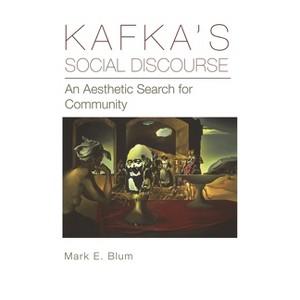
Franz Kafka is among the most significant 20th century voices to examine the absurdity and terror posed for the individual by what his contemporary Max Weber termed "the iron cage" of society.
About the Author: Mark E. Blum is professor of History at the University of Louisville in Kentucky.
304 Pages
Literary Criticism, European
Description
About the Book
Franz Kafka is among the most significant 20th century voices to examine the absurdity and terror posed for the individual by what his contemporary Max Weber termed "the iron cage" of society. In this book, Mark E. Blum examines Kafka's three novels, Amerika, The Trial, and Th...
Book Synopsis
Franz Kafka is among the most significant 20th century voices to examine the absurdity and terror posed for the individual by what his contemporary Max Weber termed "the iron cage" of society. Ferdinand Tönnies had defined the problem of finding community within society for Kafka and his peers in his 1887 book Gemeinschaft und Gesellschaft. Kafka took up this issue by focusing upon the "social discourse" of human relationships. In this book, Mark E. Blum examines Kafka's three novels, Amerika, The Trial, and The Castle, in their exploration of how community is formed or eroded in the interpersonal relations of its protagonists. Critical literature has recognized Kafka's ability to narrate the gestural moment of alienation or communion. This "social discourse" was augmented, however, by a dimension virtually no commentator has recognized--Kafka's conversation with past and present authors. Kafka encoded authors and their texts representing every century of the evolution of modernism and its societal problems, from Bunyan and Defoe, through Pope and Lessing, to Fontane and Thomas Mann. The inter-textual conversation Kafka conducted can enable us to appreciate the profound human problem of realizing community within society. Cultural historians as well as literary critics will be enriched by the evidence of these encoded cultural conversations. Kafka's "Imperial Messenger" may finally be heard in the full history of his emanations. Kafka encoded not only past authors, but painters as well. Kafka had been known as a graphic artist in his youth, and was informed by expressionism and cubism as he matured. Kafka's encodings of literature as well as fine art are not solely of the work to which he refers, but the community of authors or painters and their success or failure of community. Kafka's encodings were meant as an extra-textual readings for astute readers, but also as a lesson to his fellow authors whom he held accountable in his correspondence as cultural messengers.
Review Quotes
"In this complex study of Franz Kafka's (literary) social engagement, Blum (European intellectual history, Univ. of Louisville) takes on the Kafka critical establishment. Drawing from phenomenological discourse, the author counters prevailing notions about the intrinsic openness of Kafka's quixotic fiction. Rather than leading readers into paradox and interpretative aporia, Blum contends that Kafka was driven by a didactic idealism meant to 'hew a new path for self-critical human development' by imparting lesson[s] to his fellow authors whom he explicitly held accountable ... as cultural messengers. Blum promotes a kind of inverse reading: Kafka's world of anxiety, alienation, and absurdity transform into its opposite--utopic vision of the way things ought to be. Focusing on Kafka's three novels, the author tracks the development of Kafka's social discourse in relation to his complex, intertextual 'conversation with past and present authors.' His probing analysis of Kafka's 'iconic' repertoire results in evocative readings that provide invaluable insights into Kafka's rich allusive language. ... He sheds light on intriguing allusions buried in Kafka's multilayered prose. Summing Up: Recommended. Graduate students, researchers, faculty." --Choice Reviews
About the Author
Mark E. Blum is professor of History at the University of Louisville in Kentucky.
Dimensions (Overall): 8.9 Inches (H) x 6.0 Inches (W) x 1.3 Inches (D)
Weight: 1.05 Pounds
Suggested Age: 22 Years and Up
Number of Pages: 304
Genre: Literary Criticism
Sub-Genre: European
Publisher: Lehigh University Press
Theme: General
Format: Paperback
Author: Mark E Blum
Language: English
Street Date: August 28, 2013
TCIN: 1011234199
UPC: 9781611461466
Item Number (DPCI): 247-13-6399
Origin: Made in the USA or Imported
If the item details aren’t accurate or complete, we want to know about it.
Shipping details
Estimated ship dimensions: 1.3 inches length x 6 inches width x 8.9 inches height
Estimated ship weight: 1.05 pounds
We regret that this item cannot be shipped to PO Boxes.
This item cannot be shipped to the following locations: American Samoa (see also separate entry under AS), Guam (see also separate entry under GU), Northern Mariana Islands, Puerto Rico (see also separate entry under PR), United States Minor Outlying Islands, Virgin Islands, U.S., APO/FPO, Alaska, Hawaii
Return details
This item can be returned to any Target store or Target.com.
This item must be returned within 90 days of the date it was purchased in store, delivered to the guest, delivered by a Shipt shopper, or picked up by the guest.