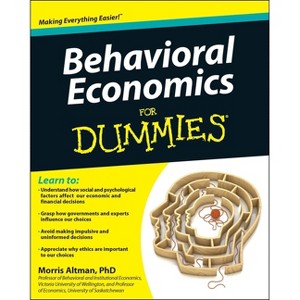
A guide to the study of how and why you really make financial decisions While classical economics is based on the notion that people act with rational self-interest, many key money decisions--like splurging on an expensive watch--can seem far from rational.
About the Author: Morris Altman, PhD, is a professor of behavioral economics at Victoria University of Wellington in New Zealand and a professor of economics at the University of Saskatchewan in Canada.
384 Pages
Business + Money Management, Economics
Series Name: For Dummies
Description
Book Synopsis
A guide to the study of how and why you really make financial decisions
While classical economics is based on the notion that people act with rational self-interest, many key money decisions--like splurging on an expensive watch--can seem far from rational. The field of behavioral economics sheds light on the many subtle and not-so-subtle factors that contribute to our financial and purchasing choices. And in Behavioral Economics For Dummies, readers will learn how social and psychological factors, such as instinctual behavior patterns, social pressure, and mental framing, can dramatically affect our day-to-day decision-making and financial choices.
Based on psychology and rooted in real-world examples, Behavioral Economics For Dummies offers the sort of insights designed to help investors avoid impulsive mistakes, companies understand the mechanisms behind individual choices, and governments and nonprofits make public decisions.
A friendly introduction to the study of how and why people really make financial decisions
The author is a professor of behavioral and institutional economics at Victoria University
An essential component to improving your financial decision-making (and even to understanding current events), Behavioral Economics For Dummies is important for just about anyone who has a bank account and is interested in why--and when--they spend money.
From the Back Cover
The guide to understanding why people really make economic and financial decisions
The field of behavioral economics sheds light on the many subtle and not-so-subtle factors that contribute to financial and purchasing choices. This friendly guide explores how socialand psychological factors, such as instinctual behavior patterns, social pressure, and mental framing, can dramatically affect our day-to-day decision making and financial choices. Based on psychology and sociology and rooted in real-world examples, Behavioral Economics For Dummies offers the sort of insights designed to help investors avoid impulsive mistakes, companies understand the mechanisms behind individual choices, and governments and nonprofits make public decisions.
Make realistic assumptions for economic analysis -- investigate the assumptions conventional economics makes, and discover how behavioral economists introduce social, psychological, and cultural considerations
Explore the relationship between the brain and economics -- understand how human behavior and surroundings affect economic phenomena
Examine the role of free choice in economic decision making -- review the conditions that are necessary in order for people to make choices that reflect their true preferences, given the constraints they face
Get happy -- recognize that factors other than wealth and money are critically important to a person's happiness, as defined by behavioral economics
Learn to:
Understand how social and psychological factors affect our economic and financial decisions
Grasp how governments and experts influence our choices
Avoid making impulsive and uninformed decisions
Appreciate why ethics are important to our choices
Open the book and find:
The many subtle factors that contribute to our financial and purchasing choices
Why people really make financial decisions
Real-world examples of how behavioral economics affects our lives
What social and psychological factors affect our decision making
How to use behavioral economics to be happier
Why government policies affect the economy
Helpful consumer tips
Go to Dummies.com for videos, step-by-step examples, how-to articles, or to shop!
About the Author
Morris Altman, PhD, is a professor of behavioral economics at Victoria University of Wellington in New Zealand and a professor of economics at the University of Saskatchewan in Canada. He is on the board of the Society for the Advancement of Behavioral Economics and is a former president of that organization. He also edited the Handbook of Contemporary Behavioral Economics.
Dimensions (Overall): 9.18 Inches (H) x 7.4 Inches (W) x .83 Inches (D)
Weight: 1.23 Pounds
Suggested Age: 22 Years and Up
Number of Pages: 384
Genre: Business + Money Management
Sub-Genre: Economics
Series Title: For Dummies
Publisher: For Dummies
Format: Paperback
Author: Morris Altman
Language: English
Street Date: February 28, 2012
TCIN: 87072239
UPC: 9781118085035
Item Number (DPCI): 247-30-6735
Origin: Made in the USA or Imported
If the item details aren’t accurate or complete, we want to know about it.
Shipping details
Estimated ship dimensions: 0.83 inches length x 7.4 inches width x 9.18 inches height
Estimated ship weight: 1.23 pounds
We regret that this item cannot be shipped to PO Boxes.
This item cannot be shipped to the following locations: American Samoa (see also separate entry under AS), Guam (see also separate entry under GU), Northern Mariana Islands, Puerto Rico (see also separate entry under PR), United States Minor Outlying Islands, Virgin Islands, U.S., APO/FPO, Alaska, Hawaii
Return details
This item can be returned to any Target store or Target.com.
This item must be returned within 90 days of the date it was purchased in store, delivered to the guest, delivered by a Shipt shopper, or picked up by the guest.