Target New ArrivalsFourth of JulyGift Ideas for DadClothing, Shoes & AccessoriesHome & DecorKitchen & DiningOutdoor Living & GardenGroceryHousehold EssentialsBabyBeautyPersonal CareSports & OutdoorsHealthWellnessLuggageSchool & Office SuppliesToys & GamesElectronicsVideo GamesMovies, Music & BooksParty SuppliesGift IdeasGift CardsPetsUlta Beauty at TargetShop by CommunityTarget OpticalDealsClearanceNew ArrivalsGift Ideas for DadBack to SchoolCollegeTop DealsTarget Circle DealsWeekly AdShop Order PickupShop Same Day DeliveryRegistryRedCardTarget CircleFind Stores
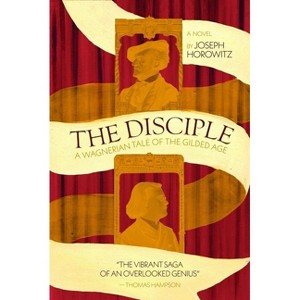
The Disciple - by  Joseph Horowitz (Paperback) - 1 of 1

The Disciple - by Joseph Horowitz (Paperback)

In Stock

Free & easy returns
Free & easy returns
Return this item by mail or in store within 90 days for a full refund.
Eligible for registries and wish lists

About this item

Highlights

  • Cloaked in mystery, Anton Seidl materialized in the New World as Wagner's personal emissary.
  • About the Author: Joseph Horowitz's eleven previous books mainly deal with the history of classical music in the United States.
  • 300 Pages
  • Fiction + Literature Genres, Historical

Description


Book Synopsis


Cloaked in mystery, Anton Seidl materialized in the New World as Wagner's personal emissary. A sorcerer, he commanded musical New York and toured widely, everywhere received with awed deference. In Brooklyn, Laura Langford's Seidl Society presented summertime Seidl concerts on Coney Island fourteen times weekly. Working women arrived in special railroad cars; Black orphans were regaled with roast chicken, ice cream, and the Tannhäuser March. A clairvoyant theosophist, Langford identified Seidl as a "chela" and traced the ceremonies of Parsifal to the Himalayas. Seidl's appeal was uncanny; at the American premiere of Tristan und Isolde, women stood on their chairs and "screamed their delight." At his funeral, women clasped elbows to force their way into the mobbed Metropolitan Opera House, a spectacle of chaos. His Manhattan friends--including Antonin Dvorák, whose New World Symphony he premiered--were legion. And yet Seidl remained a man apart, afflicted with secret sorrows.


Review Quotes


"For several decades, Joseph Horowitz has been our foremost chronicler of the vexed fate of American classical music, in particular of the wondrous story of Wagner-mania in Gilded Age Brooklyn and New York. Saturated with the heady potions extracted from years of archival work, he has at last given in to what, long ago, he was enticed to attempt in reaction to his discoveries. And that is to turn to the increasingly popular genre of historical fiction that molds together scholarship and fantasy. This has enabled the author to bring to life the protagonists on the musical scene of the 1880s and 1890s with all their missionary zeal and human foibles, providing, along the way, local color, historical nuance, irony, and ultimately pathos.

"Horowitz chooses to focus on three very different personalities, related to each other through their love of Wagner. At the center of it all we find Anton Seidl, the charismatic and enigmatic conductor whose death, in 1898, at the early age of forty-eight, and whose elaborate memorial service provide a fittingly somber conclusion to Horowitz's tale. . . .

"Seidl found an unlikely partner in Laura Langford, the energetic founder of the Seidl Society, which was reserved for women only. She came to preside over this unlikely intersection of Wagnerism and feminism, a constellation unique in all cultural history. . . .

"And then there is Henry Krehbiel, the idealistic and longtime music critic of the New York Tribune. Of Krehbiel [Horowitz] observes that he could "neither think nor act without engaging in instruction." . . .

"Beyond conveying the interactions of Seidl, Langford, and Krehbiel, Horowitz's canvas teems with topics and incidents of considerable cultural interest. . . . The Disciple is perhaps best viewed as a love letter to Gilded Age New York and its vibrant music scene. As such, it serves as a prequel to Horowitz's earlier novel The Marriage, which revisits Gustav and Alma Mahler's final sojourn in New York in 1910- 1911. To anyone interested in the history of music in New York, The Disciple and The Marriage are must-reads."

--Hans Rudolf Vaget, Wagner Notes (the journal of the Wagner Society of New York)

"Horowitz sees Seidl's sudden death at the age of 47 as a national and cultural calamity. "Bigger than the Toscanini story to come, bigger than the Bernstein story," he writes, "Seidl's New World sojourn is, finally, intensified by the pathos of unconsummated promise. Its magnitude and implications challenge understanding." . . .

"A scrupulous researcher and, most importantly, a gifted storyteller, Horowitz's lively prose, ready wit, and persuasive dialogue blow the dust of history off of his deftly assembled characters. And what a cast list it is. There's the tireless Laura Langford, proto-feminist, social progressive, clairvoyant and ardent theosophist, who, as founder of the Seidl Society, became the leading impresario in Brooklyn . . . Then there's the dean of New York music critics Henry Krehbiel, a heavy-set intellectual wending his solitary way to his desk at the New York Tribune every evening to craft his ponderous pronouncements . . . Antonin Dvorak is another fine vignette. . .

"The legendary European singers that Seidl brought to America are captured in all their gossipy self-absorption and . . . There's a refreshingly even-handed treatment of Cosima Wagner, the black widow of Bayreuth. . . . Horowitz's Richard Wagner, narcissistic, twinkly eyed, and fiendish by turns, is one of the more persuasive character sketches I've come across. . . .

"Above all, The Disciple conjures the sense of an America rich with potential, a nation crackling with energy, its buildings, transportation, and industry exploding with unbridled ambition. From Chicago to Manhattan, the author seems familiar with every borough and street . . .

And yet there's an inscrutable sadness about his central protagonist, an unfathomable melancholy . . . There's a personal tragedy at play, one that Horowitz teases out over the course of the novel, keeping us in suspense until Seidl's 'Rosebud' moment."

-- Clive Paget, Musical America

"In 1994, . . . Joseph Horowitz published his fascinating Wagner Nights, an account of the life and times of the conductor Anton Seidl, who introduced Tristan und Isolde to America (Metropolitan Opera, 1886, among many other performances during those German-language seasons), led the extraordinary series of popular summer concerts (heavy on Wagner) at Brighton Beach, and inspired the foundation of the Seidl Society, a largely female organization of cult intensity in support of Seidl's work and of Wagnerism in the U.S. It was Horowitz's research in the Seidl Society archives at the Brooklyn Historical Society that restored this artistically vital but forgotten history, with its enticing Gilded Age background and cast of larger-than-life characters, to our cultural memory.

"Now, Horowitz has fictionalized the story in the form of a novel, The Disciple, bringing the era and its people, from great artists, iconic critics, and society stars to the black children sponsored by the Society, to vivid life. . . . Chapter One tells the tale of that Tristan premiere, starring the veteran Wagner tenor Albert Niemann and the great Lilli Lehmann, seen through the eyes of one of the most authoritative of those critics, Henry Krehbiel, while Chapter Ten takes us briefly into a coaching session with Seidl and Jean de Reszke, as the latter prepared for the crowning challenge of his legendary career."

-- Conrad L. Osborne, "Osborne on Opera: A Critical Blog," April 10, 2026


About the Author


Joseph Horowitz's eleven previous books mainly deal with the history of classical music in the United States. Understanding Toscanini: How He Became an American Culture-God and Helped Create a New Audience for Old Music (1987) was named one of the year's best books by the New York Book Critics Circle. Wagner Nights: An American History (1994) was named best-of-the-year by the Society of American Music. Both Classical Music in America: A History of Its Rise and Fall (2005) and Artists in Exile: How Refugees from Twentieth Century War and Revolution Transformed the American Performing Arts (2008) made The Economist's year' s-best-books list. In tandem with his Dvorá k's Prophecy and the Vexed Fate of Black Classical Music (2021), Horowitz produced six " Dvorá k's Prophecy" films for Naxos. His current " More than Music" radio documentaries for National Public Radio, heard bi-montly via the daily newsmagazine " 1A," are an outgrowth of this activity. His forthcoming book, The Propaganda of Freedom: JFK, Stravinsky, Shostakovich, and the Cultural Cold Warrior, will deal with the cultural Cold War. The larger topic of all these activities is the role of the arts (today embattled) in American history and society. Horowitz's website is www.josephhorowitz.com. His blog is www.artsjournal.com/uq.
Dimensions (Overall): 7.81 Inches (H) x 5.05 Inches (W) x .88 Inches (D)
Weight: .8 Pounds
Suggested Age: 22 Years and Up
Number of Pages: 300
Genre: Fiction + Literature Genres
Sub-Genre: Historical
Publisher: Blackwater Press
Theme: General
Format: Paperback
Author: Joseph Horowitz
Language: English
Street Date: March 24, 2026
TCIN: 1008273412
UPC: 9781963614152
Item Number (DPCI): 247-01-6552
Origin: Made in the USA or Imported
If the item details aren’t accurate or complete, we want to know about it.

Shipping details

Estimated ship dimensions: 0.88 inches length x 5.05 inches width x 7.81 inches height
Estimated ship weight: 0.8 pounds
We regret that this item cannot be shipped to PO Boxes.
This item cannot be shipped to the following locations: American Samoa (see also separate entry under AS), Guam (see also separate entry under GU), Northern Mariana Islands, Puerto Rico (see also separate entry under PR), United States Minor Outlying Islands, Virgin Islands, U.S., APO/FPO, Alaska, Hawaii

Return details

This item can be returned to any Target store or Target.com.
This item must be returned within 90 days of the date it was purchased in store, delivered to the guest, delivered by a Shipt shopper, or picked up by the guest.
See the return policy for complete information.

Q: What is the significance of Anton Seidl in the story?

submitted by AI Shopping Assistant - 18 days ago
  • A: Anton Seidl is portrayed as a mysterious figure who shaped the musical landscape of New York during his time.

    submitted byAI Shopping Assistant - 18 days ago
    Ai generated

Q: What genre does this book belong to?

submitted by AI Shopping Assistant - 18 days ago
  • A: This book is categorized under Fiction and Literature, specifically in the Historical sub-genre.

    submitted byAI Shopping Assistant - 18 days ago
    Ai generated

Q: What is the main theme of the book?

submitted by AI Shopping Assistant - 18 days ago
  • A: The book explores the life of Anton Seidl, a conductor, and his influence on music in the Gilded Age.

    submitted byAI Shopping Assistant - 18 days ago
    Ai generated

Q: What notable events are depicted in the book?

submitted by AI Shopping Assistant - 18 days ago
  • A: The book depicts Anton Seidl's concerts, his impact on musical New York, and his unique relationships.

    submitted byAI Shopping Assistant - 18 days ago
    Ai generated

Q: Who is the author of this book?

submitted by AI Shopping Assistant - 18 days ago
  • A: The author is Joseph Horowitz, known for his works on classical music history in the United States.

    submitted byAI Shopping Assistant - 18 days ago
    Ai generated

Additional product information and recommendations

Discover more options

Frequently bought together

Best-selling Literary Fiction

Get top deals, latest trends, and more.

Privacy policy